Should you optimize your google business profile for multiple languages? What experts say

Should You Optimize Your Google Business Profile for Multiple Languages? What Experts Say
Source: Freepik
Have you ever come across a local business that tried to “quickly” translate its entire business listing into another language?
It sounds simple enough.
Add some Spanish. Maybe a bit of French. Reach a wider audience. Capture more customers.
And then you open your dashboard, stare at your business description, realize there’s a character limit, wonder whether Google will translate half of it anyway, and suddenly the whole idea doesn’t feel so simple anymore.
The problem is that multi-language optimization often starts as an impulse decision. You read that your city is bilingual, or that tourists search in different languages, and it feels like something you should be doing.
But without understanding how it actually fits into your local SEO strategy, you’re about as likely to benefit from it as most businesses are to benefit from copying every tactic they see in a marketing blog.
Here’s what experts are actually seeing, and what it means for your strategy.
TL;DR
- Multi-language in GBP works only if real bilingual demand exists.
- Character limits weaken SEO if you split languages.
- Add a second language only if you can maintain posts, reviews, and accurate translations.
What Does “Optimizing for Multiple Languages” Actually Mean?
Before diving into “should you,” let’s clarify “what this is.”
Firstly, there’s no multilingual toggle. No setting that tells Google to dynamically swap your entire profile between languages.
In practice, multi-language GBP optimization simply means manually adding content in different languages across certain fields, such as business description, posts, product or service descriptions, and review responses.
It does not include:
- Translating your business name (this violates Google’s guidelines).
- Creating separate listings for each language (which can trigger duplicate listing issues).
- Expecting Google to automatically translate your entire profile accurately (it doesn’t).
Another common misconception involves how language actually appears to users.
There are two different layers at play:
- Interface language refers to the menus, buttons, and categories that the user sees. These automatically change based on the user’s device or browser settings, and you have no control over them.
- Listing content language, on the other hand, includes your business description, posts, and custom service text. These remain exactly as you wrote them unless a user manually triggers translation, or Google attempts to translate them automatically, which is inconsistent.
Does Google Support Multi-Language GBP Content?
The short answer: partially and inconsistently.
Some standardized elements automatically translate, including:
- Categories
- Attributes (e.g., wheelchair accessible, outdoor seating)
- Hours formatting
- Predefined services (if you select from Google’s preset service list, those translate)
But most business-controlled content does not automatically translate, including:
- Business descriptions
- Posts
- Custom services
- Q&A
- Product descriptions
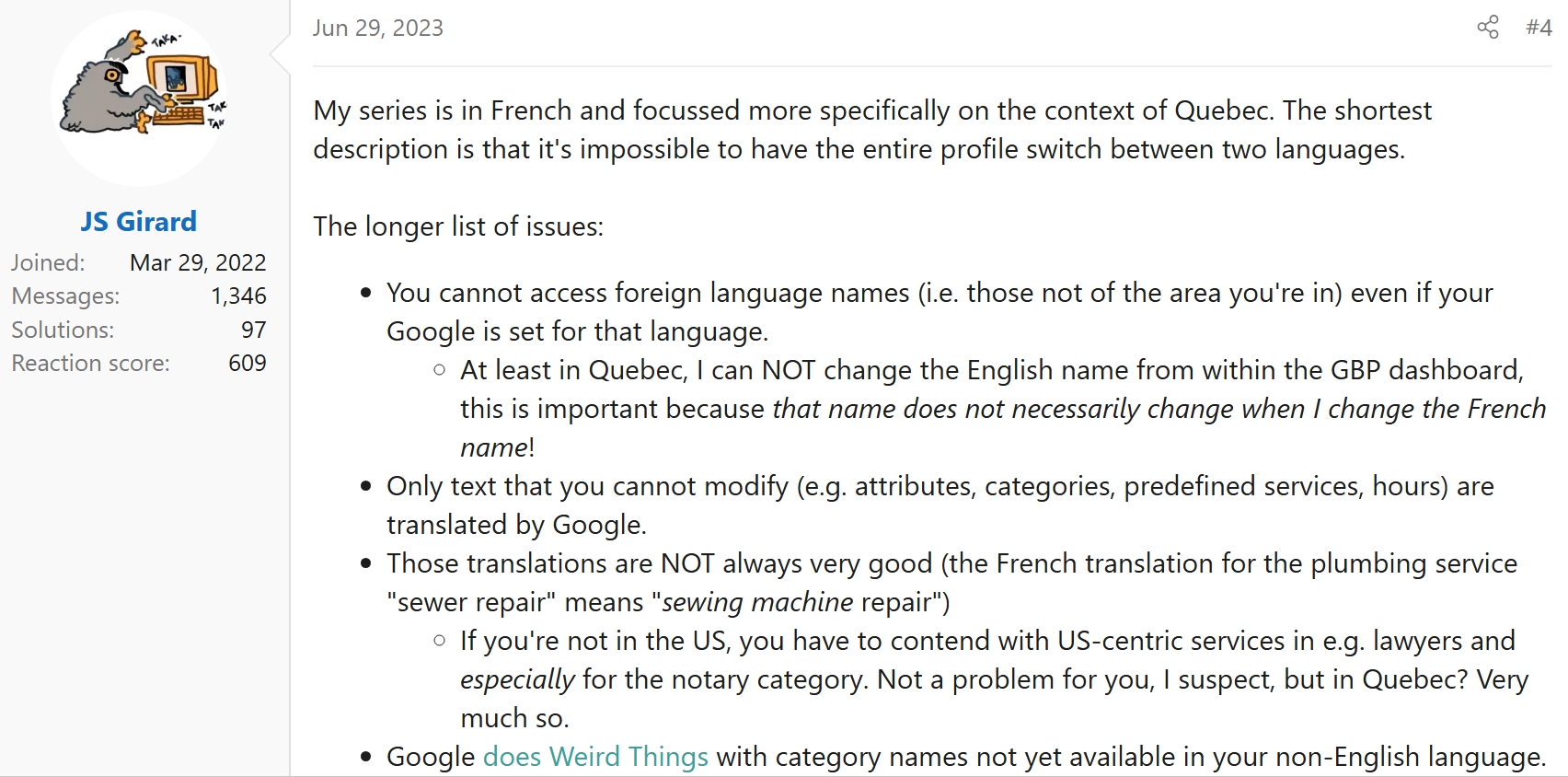
Discussions across the Local Search Forum highlight a structural limitation.
Local SEO specialist JS Girard notes that a profile cannot dynamically switch languages across all fields. You cannot fully show English to one user and Spanish to another.
Courtesy: Local Search Forum
Even when Google auto-translates reviews, accuracy varies. Idioms and colloquial phrases are frequently mistranslated.
When Multi-Language GBP Optimization Can Help
Despite limitations, multilingual optimization can help in specific situations, especially when language directly affects customer behavior.
- Linguistically Diverse Markets
In cities with strong multilingual populations, adding a secondary language (after the primary one) can improve engagement, especially when paired with language-specific posts.
- Tourist-Heavy Locations
Tourism-driven businesses often benefit from seasonal multilingual posts and review responses in the traveler’s language.
- Industries with High Multi-Language Intent
Language matters most in:
- Hospitality
- Healthcare
- Legal services
- Cultural or international retail
In these industries, clarity affects trust as much as visibility.
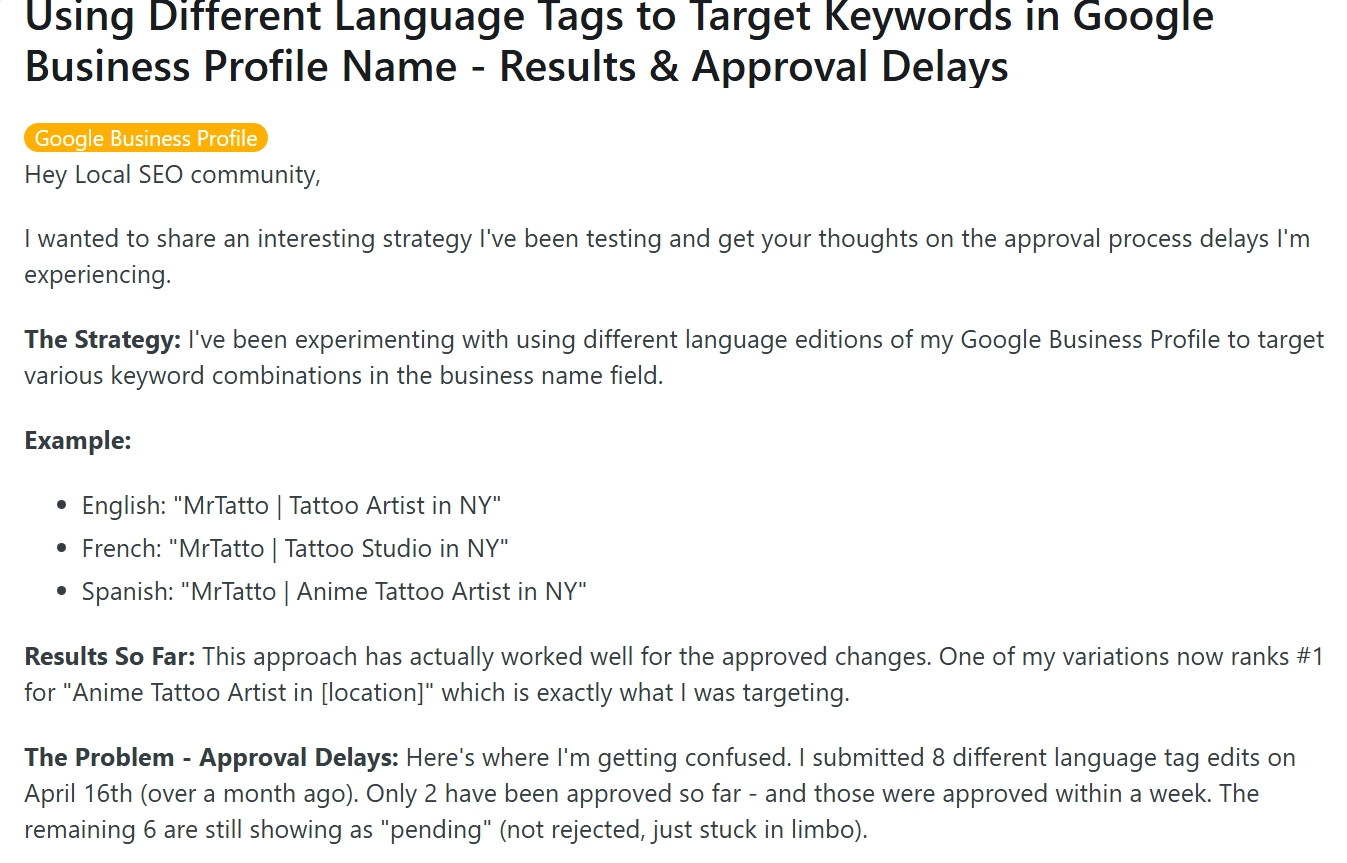
In one field experiment shared on Reddit, a local SEO practitioner tested different language-specific keyword variations within a GBP name. Some approved variations ranked higher for non-English search queries. However, approval was inconsistent and results were not universal.
Courtesy: Reddit
What Experts Actually Say (Summarized)
As more agencies tested multilingual strategies, two consistent viewpoints emerged.
The “Pick One Language” Camp (Majority Opinion)
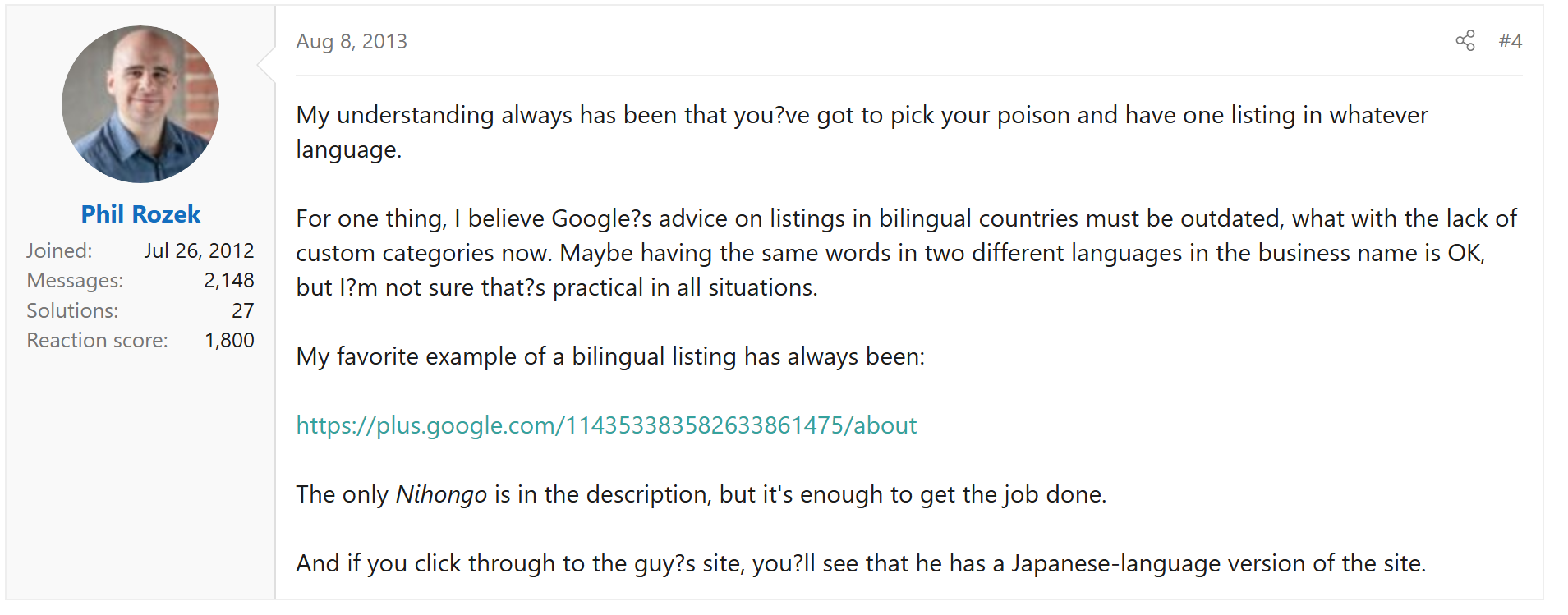
Many local SEO professionals recommend focusing on one primary language.
Here’s how Phil Rozek (local SEO consultant and founder of Local Visibility System) puts it:
Courtesy: Local Search Forum
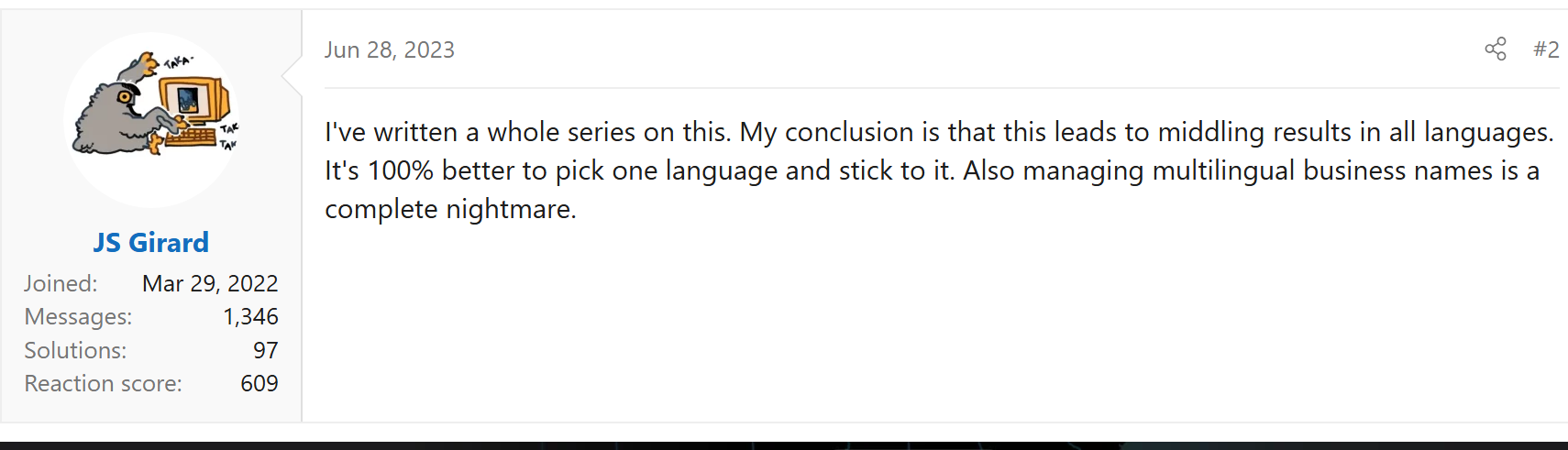
JS Girard describes split-language profiles as producing “middling results,” largely due to:
- Character limit trade-offs
- Operational complexity
- Mixed relevance signals
Courtesy: Local Search Forum
With only about 750 characters available in the business description, dividing space across languages reduces keyword strength.
The “Strategic Bilingual” Camp (Minority But Valid)
Some agencies, like InboundREM, recommend validating demand first using analytics and customer data. They suggest using language-specific posts, attributes, and linked landing pages to reach non-English-speaking audiences, while carefully tracking performance.
This approach works best in genuinely bilingual markets (Miami, parts of Texas/California, Montreal) where businesses can maintain multilingual content consistently.
The “Separate Listings” Debate
Here, expert consensus is clear. Creating multiple listings for different languages without separate physical locations violates Google guidelines and risks duplicates.
Language alone is not a valid reason for separate listings.
Potential Downsides & Risks
Even when multilingual optimization makes sense, experts highlight several common risks and downsides.
- Duplicate Content Confusion: Mixing languages in one description can dilute keyword relevance for both.
- Character Limit Trade-Offs: Two languages mean fewer keywords and weaker topical depth per language.
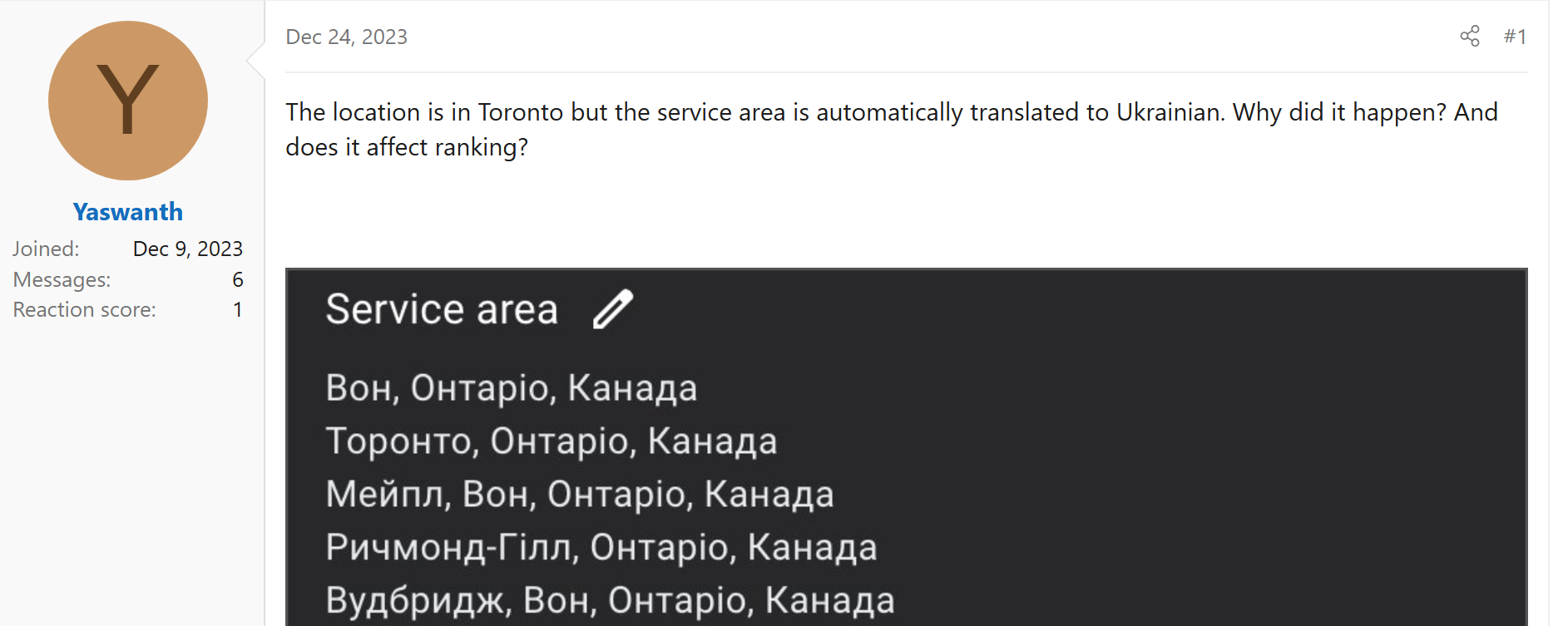
- Translation Quality Issues: Poor translations can harm credibility. Automatic translations can even change the service’s meaning entirely. A case shared in a Local Search Forum thread showed GBP services displaying in the wrong language, confusing users and requiring a new profile to fix.
Courtesy: Local Search Forum
- Operational Complexity: Multi-language profiles require ongoing work:
- Separate posts
- Language-matched review responses
- Multi-language updates and FAQs
Many businesses underestimate the operational side, promoting languages they cannot actually support.
Implementation Approaches
If you’ve decided to proceed with multi-language optimization, the next step is execution. Like most local SEO tactics, success depends less on adding content and more on adding it strategically. Do it only when data and operations align.
When You Should Add Multi-Language Content
Add languages when these are true:
- You see non-English search volume in Google Analytics/Search Console.
- ~30%+ of paying customers use another language.
- You have bilingual staff or reliable translators.
- Your market demands it (tourist hubs, ethnic neighborhoods).
If those aren’t met, gains are unlikely.
When You Should Not
Don’t add languages based on gut feeling. Just because you’re in California doesn’t mean you have add Spanish. Avoid multiple languages when:
- You lack supporting data.
- No staff to handle multilingual replies.
- You’re in an ultra-competitive market and every character matters.
- Your services need precise wording (legal/medical/financial).
Bad translations and poor operations can harm credibility.
What Fields Matter Most
Here’s how to plan your efforts:
Priority 1: Business Description
Top priority. Put the primary language first, secondary second, clearly separated. Keep within the ~750-character limit and use a clear separator (line break, em dash, bullets) so each language block is distinct. Don’t split evenly unless data forces it.
Priority 2: Google Posts
No dual-language toggle. Publish separate posts per language, adapting phrasing and timing for each audience (e.g., morning post in English, afternoon one in Spanish).
Priority 3: Review Responses
Reply in the reviewer’s language to preserve context and user experience.
Priority 4 (Lower): Services/Products
Localize only if you have space and bandwidth. But description and posts matter more.
How to Handle Translations Correctly
Use professional translation for permanent, high-visibility text (description, service pages, templates). Machine translation is okay for short posts or quick replies, but always human-review.
Also Read: Top 20 Google Business Profile Management Tools for Agencies
Google Algorithm Considerations
Google’s local ranking algorithm prioritizes three core local signals: relevance, distance, prominence. Splitting your copy across languages can dilute all three:
- Relevance: Fewer keyword signals per language.
- Distance: Unchanged by language.
- Prominence: Drops if language audiences can’t engage.
Research from Wiremo shows language settings can shift rankings by up to 15 positions for the same query, meaning a competitor with language-matched content can outrank you for that user.
Translation alone won’t guarantee visibility. Google still checks keyword relevance, engagement, and citation/NAP consistency.
Evidence & Case Insights
Research from Wiremo and Search Engine Journal on multilingual local profiles shows higher clicks, calls, and direction requests when content matches the searcher’s language.
- What works: Separate posts per language, reply to reviews in the reviewer’s language, keep the dominant language first in the description, and track language-specific ranks (use rank tools).
- What doesn’t: Multiple translated business names, relying on auto-translate for critical fields, creating separate language listings, or splitting descriptions 50/50. These often produce “middling” outcomes (as per practitioners and Local Search Forum feedback).
Best gains appear for tourist businesses, ethnic service providers, and seasonal markets (targeted posts during peaks).
Practical Checklist: When to Consider Multi-Language Optimization
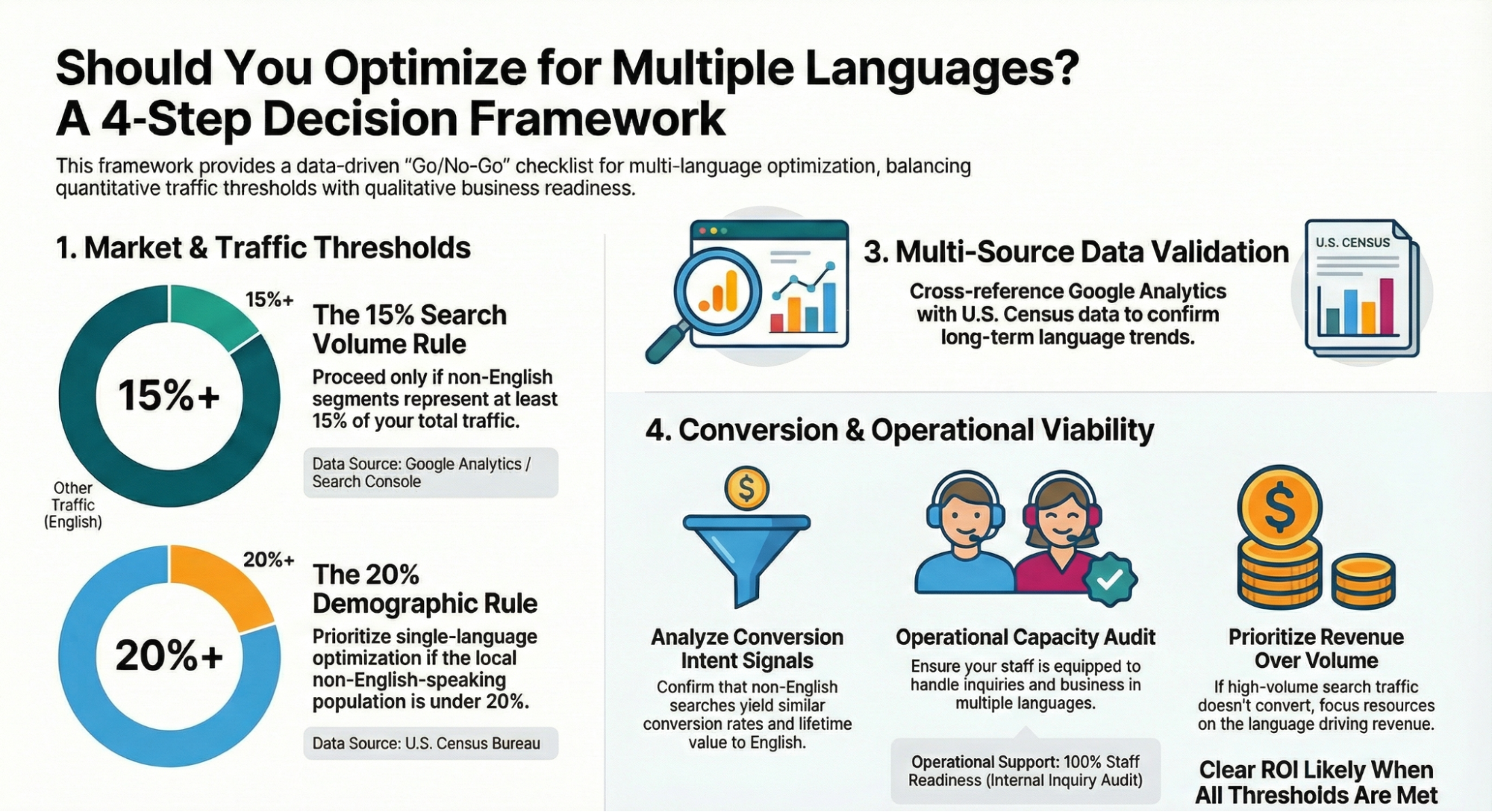
Use this decision framework before committing resources:
Conclusion
As more businesses test multilingual optimization, the conclusion has become clearer. The expert consensus on multi-language optimization isn’t “always” or “never.” It’s conditional.
Most businesses perform best when they fully optimize one language rather than splitting focus across several.
If you’re considering multilingual optimization, use Synup to manage, monitor, and optimize your listings across locations and languages with accuracy and scale.
Also Read: Top 8 White Label Local Listing Management Software
FAQs
- Should the secondary language match your website language?
Yes. If you add a language to your profile, link to a landing page in the same language to improve consistency and conversions.
- How often should multilingual content be updated?
At the same frequency as your primary language. Outdated secondary-language content reduces trust and engagement.