





If you’re currently running a growth-focused digital agency, you can always feel the ground shifting under your feet.
The old way of doing things is dead.
For years, many agencies made decent money on the “crappy content” model. They keyword-stuffed a few pages, bought low-quality backlinks, and played the volume game. It worked… until it no longer did.
The rise of Large Language Models (LLMs) and generative AI has completely fractured traditional search. Google’s algorithms are smarter, and users are getting answers before they even click a blue link. With experience supporting hundreds of thousands of local, small, and mid-sized businesses at Synup, this is clear: for agencies serving these clients, this shift requires a complete rethink of the traditional playbook.
Here are the latest SEO trends and a necessary blueprint for agency owners to maintain consistency, cut down on client churn, and outlast the current volatility. Get ready for 2026.
TL;DR: The New SEO Blueprint for 2026
- Shift from SEO to AEO: The goal is no longer a top link; it’s being cited as the source of truth by AI/LLMs.
- Structure and Consistency are King: Obsess over structured data (Service, Person schema) to feed machines facts.
- The 7 Essential New SEO Trends
- Niche Focus May Be the New Scale Strategy
- Create highly specialized, authoritative content for a niche audience (e.g., HVAC in a specific metro) to justify higher retainers.
- Use the client’s real-world experience and personal stories as the core content.
- Communities & Social Are New Trusted Sources
-
- Control the LLM relationship by actively building owned communities (email lists, private groups) instead of solely relying on Google traffic.
- Engage and monitor platforms like Reddit and TikTok, as AI uses these communities for real-world validation.
- Local SEO Discovery Is Changing
-
- Reviews Drive AI: AI uses reviews for sentiment analysis to choose the best local business (e.g., “fast service,” “dog-friendly”).
- Focus on Specific UGC: Coach clients to get reviews that mention specific keywords and attributes the AI is looking for.
- Technical SEO Still Plays a Key Role
-
- Clean site architecture, fast Core Web Vitals, and strong security (HTTPS) remain critical as they signal reliability to all crawlers, including LLMs.
- Implement regular consistency checks to ensure machine accessibility and eliminate conflicting signals.
- Measuring Brand Influence Over Rankings
-
- Rethink your KPIs. Abandon the obsession with organic ranking positions.
- Report on influence. Focus reporting on Branded Search Volume and AI Visibility Score to prove growing trust and higher ROI.
- Are We Ready for Agentic SEO and Automated Purchases?
-
- The future is AI assistants making direct bookings and purchases. Prepare your clients for zero-click conversions.
- Ensure client inventory and scheduling data are flawlessly exposed and machine-readable via APIs and structured data.
- Citations Are the New Backlinks
-
- Source of Truth: Create definitive, fact-based assets (e.g., a local cost index) that LLMs will cite, driving authority.
- Convert Unlinked Mentions: Actively track when your client’s brand is mentioned without a link and convert that citation into a traditional backlink.
How Can We Maximize Visibility in AI & LLM Search?
Let’s get the biggest misconception out of the way first: the idea that LLM visibility is purely random.
We’ve seen agency owners say there’s no method yet to maximize visibility in AI search. Here’s the prevailing sentiment:

Source: Synup
This perspective is dangerously shortsighted and misses the fundamental mechanism of how these models work.
While we would never, ever use the word “rank” when talking about AI chat or answer engines, there have been countless real-world case studies that show you absolutely can actively work on two things that drive citation:
- getting your brand mentioned more often and,
- getting your website cited more often by these models.
Optimization for Google’s AI Overviews has been a critical focus for years. The underlying principle is simple: consensus and structured data. Why would similar, intentional approaches not work for other major LLM interfaces like Perplexity, Google AI Mode, or even advanced Bing/Copilot answers?
Another good debate among content agencies is:
Is LLM SEO really that different from regular SEO?
The answer is yes and no. The foundations (clean code, great content) still matter. But the new SEO trends are moving us from traditional SEO to AEO: AI Engine Optimization.
The shift is about getting cited and mentioned in those AI Overviews and LLM summaries that are eating up top-of-funnel queries (awareness-type content).
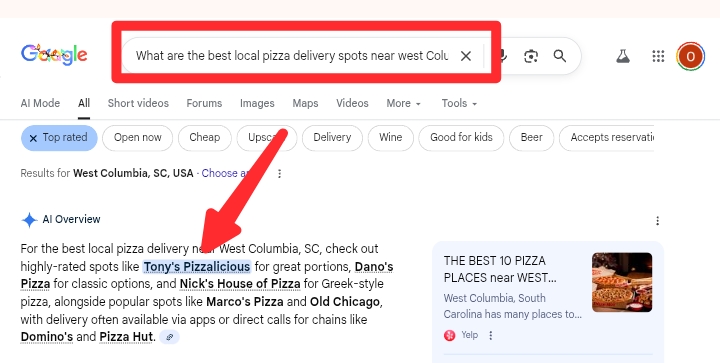
When someone asks an AI assistant, “What are the best local pizza delivery spots near me?” or “How do I fix a leaky faucet?”, your client’s brand needs to be the one the AI chooses to reference.
Source: Google
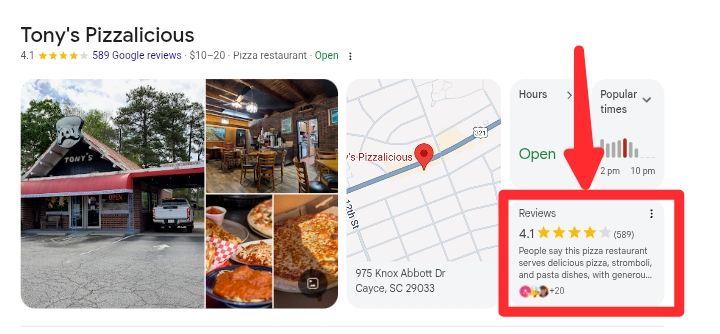
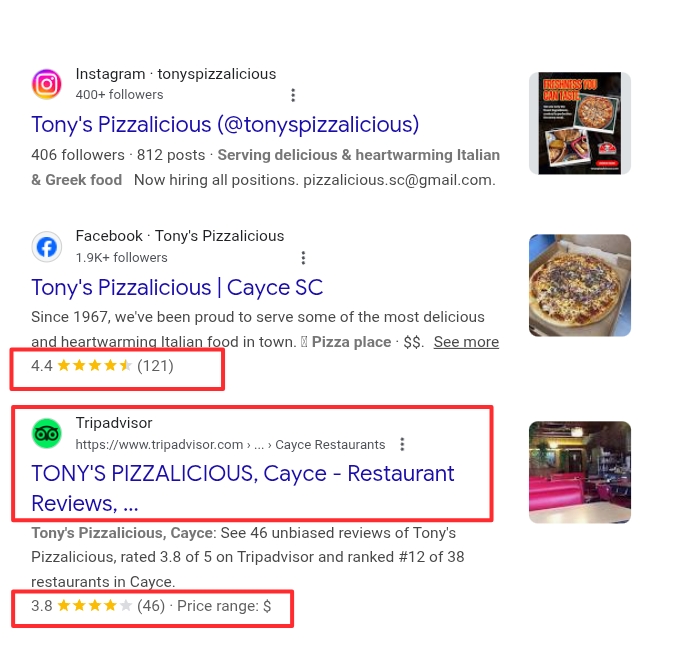
And no, Tony’s Pizzalicious and Co. didn’t get lucky in this case. It’s serious work of artificial intelligence search engine optimization (aka, AI SEO): consistent SEO and PR that goes beyond the website.
As you can see:
Source: Google
To be the brand AI engines choose, you have to feed it the facts and trust signals it can easily consume, verify, and cite.
Also, agencies need to obsess over structured data. It’s not just about getting the schema right and keywords in. You need to ensure every piece of information about your client is machine-readable, perfectly consistent, and includes trust signals.
Consistency is an LLM Trust Signal
A major weighting factor for LLMs is the consistency of facts across the web. Your client’s specific business name (e.g., “Southwest Auto Repair, Inc.”), exact services offered, and core value propositions must be identical across their website, local listings, citation sources, and major social profiles. If your website says “Oil Changes $49” and your Google Business Profile says “Oil Changes Starting at $45,” the AI flags that discrepancy, reducing the trust signal. The AI is looking for a high-fidelity consensus to establish “truth.”
Real-World Application:
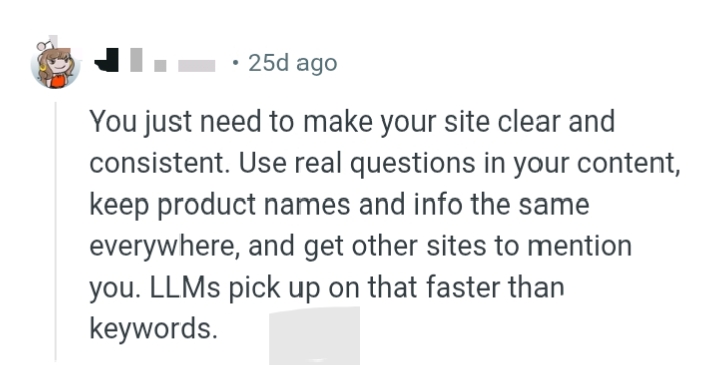
One agency strategist recently shared how her team cracked AEO. They stopped overthinking keywords and focused on the basics most brands skip.
First, they made their website dead clear and consistent with no mixed messages OR three versions of the same product name.
Source: Reddit
If a service was called “Growth Audit,” that exact name also showed up on the website, Google Business Profile, directories, invoices, everywhere. Same spelling and wording, with no confusion.
Next, they recommend rewriting content around real questions people ask. Not SEO-robot stuff like “best enterprise optimization solution.” More like:
- “How long does this service take?”
- “Who is this NOT for?”
- “What does pricing usually look like?”
- “What happens after I sign up?”
Those questions became FAQs, subheadings, and short explainer sections across key pages.
Then came authority. They focused on getting mentioned where it made sense: partner blogs, industry roundups, podcasts, even client case studies that lived outside their own site.
1. Niche Focus May Be the New Scale Strategy
For a long time, the agency model was publishing broad content and getting more leads for clients. The bigger the net, the more fish. Except that, right now, the AI is a bigger net, and it’s catching all the generic “fish.”
We are moving from an era of publishing for a broad, low-intent audience to cultivating a niche audience that’s hard to access.
Think about it: AI can write a generic article on “10 Tips for Plumbing Maintenance” in six seconds.
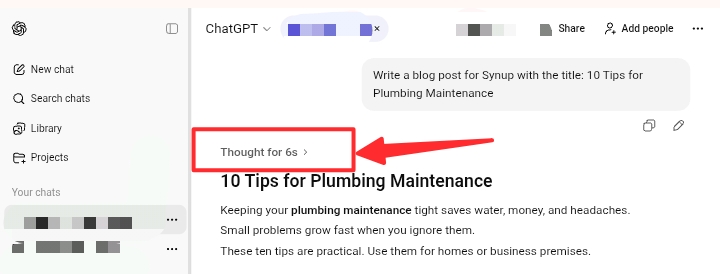
Source: ChatGPT
It cannot, however, write a deep, 4,000-word case study on “How the new municipal code impacts commercial boiler installations in Omaha’s Old Market district,” written by a master plumber with 30 years of experience.
Agencies must now super-serve specific, high-intent audiences to attract premium clients and outmaneuver generic AI-generated content. This strategy directly elevates your client’s perceived expertise.
E-E-A-T and The Personal Story
The quality framework of E-E-A-T (experience, expertise, authoritativeness, and trustworthiness) is becoming a game changer.
- Ditch the stock photo author bio: The era of the “Staff Writer” avatar is over. Agencies need to actually interview the client (the dentist, the roofer, the lawyer) and build the content around their specific, real-world experience.
- Show the work: Instead of writing generally about “roofing materials,” show a short video of the client installing a specific TPO membrane on a commercial building in a blizzard. That real-world experience is what AI cannot replicate.
2. Communities & Social Are New Trusted Sources, Beyond Google
Discovery is totally fragmented now. If you’re a consumer looking for “the best patio builder near me” or “local brunch spot,” you’re probably not clicking the first three sponsored content on the search engine results page (SERP), because, apparently, it’s paid content.

Source: Google
A lot of people are heading to:
- Reddit: To ask a sub like r/Adelaide for brand recommendations or warnings.
- YouTube/TikTok: To see a visual review or a “day in the life” video of a contractor.
- Nextdoor: To ask your literal neighbors who they used.
That’s because they are looking for unfiltered human opinions coming from actual people with experience of a product or process, not ad content or an optimized-for-SEO blog post.
Control the Relationship
Your strategy must diversify beyond Google. You need to actively help your clients build owned communities (email lists, a dedicated Substack, a private Facebook group) to control the relationship with LLMs.
All those forums and social sites are now feeding the LLMs. According to a 2024 study of 1.4 million keywords, when looking at the top 10 results on the SERP, they found that content from Discussion & Forum platforms like Reddit, Quora, and more was triggered for 33% of queries.
Source: seoClarity
These are where LLM and AI engines pull their content. This proves that what happens off your client’s site is now as important as what happens on it.
Read More: Reddit and Forums as Reputation Battlegrounds: Should Local Businesses Care?
3. Local SEO Discovery Is Changing
We shouldn’t lose focus. Advanced local SEO solutions with, for instance, grid rank tracking are still quite relevant in 2026.
But there’s a critical shift that agencies focused on local clients must also pay attention to. With the advent of “AI Mode” and AI-driven searches in maps, how a user finds the local sandwich shop is getting a radical makeover.
The key idea is this: Reviews and UGC (User-Generated Content) will drive awareness and visibility in AI-driven local searches.
When a user asks Google Maps, “Find a family-friendly Italian place with good vegetarian options and fast service,” the AI is doing real sentiment analysis and synthesizing hundreds of reviews and Q&As to produce that single, confident answer.
It’s no longer about who ranks #1 for “Italian restaurant,” and neither is a 4.8-star rating enough anymore. The models need to read what the 4.8 is based on. It’s about who the reviews substantiate as the best fit.
Here’s what to do as an SEO agency:
- Deepen the Review Strategy: Agencies need to move beyond simply getting 5-star ratings. We must coach clients to get reviews that mention specific keywords and attributes: “great coffee,” “dog-friendly patio,” and “fast oil change.” The AI cross-references these specific mentions.
- Q&A is the New Keyword: Managing the Q&A section on Yelp, and other key local listings, is now an essential preemptive SEO strategy. Your client needs to answer every question accurately, as the AI often pulls these answers directly.
If your agency wants to provide an exceptional experience and reduce churn, you need to deliver on this consistency.
4. Technical SEO Still Plays a Key Role in the AI Era
With all the focus on content and AI, it’s wrong to think technical SEO is now in the backseat.
While content changes, the underlying structure of the web remains the same. Clean site architecture and accessibility are essential for both human and machine crawlers, including LLMs.
The AI can’t understand or cite what it can’t easily access.
Speed, Clarity, and Core Web Vitals
You need to advise on consistency in site monitoring, technical QA, and ensuring the brand message is accessible to machines.
- Load Time is a Trust Factor: A slow-loading site is bad for users, but it’s also a signal to AI crawlers that the content might not be the highest quality. Focus on Core Web Vitals (CWV) not just for ranking but for credibility.
- Accessibility is Universal: WCAG compliance (Web Content Accessibility Guidelines) isn’t just about people with disabilities; it’s about making your content understandable to every machine that reads it. Using proper alt text, headings, and logical document structure feeds the AI exactly what it needs to construct a summary.
- The Silent Killer: We often forget the basics. Broken internal links, orphaned pages, and messy JavaScript hurt your client’s content. Technical SEO ensures the AI sees the right version of the truth, which is the foundation of all the new SEO trends.
For the local clients, this means that even a simple 5-page site needs to be impeccably clean.
5. Measuring Brand Influence Over Rankings
We all know the traffic numbers are getting hollowed out. As the SERP (Search Engine Results Page) gets swallowed by AI Overviews and enriched features, chasing the “blue link number one” is an increasingly flawed KPI.
A client whose traffic dropped 20% but whose branded search volume is up 30% is winning. We need a new way to prove it.
You have to shift the conversation from transactional metrics (ranking reports) to holistic influence metrics (value reports). The new metrics that matter in this AI age include:
- AI Visibility Score: Start tracking and reporting on how often your client is cited in AI Overviews or other answer boxes. Give it a score and show an increase over time. This proves the content is gaining authority.
- Branded Search: This is your agency’s best KPI. Branded search volume (people looking for “Client Name reviews” or “Client Name hours”) means you’ve created demand and trust outside of an algorithm. Plus, branded traffic is dramatically higher-intent. If your unbranded traffic converts at 2% and your branded traffic converts at 18%, losing 100 unbranded clicks for 10 branded clicks is a huge win.
- Community Share of Voice (SOV): Report on how often your client is genuinely recommended in local forums compared to their top three local competitors. This is direct proof that your community and content strategy are working.
- Social Mentions & Sentiment: A surge in mentions (even without a link) on Reddit or TikTok is a massive indicator of brand interest. Plus, monitoring sentiment (are they talking positively or negatively?) gives real-time feedback on reputation
The Narrative Change: Don’t apologize for a traffic dip. State clearly: “We strategically lost 1,500 clicks this month from low-intent searchers asking ‘What is X?’ and gained 500 high-intent searches directly for you. We are building trust, not just traffic, which is a better ROI.”
Also Learn: Track These Important Client Metrics Every Month to Improve Your Agency Services
6. Are We Ready for Agentic SEO and Automated Purchases?
This is the horizon: the full integration of AI assistants in daily life, what we call agentic SEO.
We’re starting to see agentic SEO tools like WordLift’s AI SEO Agent, which already has the ability to connect with GSC and Google Analytics (GA4) to cluster keywords and recommend/implement schema markup.
But the key idea here is that future search journeys (e.g., full travel bookings, business inventory ordering, service calls) will be generated and executed within closed AI systems. The AI acts as an agent that makes purchasing decisions for the user.
In the near future, a user won’t search Google for a dog groomer. They’ll ask their AI agent: “Book a dog grooming appointment for Baxter this Saturday at the highly-rated place near my office.” The AI agent will find the provider, check their scheduling API, and confirm the booking, all without a single SERP click.
How to Prepare for the Agent
- API Readiness: Your client’s booking, inventory, and pricing data must be flawlessly exposed and machine-readable. You should be asking clients, “Do you have an open API or integration that allows an outside system to interact with your inventory, pricing, or booking system?” If your client is a local auto repair shop, can an AI agent check their real-time availability and book a slot? This is a non-SEO conversation, but it becomes the next layer of SEO.
- The Zero-Click Conversion: The goal, very soon, will no longer be a click; it’s a direct booking or an automated purchase. This means all your structured data (pricing, hours, location) has to be 100% accurate, because the AI is betting its reputation on it.
- Trust Above All: The AI agent’s sole goal is to serve the human user. It won’t pick a cheap option with bad reviews or messy data. It will choose the most reliable, best-reviewed, and most transparent option. That circles back to E-E-A-T and impeccable reputation management.
This trend is an early look at how agencies should be thinking about “getting into” those closed systems and preparing for automated purchasing decisions.
7. Citations Are the New Backlinks
Traditional link building isn’t dead, but its function is changing.
AI tools often pull answers from different sources. When your content gets cited there, it can drive visibility even if your primary Google rankings drop.
The Source of Truth Strategy
Stop writing content that rehashes other people’s ideas. Create authoritative, definitive assets or resources that are clearly the best on the planet for that niche topic. These are the assets that an LLM will want to cite because they’re comprehensive and final.
Practical Example: For a small accounting firm client, instead of “Tax Tips 2026,” publish “The Official 2026 Guide to Small Business Tax Deductions in [Your State], Including All New State-Specific Credits.” Include a detailed research-based infographic for that industry. That localized, definitive guide is good material for machine citation.
That’s a way to use data as link bait. As another example, let’s say a local landscaper publishes an annual “Cost of Deck Building Index” for their county. When a local news site or real estate blog cites that number, the AI notes that the landscaper is the source of original data.
Also Read: Importance of Local Citations for AI Visibility
How Do You Prepare Clients for These Changes?
As an agency owner, your job is to translate these into a simple, confident strategy for the client who is still concerned about their organic ranking.
- Change the Reporting Narrative: Stop leading with “We’re #3 for ‘dentist near me.'” Lead with: “We saw a 15% increase in branded searches, and your business was cited three times this month in local AI summaries. Your brand trust is growing.”
- Mandate Content Interviews: Stop writing content without the client’s real input. Budget time for a 30-minute monthly call where the client talks about their real-world experience. Use that specific raw material to write the high-E-E-A-T content.
- Audit for Consistency: Before anything else, audit the client’s entire online presence for data discrepancies. Make sure every listing, price, and fact is identical across all listings. Use a tool to manage those local listings for clients automatically. Inconsistency is now the fastest way to get kicked out of the AI’s answer box.
Also Read: How to Manage Client Expectations During Algorithm Changes
Conclusion
The latest SEO trends of 2026 make it clear: the game has changed. We’re moving from a volume economy to a trust economy.
The shift is difficult, but it’s an opportunity for agencies to finally move from being commodity vendors to indispensable marketing partners for their clients.
For the agency strategist, success in 2026 means integrating hyper-specific, experience-backed content with flawless technical execution and relentless reputation management. The goal is to make your client the most trusted, most easily verifiable source of truth in their local market. That’s how we ensure our powerful SEO solutions deliver real, defensible value in an age largely driven by AI SEO.
FAQs
1. How do we handle “Zero-Click” searches where the user never actually visits our client’s site?
You have to stop treating the website as the only destination. In 2026, the Google Business Profile and the AI Answer Box are the new homepages. Your goal is to convert the user right there. This means your information fields need to be robust, and your “Call” or “Book” buttons must be integrated directly into the search interface.
2. Is voice search important for local businesses in 2026?
Yes. It’s now the primary way people interact with AI agents. When someone tells their car, “Find me a mechanic open now that handles Volkswagens,” the AI isn’t browsing a list but picking a winner. To win here, your content needs to use conversational, long-tail phrases. Voice search relies heavily on the “Opening Hours” and “Services” sections of your local listings for clients, so if those aren’t live-synced, you’re invisible.
3. Is traditional link building a waste of time now that citations are so important?
Not at all, but the strategy has shifted. A backlink is a vote of confidence for humans, while a citation is a fact-check for AI. Additionally, high-quality links still pass authority, helping you show up in AI Overviews. The best move is to create “source-worthy” data, like a local pricing index, that naturally earns both a link and an AI citation.