



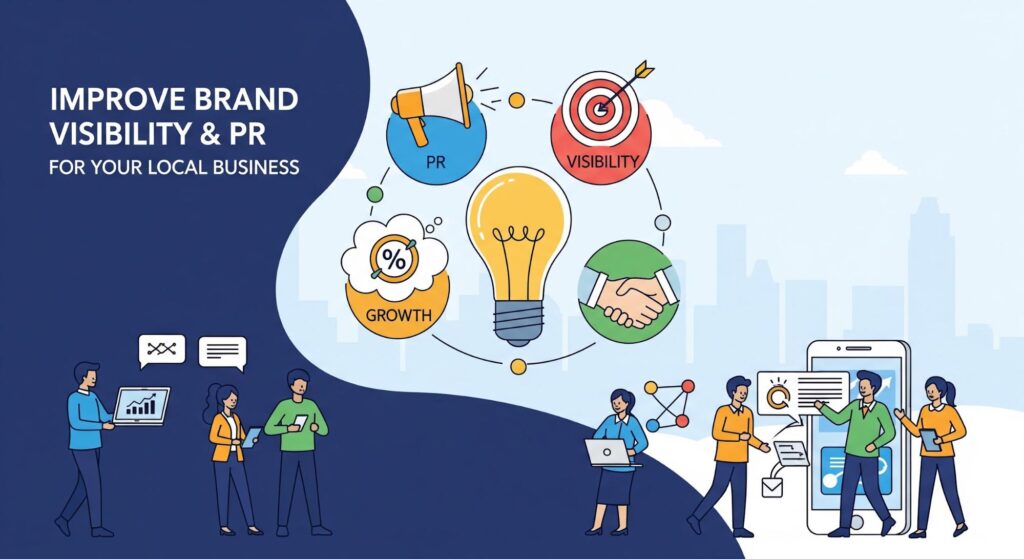
 Building a brand for a local business used to be dead simple. You bought a Yellow Pages ad, sponsored a softball team, and hoped the sign out front was big enough to catch eyes from the main road. Today, things have changed completely. Local brands compete for every inch of screen space and every trust.
For agencies managing local clients, the challenge is clear:
How do you make a business the name on everyone’s lips without burning through a massive ad budget?
This guide breaks down how to improve brand visibility and public relations for local businesses through a mix of smart digital moves and old-school community ties. This is not about getting a feature in the New York Times but winning the three-block radius. It is about making sure that when someone needs a plumber, a baker, or a lawyer, your client is the only logical choice.
TL;DR
- Foundation First: Fix your NAP (Name, Address, Phone) consistency across all local listings before pitching to the media.
- GBP is a Media Channel: Treat your Google Business Profile like a news feed. Post community feats, awards, and event photos to prove you are a local pillar.
- Stories Over Sales: Journalists want human interest, local impact, and milestones. Pitch the “why,” not the “what,” to reporters and radio hosts.
- The Power of Neighbors: Partner with nano-influencers like PTA heads or Facebook group admins who actually live in the zip code.
- Reputation is Perpetual PR: A 4.9-star rating is a 24/7 press release. Respond to reviews, especially the bad ones, within 24 hours to show integrity.
- Measure What Matters: Track branded search volume and local share of voice to prove your PR efforts are driving intent.
What Defines Brand Visibility vs. Public Relations in a Local Context?
Brand visibility and public relations…We often use these terms as if they mean the same thing. They don’t.
Brand Visibility
Brand visibility is about being found. It is the tactical side of marketing.
If a customer searches for “coffee near me,” your brand visibility efforts ensure your brand appears in the top 3 results.
Here are what helps with visibility:
- Google Business Profiles
- Local service ads
- Physical signage
Without visibility, any local business is a ghost. They could be the best in the world, but if the map doesn’t show them, they don’t exist.
Public Relations
Public Relations is about building trust. It is the strategic side of marketing.
While visibility puts the brand in front of people’s eyes, PR puts the brand in their hearts. It is the story told about the business when the owner isn’t in the room. PR is about credibility. It includes:
- Community goodwill
- Expert positioning
- Storytelling
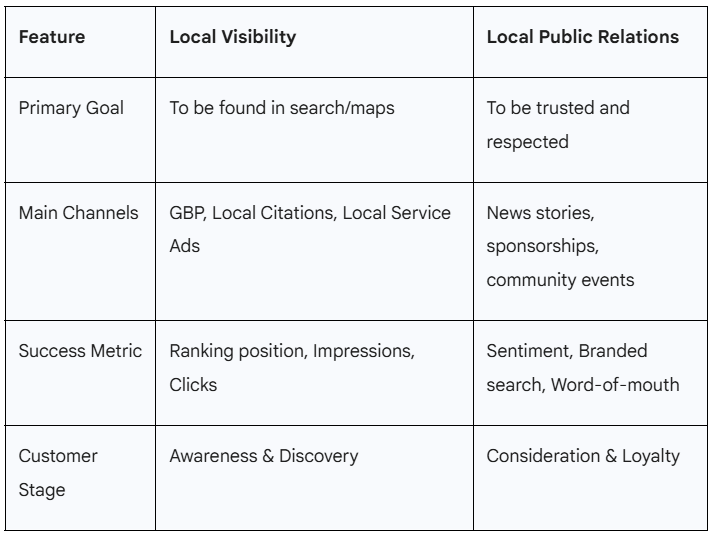
Here’s a side-by-side comparison between visibility vs PR:
How Does Local SEO Act as the Digital Foundation for PR?
Before pitching media or running campaigns, your digital foundation must be solid. Local SEO ensures that when people hear about your business, they can easily find and trust it online.
Think of it this way: if a local journalist writes a glowing piece about your client, readers will immediately search for the brand. If they find a broken website, incorrect contact details, or a misplaced map pin, that momentum disappears, and the lead is lost.
Here is how local SEO acts as the digital foundation for PR:
1. Establishes Trustworthiness and Authority
Google uses E-E-A-T (experience, expertise, authoritativeness, and trustworthiness) to rank sites, and local SEO is key to proving this.
- Google Business Profile (GBP): A fully optimised and verified Google Business Profile serves as the primary source of truth for a business’s identity, which is essential before launching any PR campaign. Google Posts are your front-page news. Don’t just post 20% off coupons. Use them to broadcast the brand’s heartbeat to the neighborhood.
- Reviews as Social Proof: Positive online reviews, managed via local SEO, act as third-party validation, strengthening the reputation that PR strives to build. Let’s say a local boutique gym gets a shoutout in a “Best of [City]” blog. A potential member clicks through and sees 150 neighbours raving about the “no-judgment atmosphere.” That managed reputation confirms the PR narrative. Without those reviews, the PR just feels like a paid ad.
Also Read: What is Review Recency: Does it Matter for Local SEO?
2. It Provides Link-Worthy Local Context
Digital PR struggles if you don’t have something worth linking to. Local SEO creates the honey that attracts the local media bees.
Instead of a press release saying “Plumber Joe is great,” create a blog on “2026 Homeowner’s Guide to Surviving [City Name]’s Winter Freezes”. Now, when you pitch to, say, local reporters, you’re offering a resource, not a sales pitch (more on this later!).
3. Citations for Sending the Right Signals
Citations remain one of the clearest trust signals Google uses to verify that a business actually exists where it claims to.
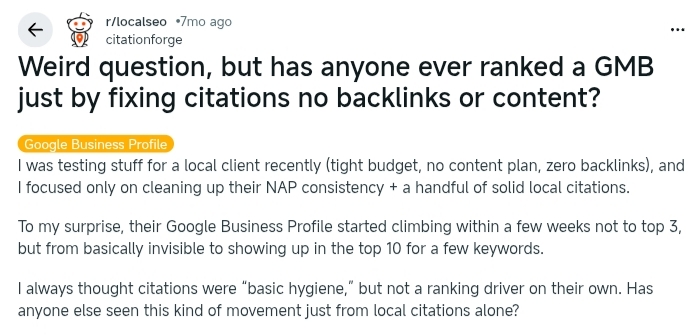
A practical example makes this real. One local SEO practitioner recently shared a field test with a small service business that had almost no marketing budget.
The only activity during a six-week sprint was a detailed NAP cleanup and the consolidation of outdated listings. The results were noticeable:
Source: Reddit
This aligns with what many agencies see during citation audits.
A typical small business hypothetically has between 40 and 120 live listings across directories, data aggregators, maps, and niche platforms. When Google starts crawling all these, it struggles to connect signals. Instead of one strong business entity, what it sees are fragments. Cleaning citations manually or with a listing management tool consolidates authority into a single business identity.
Local SEO in 2026: Dominating the Near Me Factor and Zero-Click Search
Most (up to 84%) local searches happen on mobile devices while people are actually in their cars.
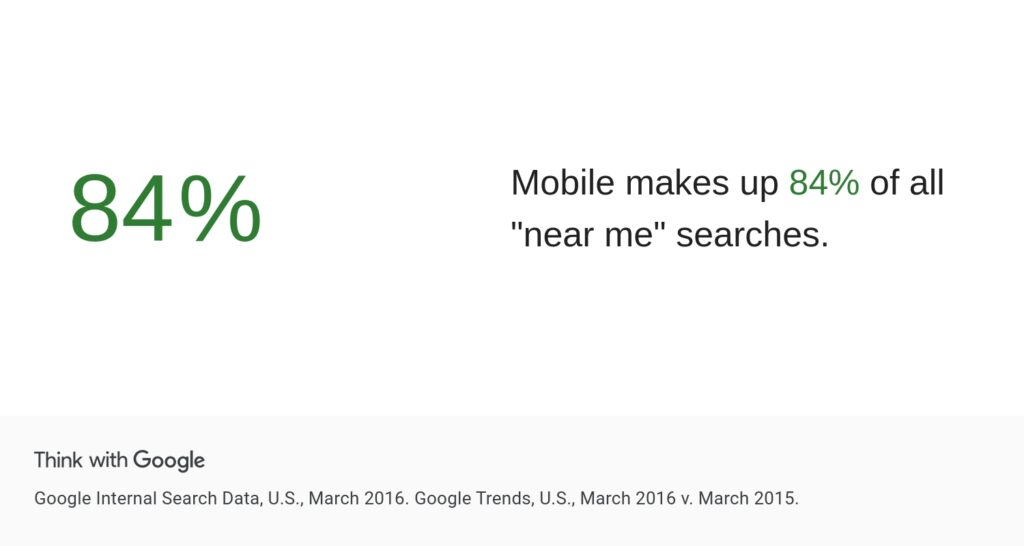
And, according to Google itself, 76% of these local smartphone searchers are ready to visit a physical place within 24 hours.
If you aren’t optimized for the specific neighborhood name, you lose the lead.
Also Read: Everything You Need to Know about Local SEO [2026 Edition]
Another thing to watch is the rise of featured snippets. These are the zero-click results that answer questions immediately.
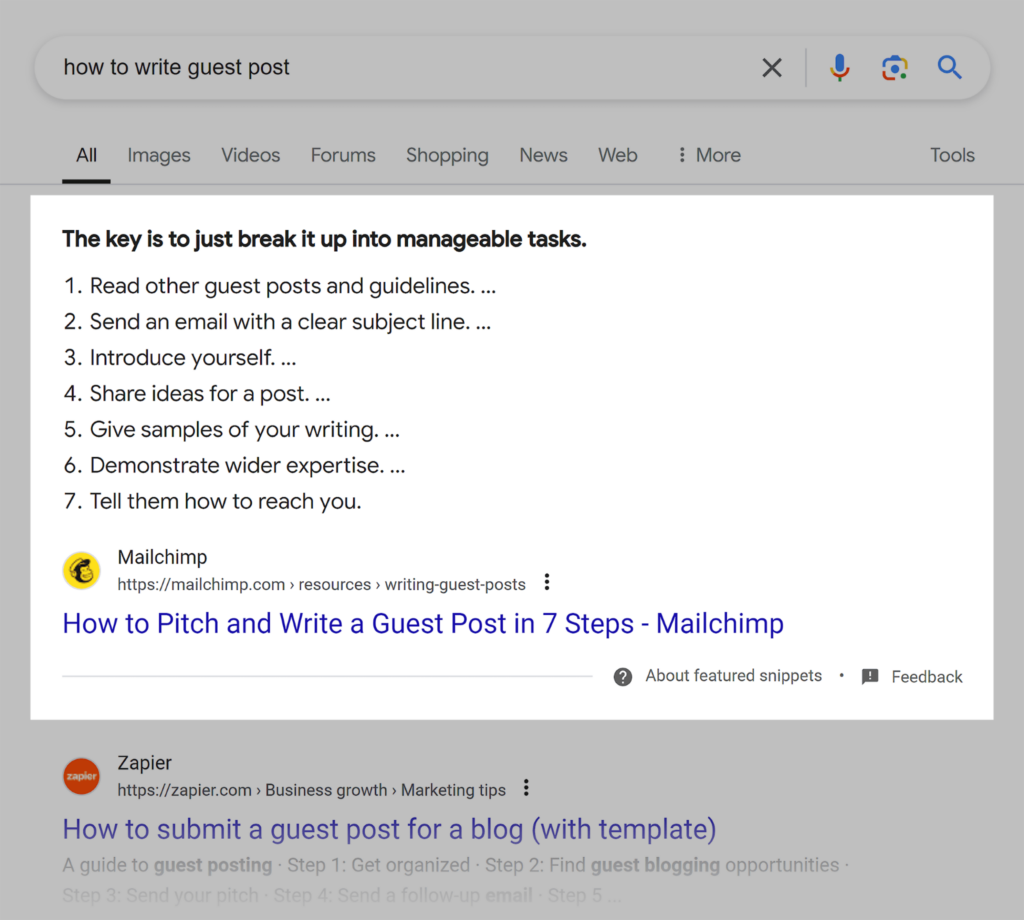
Source: Google
To start appearing in featured snippets, focus on creating locally relevant, search-optimized content supported by strong E-E-A-T signals (Experience, Expertise, Authoritativeness, and Trust).
Pro Tip: A smart starting point is local FAQ content! Simple question-answer-based content is easy to pull into a snippet.
For example, if your client is a roofer, publish a page that answers: “How much does a roof repair cost in [City Name]?”
If Google pulls that response into a featured snippet, your client instantly becomes the visible authority. They earn trust before the customer even clicks.
Learn More: How AI Search Will Affect Your Local SEO Clients
How Can You Craft Newsworthy Stories for Local Media?
Local newsrooms are shrinking, and journalists are desperate for stronger stories. They will absolutely delete uninspiring sales pitches.
If you want to get your client on the news, stop selling their product and start telling their story.
- Human Interest: A business owner overcoming personal odds to open shop.
- Community Support: Filling a gap left by city budget cuts or disasters.
- Historical Milestones: A shop celebrating its 50th year in the same spot.
Think about a local bakery owner sponsoring a Little League team. That is nice. But a baker sponsoring the team after the city cut the sports budget? That’s a story.
It has conflict, heart, and a local hero. But to get these stories out, you have to build a media list. Don’t just blast a generic PR wire. Here’s where to look:
Beat Reporters
These are the folks at the city paper or the local business journal who are looking for a trend or a struggle.
Find the reporter whose name appears under every “New Business” or “Economic Development” headline in your local gazette.
Don’t just send a press release. Send a personal note to the business beat reporter.
”Hey Sarah, I saw your piece on the closing of the old mall. My client, Old Town Hardware, just hit 40 years in the same spot. They’ve seen the neighborhood change from dirt roads to condos. Want to talk to the owner about why “shop local” is actually working here?”
Radio Hosts
Radio is far from dead in local markets. When people are stuck in traffic, they want to hear from someone who sounds like a neighbor.
Look for the local talk radio segment that features community spotlights. These hosts have three hours of airtime to fill every single day. They are often desperate for a well-spoken guest with a timely tip.
Let’s say your client is a local HVAC company during the first big heatwave of the summer.
Pitch the “Expert Tip” angle: “Hey Dave & The Morning Crew, it’s going to be 100 degrees this weekend. My guy at Miller Air has three 2-minute tips on how to keep your audience’s ACs from blowing a fuse before the weekend hits. He can hop on for a quick segment at 7:10 AM to save your listeners some serious cash.”
Hyper-local Bloggers & Group Admins
The local blog or the admin of the Main Street neighborhood Facebook group holds more power than the evening news. These people are the digital mayors of the town. They care about things like “Is the new playground safe?” or “Where is the best place to get a gluten-free birthday cake?”
If you are working with a new local bakery that specialises in allergy-friendly treats, don’t just post a link in their group (you’ll get banned). Reach out to the admin first and make a pitch.
Example: “Hi Jessica, I’m the admin for Sunny Day Bakery. We just opened on 4th Street. I’d love to drop off a box of nut-free cupcakes for your next neighborhood meet-up with no strings attached. We just want the neighbours to know we’re here.”
When you pitch, keep it brief. Use a hook that mentions the specific neighborhood. Give them a local angle that affects their readers.
Why You Should Focus on Community Engagement Over Traditional Ads
Ads are an interruption, and community engagement is an invitation.
79% of people say user-generated content significantly influences their purchasing decisions. People trust their neighbours more than they trust a billboard.
UGC campaigns can achieve click-through rates up to 4 times higher than those of traditional brand-only content. This is because it feels real. When a local business engages with the community, they are creating opportunities for that content to exist.
Some ideas:
- Set up a booth, don’t just send a check.
- Hand out water or towels at a local 5K.
- Have the owner shake hands and meet neighbors.
This creates a physical touchpoint. It makes the brand a part of the experience. Besides that, it gives people something to take a photo of and post.
Charity partnerships are another winner. Align the client with a cause that fits their values.
A pet store should partner with a local shelter. A gym should partner with a youth health program. This is called cause marketing. It builds deep emotional connections that a 10% off coupon never could.
Some more inspiration:
- Educational Workshops: Hosting free classes builds massive expertise.
- Resource Sharing: Letting a local non-profit use your space for meetings.
- Skill Donation: A lawyer offering a free clinic for local seniors.
How Do Local Partnerships and Cross-Promotions Drive Reach?
In a local economy, your neighbours are your best allies. The neighbour strategy is about finding non-competing businesses that share the same target audience.
Think about a gym and a health food cafe. They aren’t stealing customers from each other but serving the same person at different times of the day. By partnering, they can double their reach instantly. Try bundle offers:
- The Cross-Sell: Like: “buy a workout, get a smoothie half off next door.”
- The Referral: Give a client a voucher for the shop across the street.
- The Display: Place brochures in each other’s lobbies or checkout lines.
Along with that, try co-branded email blasts. If both businesses have 500 subscribers, the message reaches 1,000 locals.
It also lowers the cost of acquisition for both businesses. Instead of paying for Facebook ads, they are sharing the leads they already have.
What is the Role of Micro-Influencers in Local Markets?
When we hear the word influencer, we think of celebrities with millions of followers. In local PR, those people are unfortunately useless.
You need to be looking at the head of the local PTA. You need the person who runs the neighborhood Facebook group.
These are nano-influencers. They might only have 1,000 to 5,000 followers. But those followers all live in the same zip code. When they recommend a new pizza place, the neighborhood actually goes there.
Here’s how to work with them and get started:
Start by identifying your client’s best customers, especially those who already post about the business. These are your natural advocates. Offer them VIP treatment such as a complimentary meal, a behind-the-scenes tour, or exclusive access to a soft opening or tasting event.
In exchange, encourage a shoutout or tag to generate authentic digital word-of-mouth.
To support this strategy:
- In-store signage: Invite customers to tag the business for a chance to be featured.
- Exclusive access: Offer early previews, tastings, or invite-only experiences.
- Personalised offers: Provide unique discount codes they can share with their followers.
How Can You Leverage Events for Instant Brand Awareness?
Events are the fastest way to get a lot of people to notice a business at once. They create a destination. Instead of hoping people stop by, you are giving them a reason to put the business on their calendar.
Hosting owned events is a great start. Grand openings are obvious, but what about:
- VIP nights: Making top spenders feel like neighborhood insiders.
- Product launches: Turning a new menu item into a big event.
- Seasonal festivals: Hosting a pumpkin carving or holiday mart.
These events make people feel special. They turn a transaction into a relationship.
If the client can’t host an event, they should participate in city events: set up a booth at the farmer’s market. Get a spot at the holiday street fair. This puts the brand in the middle of the local action.
On top of that, you can use digital tactics like event geofencing. If there is a huge festival three blocks away, run mobile ads that only show to people inside that festival. This allows you to piggyback on the foot traffic of much larger events. Invite potential viewers to stop by for a discount and track how many people saw the ad and actually walked in. It is a smart way to get high-intent eyes on a brand.
How Does Online Reputation Management Feed into Public Relations?
Your reputation is your PR. In the local world, a 4.9-star rating is more powerful than a full-page ad in the newspaper. It is a perpetual press release that works 24/7.
When someone sees a high rating with hundreds of reviews, they assume the business is the best.
But reputation management isn’t only about getting stars but also about how the business communicates. Responding to reviews is a public act. When a client responds to a positive review, they are showing gratitude.
Here’s how to do this: How to Respond to Positive Reviews: 5+ Awesome Examples
How you handle negativity is the ultimate PR pivot. If a bad review goes viral, don’t hide. Apologise publicly. Validate the customer’s feelings. People are, in fact, quite attentive to the negative reviews and how you respond.
Offer a real solution. When other people see the business taking responsibility, they respect it. Often, a well-handled bad review can build more trust than a perfect one.
Learn More: How to Handle Negative Reviews From Your Customers
Showcase that social proof everywhere. Don’t leave it on the review sites. Integrate testimonials into the website headers.
How Do We Measure the Success of Local PR Efforts?
As an agency owner, you know that if you can’t measure it, the client won’t pay for it. PR can feel soft, but you can track it with the right metrics.
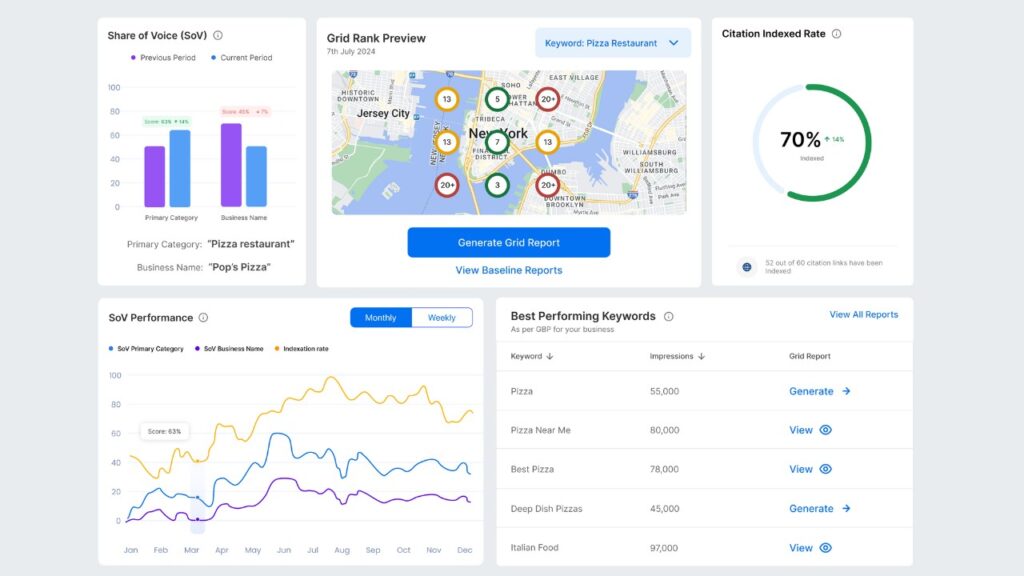
Start with the Share of Voice. Track how often your client is mentioned in local social groups compared to their top three competitors.
Source: Synup
Check:
- How many times is the brand named in local groups?
- Are the conversations positive, neutral, or negative?
- Is the brand “winning” the neighborhood grapevine?
Next, review referral traffic in Google Analytics to see how many users are coming from local news or partner websites. Monitor branded search volume, as an increase shows stronger awareness and PR impact. Finally, correlate spikes in foot traffic with PR activity, such as a charity drive, to clearly demonstrate ROI.
Conclusion
Improving brand visibility and local PR is about becoming a known and trusted name within the neighborhood.
When you combine the technical strength of local SEO with the human touch of community engagement, you move your clients away from the race-to-the-bottom pricing of a commodity and into the position of a local authority.
Remember that every review, every local partnership, and every community event strengthens the brand’s reputation. If you continue doing this, you will build a brand that becomes a permanent part of the local landscape.
FAQs
- How long does it take to see results from local visibility and PR efforts?
After launching PR efforts, you’ll typically see an increase in calls, profile views, or customers mentioning they found you on Google within the first one to two months. More meaningful traction often appears between three and six months as reviews grow and local coverage builds. Larger gains, such as increased branded searches, steady referral traffic, and strong neighborhood recognition, usually emerge after six months of consistent effort.
- How can a local business get free press coverage?
Position yourself as the go-to local expert who helps people, not just someone trying to sell services.
- Share useful tips during seasonal events or local challenges.
- Celebrate milestones that matter to the community and take part in charity or neighborhood initiatives.
- Journalists and radio hosts look for real stories with heart, impact, and local relevance.
When you consistently provide value and insights, media outlets start reaching out to you, not the other way around.