



Over the last few years, we’ve watched agencies grow from a handful of clients to hundreds, and we kept seeing the same friction points show up again and again. Different clients are subscribed to different combinations of apps. Agencies often have to do manual setup during onboarding for each of their clients. And cross-sell depends heavily on sales conversations instead of being built into the client experience.
Plans feature in Synup OS is built to address these problems at their root by helping agencies turn marketing apps into clear, customizable packages for clients.
The Problem We Kept Seeing
Agencies sell outcomes like visibility, reputation, and growth. But delivering those outcomes usually means stitching together individual marketing apps behind the scenes.
Managing service packages for every client manually creates a lot of friction. Two clients paying for “the same package” end up with different configurations. Teams have to remember what app and service goes into which offering. And while revenue is visible, profitability often isn’t.
Cross-selling adds another layer of complexity. Oftentimes, clients don’t even know what else is on the table for them apart from their currently subscribed services. Expanding an account typically means another sales or CS call, another explanation, and another invoice, even when the next step should feel obvious to the client.
Why We Built Plans
We didn’t want to introduce rigid pricing tiers or force agencies into a predefined structure. Instead, we wanted to give agencies a way to define their own offerings and scale them consistently.
Plans give agencies a way to bundle marketing apps into intentional packages, apply those packages quickly, and control how they’re presented to clients, without changing how agencies sell or bill today.
Creating a Consistent Customer Experience
As agencies scale, consistency becomes one of the hardest things to maintain.
Plans allow agencies to define exactly what’s included in each package and apply it instantly to new and existing clients with a single step (also enabled by our CSV upload functionality). This removes the need to manually select apps every time and ensures that clients on the same plan receive the same experience.
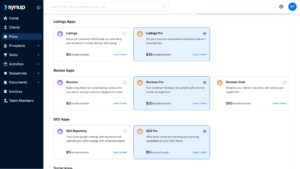
Inside the client dashboard, plans also create clarity. Clients can see what they’re subscribed to and what other options are available, making the relationship feel more transparent and product-led rather than ad hoc.
The result is smoother onboarding, fewer setup errors, and a more professional experience both for clients and internal teams.
Visualize Your Margins Better
Most agencies know how much they charge, but fewer have a clear view of what each package actually earns. Plans introduce pricing directly into the system.
Agencies can set selling prices based on how their services are delivered:
- per location for listings, reviews, and SEO
- per social connection for social media.
Synup OS then compares those prices against underlying costs to calculate your profit margins.
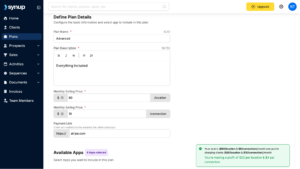
Instead of relying on external spreadsheets or assumptions, agencies can start seeing which offerings are truly profitable and where pricing might need adjustment. Over time, this turns pricing from a static decision into an informed strategy.
Making Cross-Sell Part of the Client Experience
Growth shouldn’t rely entirely on sales conversations. With Plans, expansion becomes part of the product experience. Clients can see higher-tier plans and additional capabilities directly in their white label dashboard, making upgrades feel like a natural next step rather than a pitch.
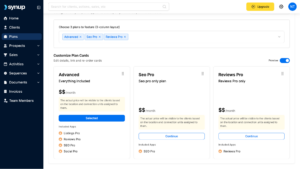
Agencies stay fully in control of how upgrades are handled by adding their own payment links, whether that’s PayPal, Stripe, or any other checkout flow they prefer. Synup OS supports the upgrade journey without interfering in billing relationships. This creates a quieter, more scalable path to expansion revenue.
Plans are more than a packaging feature; they’re foundational infrastructure for agencies that want to grow without adding operational complexity.
They help standardize offerings, surface profitability, and build expansion into the client experience while preserving the flexibility agencies need.