




 Source: Freepik
A contract is your dam that’s braving the treacherous waters of expanding expectations that pile up one “small” request at a time.
Maybe you’ve got that one client who keeps asking for more revision requests or different reports every other week. At first, you just do them. They’re… well, small, and you don’t want to sound difficult.
But then, suddenly, those extras turn into new deliverables that cost the team 5 extra billable working hours that weren’t budgeted. The upper management is not helping either. Their stance and advice are basically, “Make the client happy.”
It’s not because they’re bad clients. Your contract (if any) simply didn’t spell out the boundaries.
A good SEO contract template is the foundation that keeps your business profitable. It protects your team and keeps relationships clean. It’s an SEO services agreement that sets expectations, defines boundaries, and saves you from countless headaches.
Why a Solid SEO Contract is Your Best Protection
Every agency owner has a war story: unpaid invoices, clients who think SEO includes redesigning their website, or unrealistic expectations about ranking on page one in two weeks.
A proper contract spells things out early by defining what’s included, what’s not, and what happens when things go sideways.
Here’s what makes an SEO agency contract your best protection.
1. Prevents Scope Creep
If you’ve ever had a client slowly expand your workload without expanding the budget, you already know the pain of scope creep in SEO services. It starts with something like: “Can you also track these extra keywords?” Then it ends with your team doing triple the work for the same fee.
You need to nip scope creep before it becomes the norm. Most clients don’t mean to take advantage, but simply don’t understand where SEO starts and ends. But once you say yes a few times, it becomes expected.
That’s why it makes sense to define your SEO contract deliverables list clearly and early. List everything covered: keyword research, technical audits, link building, and reports.
Then write what’s not included, which can be content writing, social media, web development, or PR. If a client wants to expand the scope, have a process: note the extra task, quote it, and add it to the next cycle after sign-off.
One agency founder shared how his customer kept adding new report types without realizing the time involved. This advice was golden: move them to a prepaid marketing agency service contract SEO that renews monthly. That way, when they ask for new work, you can simply say, “Let’s add that to next month’s scope.”
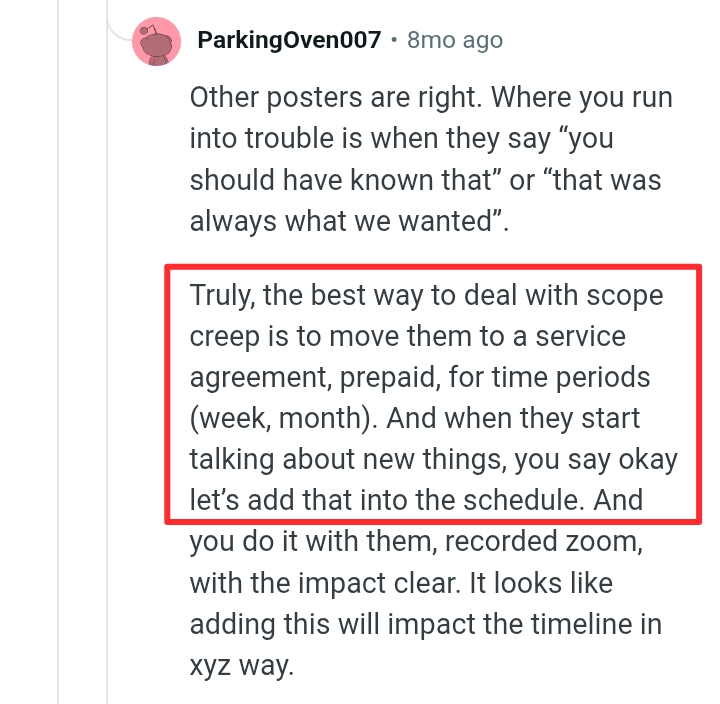
52% of all projects face scope creep because deliverables aren’t properly defined. However, a clear, upfront contract eliminates that margin-killer.
2. Ensures Timely and Fair Payment Terms
Money keeps the lights on. Every agency owner knows how ugly things get when it doesn’t come in on time. An overwhelming (97%!) of agencies say late payments slow their growth. That checks out.
When your SEO agency payment terms are vague, invoices turn into endless “Hey, just checking in…” emails. That’s why your SEO contract template should spell out every detail: when you’ll be paid, how, and what happens when clients miss a deadline. Something like this works well:
“Payments are due within 10 business days of invoicing. A 1.5% monthly late fee applies after 15 days. Work pauses automatically after 20 days of non-payment.”
It reads firm, but it’s fair. It also sends a clear message: you run a real business and not a hobby job.
Most agencies assume clients will “just pay.” But there’s another side to this: international payments. If you’re working with clients overseas, you’ve got to think about exchange losses and transaction fees. For example, even a 2% FX fee on a $5,000 monthly retainer is a quiet $100 gone every month; that’s $1,200 over a year, wiped off your profit margin.
So, when you’re drafting your SEO retainer agreement template, add a small line about how fees, currency conversions, and processing costs are handled. It saves you from losing money to fine print or fluctuating rates.
3. Manages Client Expectations
Here’s a reality most clients don’t know: no one can guarantee a #1 ranking. Not even Google. Yet, so many agency-client fights start with expectations about results.
That’s why your SEO services agreement should include a clear disclaimer that results depend on factors outside your control. These can be search algorithms, content quality, market competition, and client responsiveness.
Without that, you’ll end up like this user (and countless others):
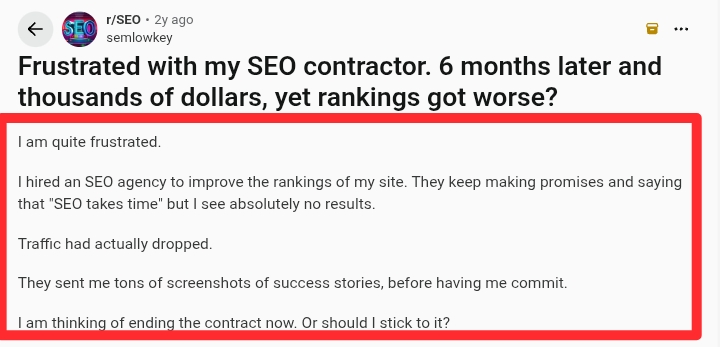
Don’t get us wrong. There are agencies that know nothing about SEO but clumsily manoeuver their way to the top of the rankings they promise.
But the frustration in this post reflects what happens when expectations aren’t managed from day one.
So, be clear. Add a clause like:
“While the agency will use industry best practices, SEO results are subject to variables including search engine algorithms and external competition. No specific ranking or traffic level is guaranteed.”
Then, educate your clients. Tell them the timeline: 3–6 months for measurable results, 6–12 months for ROI. Show them your deliverables and tracking reports upfront.
4. Provides Legal Recourse When Things Go South
Even with good intentions, projects sometimes end early due to shifting budgets, changing management, or shifting priorities. Without a written exit plan, things normally don’t end well.
A clear SEO agency contract should include:
- Termination clause: “Either party may terminate with 30 days’ written notice.”
- Refund policy: “Setup fees are non-refundable; remaining retainers are pro-rated.”
- Ownership rights: “Deliverables remain agency property until all dues are cleared.”
The Essential Clauses in an SEO Contract: A Blueprint
Here’s the practical breakdown of what every SEO agency needs; that is, the must-have clauses in your SEO agency contract and how each one works in the real world.
1. Parties and Effective Date
Start simple. List both businesses properly, including the legal names, addresses, and the date the contract kicks in.
Why it matters
This is what makes your contract legally valid. It timestamps when work, payment, and obligations start. Without it, there’s wiggle room for clients to say “we didn’t start yet” or “we didn’t agree on that version.”
Sample wording:
“This SEO Services Agreement (the ‘Agreement’) is made and entered into on [Date] by and between [Agency Name], a registered company in [State], and [Client Business Name], located at [Address].”
Pro tip: Always use full legal names, not “ACME Marketing,” if the company is legally registered as “ACME Digital LLC.” We’ve seen a client’s finance department refuse payment because the contract name didn’t match the entity registration.
2. Scope of Work & Deliverables
This is your safety net against scope creep in SEO services. Outline exactly what’s included: keyword research, technical audits, link-building, monthly reporting, and what’s not.
Why it matters
Some clients often assume SEO means “everything digital.” If you don’t clarify, those assumptions can cost your team time and profit.
Sample wording:
“Agency will provide the following services:
- a) Keyword research for up to 30 keywords;
- b) On-page optimization of up to 10 pages per month;
- c) Monthly link-building outreach targeting DR 35+ sites.
This agreement does not include paid advertising, web design, or social media management.”
Without this, don’t be surprised hearing clients asking for PPC and content writing under their SEO retainer because they “thought it was all part of SEO.”
3. Payment Terms
This outlines how much, when, and how payments are made. Include invoice cycles, due dates, and what happens if a client pays late.
Why it matters:
Agencies need predictable income. Missed or delayed payments can choke your operations fast. Remember that study from PYMTS? Delayed payment is a growth killer for virtually all agencies.
Sample wording:
“Client agrees to pay [your agency] a monthly retainer of [Amount] USD, due on the first business day of each month. Late payments after 10 days will incur a 1.5% monthly interest fee. Work pauses automatically after 20 days of non-payment.”
4. Terms & Termination
The terms and termination clause defines contract length, renewal, and how either party can exit.
Why it matters: It avoids the dreaded “auto-renewal” surprise or a client pulling out mid-project without notice.
Sample wording: “The initial term of this Agreement shall be six (6) months commencing on the Effective Date. Thereafter, it renews monthly unless either party provides 30 days’ written notice of non-renewal.”
Actionable tip: You may add a clause that both sides must confirm continuation 30 days before renewal. It keeps communication healthy and avoids resentment.
5. Client Responsibilities
The client responsibilities clause specifies what clients must provide. These can be admin access, CRM login, analytics credentials, content feedback, or sign-offs.
Why it matters: Your work depends on their input. Without timely access or approvals, results and reporting can lag, and you get blamed for delays.
Sample wording: “Client shall provide [your agency] with administrative access to the website and analytics tools within five (5) business days of the Effective Date. Client agrees to deliver content feedback within three (3) business days of receipt.”
An agency once spent two months waiting for Google Analytics and WordPress access, only to be blamed in the fourth month for “no traffic improvement.” Adding a clause that pauses timelines if clients don’t deliver assets or approvals is how you protect your turnaround timeline.
6. Confidentiality & Non-Disclosure
A clause regarding confidentiality and non-disclosure can help keep sensitive data and make all your strategies private.
Why it matters: Your keyword research, backlink lists, and technical reports are intellectual property. You don’t want them reused or leaked to competitors.
Sample wording: “Both parties agree to maintain confidentiality of all proprietary data, keyword strategies, analytics, and business information during and for two (2) years following this Agreement.”
7. Limitation of Liability
The limitation of liability clause caps the agency’s exposure if something goes wrong.
Why it matters: Algorithms change, hosting fails, and rankings fluctuate all the time. You can’t control everything. This clause prevents clients from demanding damages that exceed what they’ve paid you.
Sample wording: “Agency’s total liability under this Agreement shall not exceed the total fees paid by Client in the 12 months prior to the incident.”
8. Disclaimer of Guarantees
This disclaimer acknowledges that SEO results depend on factors beyond your control. Include this as your honesty clause.
Why it matters: It sets realistic expectations and shields your agency from unreasonable claims.
Sample wording: “Client acknowledges that no guarantees are made regarding search engine rankings or traffic volume. Agency cannot control search engine algorithms or competitor behavior.”
A common client/agency scenario we’ve seen is when frustrated business owners share that their SEO firms “promised top ranking in 60 to 90 days.” When results don’t come, the relationship tends to crash.
Synup Sample SEO Contract Template (Ready to Use)
Here’s a simple SEO retainer agreement template you can adapt for your agency. Feel free to edit, save, and reuse.
DOWNLOAD our Sample SEO Contract
Key Considerations & Best Practices
- Get a legal review: Contracts differ by state and jurisdiction. Always have a lawyer glance at it before using.
- Customize per client: A marketing agency service contract SEO for local businesses differs from SaaS or e-commerce. Adjust scope and KPIs accordingly.
- Use e-sign tools: DocuSign, PandaDoc, or Adobe Sign to make the process quick and paperless.
- Add transparency clauses: Monthly reports and KPI tracking keep clients confident.
- Avoid “guaranteed results” talk: Experienced SEOs on Reddit often warn that “anyone promising page-one rankings doesn’t understand how search works.”
- Educate clients early: During onboarding, explain realistic SEO timelines: 3 to 12 months, depending on competition.
- Clarify renewals: No hidden auto-renews. Send a 30-day reminder before extensions.
- Manage change requests: If clients ask for extras, price them and log them with a written amendment.
- Define success metrics: Spell out what “results” mean: organic traffic to conversions, or keyword movement.
- Include dispute resolution: Arbitration or mediation first saves time and legal costs later.
Other Templates for Further Inspiration
If you want extra references to build from, here are some templates worth exploring:
- PandaDoc SEO Agreement Template: Great for structure, editable for any service tier.
- TemplateLab Marketing Services Agreement: Good for clause examples on termination and confidentiality.
- Free SEO Retainer Agreement Template: Helpful for ongoing retainers or multi-service clients.
Use them as benchmarks, but customize your contract to match your process and tone.
Frequently Asked Questions
1. How long should an SEO contract be?
A solid SEO agency contract typically runs 6 to 12 months, enough time to achieve measurable ranking and traffic improvements. Anything shorter rarely shows sustainable results since SEO compounds over time. After the initial term, most agencies switch to rolling monthly renewals for flexibility.
2. Can I end an SEO contract early?
Yes, if your SEO services agreement includes a termination clause. It should specify a 30-day written notice and outline how handovers or final payments are handled. This protects both sides if priorities change or budgets shift mid-term.
3. What happens if the client doesn’t provide access or feedback?
When a client delays access to their CMS, analytics, or approvals, your timelines stall, and it shows in the results. That’s why your SEO client responsibilities clause should clearly state that deadlines adjust if inputs aren’t received on time. In practice, most agencies pause delivery or bill for standby hours until access is granted.
Conclusion
An SEO contract template protects your agency, keeps projects organized, and sets the tone for mutual respect from day one. When everything’s clear from deliverables to payments, it gives an impression of professionalism, and clients feel safer.
Before you take on another project, pause and get your contracts right. Define your scope, set timelines, and ensure that every expectation is documented.