



Source: Freepik
If you often feel scattered or find yourself oscillating between celebrating new retainers and asking over Slack who’s handling what, it usually means your agency structure hasn’t caught up with your growth. Many agencies hit this stage. And at that point, what you need isn’t more tools, longer nights, or another project management board.
A marketing agency organization chart is the backbone of your business. It shows who reports to whom, how projects move, and who’s accountable for what. Without it, you can have all the horsepower in the world and still fall apart at the first bump.
In this guide, we’ll explore the three most common structural models agencies use, when each works best, and how to choose the right setup for your team.
TL;DR: The 7-Step Blueprint for a Scalable Agency Structure
- Your team is your heart. But your structure is the backbone that keeps growth steady.
- A clear marketing agency org chart keeps roles defined, communication flowing, and clients happy.
- Common types of agency structures
- Departmental or traditional: Great for volume work and specialization, but can cause silos.
- Client-Centric (Pods): Ideal for high-touch clients; builds ownership and speed.
- Hybrid: Mix of both; combines expert depth with pod flexibility.
- The 7-step blueprint for enduring success, even as you scale
- Step 1: Assess Your Situation & Goals
- Step 2: Choose the Right Model
- Step 3: Define Roles & Responsibilities
- Step 4: Map Workflows & Communication
- Step 5: Implement the Structure
- Step 6: Review & Optimize
- Step 7: Best Practices.
Common Types of Agency Structures
Every agency eventually has to pick a lane. You either organize by skill, by client, or by a mix of both. The choice sounds simple, but it affects how fast you grow, how you manage chaos, and how your people feel coming to work every day.
Let’s walk through how each model works in the real world.
The Departmental Model
This is the “traditional” agency structure that’s been around for a long time now. Everyone’s grouped by what they do best (SEO, PPC, content, design, or development) with department heads running their teams. This structure functions like a hierarchy, making it ideal for larger teams that handle diverse services under one roof.

It’s clean, it’s predictable, and for high-volume agencies, it works beautifully.
A lot of mid-sized agencies still use this structure because it’s stable. But they also experience the most “cross-department friction” when running multi-channel campaigns.
Why it still works:
- It’s easy to scale by hiring more specialists.
- Training is straightforward since each leader owns a single discipline.
- Metrics and reporting are clean because departments track specific outputs.
- Quality control stays high since each craft has its own standards.
Where it breaks down:
- Teams start feeling isolated from the bigger picture.
- Client communication splinters between departments.
- Handoffs slow projects and blur accountability.
The Client-Centric Model (Pod or Client-Team Model)
This one flips the traditional structure on its head. Instead of organizing by skill, you organize by client. Each “pod” becomes a mini agency or a semi-autonomous ecosystem, complete with a strategist, account lead, creative, and ad specialist who handle every part of that client’s work.
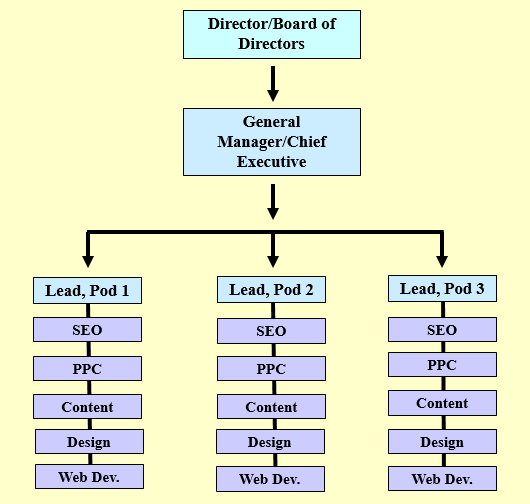
It’s built for agencies that value relationships and speed.
Imagine a Los Angeles creative agency managing 20 enterprise clients. They create pods of five people, including a strategist, designer, paid media manager, content lead, and account manager. Each pod handles two or three clients and meets daily. They plan, execute, report, and make decisions together.
From our experience, clients love this. They talk to one small, dedicated team that knows their brand inside out, with no email bouncing between departments or waiting days for creative approvals.
Everything moves faster because the decision-makers sit in the same virtual room.
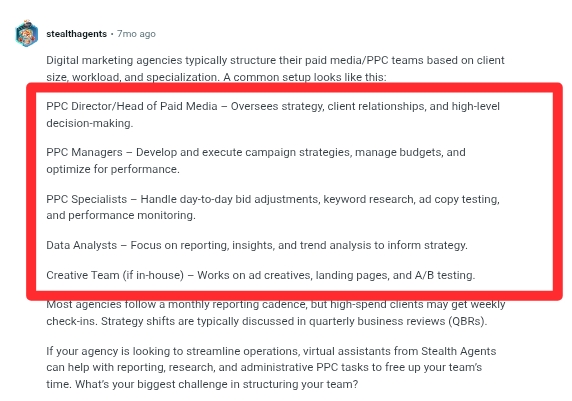
An agency marketer recently shared how their agency structured using this model under Stealth Agents. Their structure looked like this:
Source: Reddit
That’s the pod model in practice. It’s client-focused, flexible, and lean. This model keeps things moving without all that red tape and time-consuming knowledge transfers.
Why it works:
- One clear contact point for clients.
- Teams build deep, long-term client understanding.
- Faster approvals and stronger relationships.
When it may not work:
- Cost per client goes up.
- Skill depth can drop without proper cross-training.
- Workload balance becomes tricky when client demands fluctuate.
Pro tip: Start with one premium client or vertical and pilot the model. Measure average response time, turnaround speed, and satisfaction scores before scaling.
The Hybrid Model
Most modern agencies land here. It’s the “best of both worlds” setup. Departments still exist, but project pods pull from those departments for key accounts.
Maybe you run a digital agency with five core teams: SEO, PPC, Creative, Strategy, and Analytics. For large clients, they form pods made of one expert from each team.
For smaller accounts, they keep the traditional departmental flow. Everyone collaborates daily on Slack but reports to their department heads for approvals.
That’s a hybrid advertising agency structure in motion.
Why it works:
- Keeps departmental quality while enabling collaboration.
- Adapts easily as services grow.
- Spreads leadership across pods and departments.
Watch out for:
- Reporting confusion if people don’t know who their “real” boss is.
- Pods become isolated mini silos if communication stops.
Step 1: Assess Your Current Situation and Goals
Before changing your marketing agency structure, pause for a reality check. You can’t fix what you don’t understand. Every growing agency needs a clear picture of what’s working, what’s breaking, and where it’s heading.
That’s what this diagnostic step helps with.
Most agency founders skip it and go straight to redesigning their agency organization chart, adding new titles, or hiring more managers. But without understanding your current situation, you’ll end up with fancy job titles and the same chaos underneath.
Here’s how to properly audit your agency before any restructuring:
Get Honest About Your Pain Points
Start with the hard questions.
Are your account managers stretched too thin? Are projects constantly running late? Do clients complain about hearing three different answers from your team?
If you answer yes to most of these questions, that’s a sign of structural problems.
Team burnout, unclear ownership, and overlapping responsibilities usually mean your agency’s structure isn’t keeping up with your client load.
To get clarity, sit with your leadership team (after encouraging them to sit with their teams) and list out the top five recurring issues.
Review Your Goals Before You Rebuild
Your structure should match where you’re heading, not where you’ve been.
Ask yourself:
- What revenue target are we chasing in the next 12 months?
- How many clients can we realistically handle at our current capacity?
- Do we plan to add new services or verticals?
- Are we aiming for speed, specialization, or deeper client relationships?
If your goal is scale, you’ll need clearer departments. If your goal is creativity and agility, pods might be better. The right agency organizational chart supports those priorities, not fights them.
For example, a mid-sized agency doing $3M a year with 30 staff may want to grow to $5M without doubling headcount. That means tighter workflows, fewer bottlenecks, and clearer accountability. On the other hand, a boutique creative agency working with 10 big clients might aim for higher retainers, not more clients. They’d instead need flexibility and collaboration, not more hierarchy.
Verify Your Agency’s Maturity Level
Some agencies think they need an enterprise-style organizational chart, but they’re not ready yet.
- If your agency is under 15 people, skip the heavy structure. Focus on who owns client delivery, who manages projects, and who reviews results (sort of like a pod structure, but you all rotate your hats). That’s enough for a functional setup.
- Once you pass 25 staff, you need role clarity and reporting lines. Departments or pods become essential to keep things from collapsing.
- With 50+ staff, you’ll need department heads, project management layers, and reporting tools to keep everyone aligned.
Every agency has a “structure tipping point.” Recognize yours early.
Identify Ownership Gaps
Draw out your workflows and chances are, you’ll start spotting all the missing “owners.”
Who’s accountable for deliverables, not just assigned tasks?
Who’s responsible for profit margins? Who keeps an eye on client satisfaction?
In most agencies, three people own different parts of one job. That’s what kills accountability.
A strong company structure helps you fix that. Each key function (strategy, delivery, and relationships) should have a clear owner.
If your project managers are also writing copy, that should be corrected. If your creatives are answering client emails, you know where to start fixing the problems.
Align Culture with Structure
Culture matters more than most founders can ever realize.
If your agency thrives on creative freedom, don’t suddenly enforce strict departmental walls. You’ll suffocate innovation and risk losing what makes your work special.
If you run a performance-driven team focused on KPIs and automation, a pod model might slow you down.
Your agency hierarchy should mirror how your people naturally work.
Step 2: Choose and Align the Right Model
Now that you’ve got your audit, let’s find your match.
If you’re a small boutique, forget the hierarchy and go flat or pod-based.
Everyone should see how projects move from idea to execution. That keeps collaboration fast and ownership clear.
If you’re mid-sized, start blending. Use departments for skill depth and pods for complex clients.
If you’re large or scaling past 50 people, create a layered ad agency hierarchy with department heads and team leads. This keeps leadership focused on growth instead of daily fires.
Model Selection Matrix
Here’s a quick example matrix that can help you visualize a model that will be right for you.
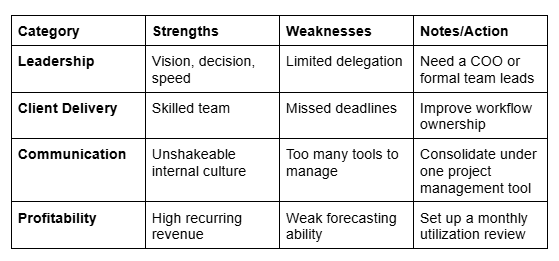
You’ll spot patterns instantly. Maybe your team’s strong, but leadership’s stretched. Maybe communication’s great, but project scope keeps ballooning.
This helps you narrow your direction before diving into workflows.
Don’t copy another agency’s playbook. Every marketing agency management structure evolves differently. What worked for another shop might choke yours. Instead, use your audit data. Build a structure that fixes your real problems and not someone else’s.
Step 3: Define Key Roles and Responsibilities
You can’t grow a serious agency when everyone’s wearing every hat. That works when you’re five people sitting in a coworking space. It doesn’t when you’re managing twelve retainers and running campaigns across three time zones.
So, before building out a marketing agency structure, you’ve got to define what each person owns and make it visible.
1. The Leadership Team: Strategy, Systems, and Sustainability
In an average mid-sized agency (30–70 staff), leadership usually includes a CEO, COO, and CFO, each covering specific value pillars.
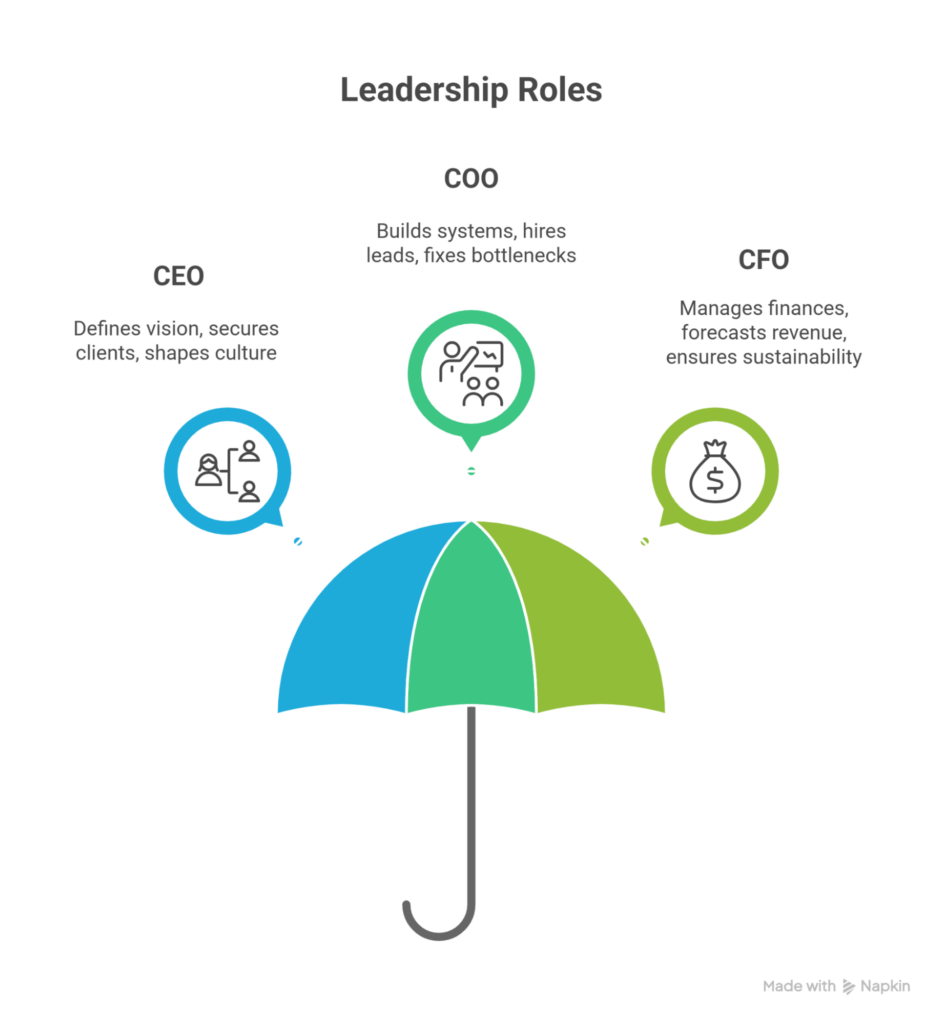
The CEO owns and defines the vision of the business. This leader brings in key accounts and shapes the agency’s culture. To the CEO, success often looks like keeping the client retention rate above 90% and consistently hitting the yearly growth target.
The COO builds repeatable systems, hires departmental leads, and fixes bottlenecks. Success here may look like an 85%+ on-time delivery rate and average project margins above 25%.
Lastly, the CFO is the one in charge of ensuring sustainable finances by managing budgets and revenue forecasting. Key indicators of performance here include keeping overall profit margin at or above 20% and utilization above 75%.
Maybe you have a consulting agency with 40 employees. But then you realize that creative and strategy teams were constantly clashing over priorities. By bringing in a COO with an operations background in SaaS, you may see project overruns drop and billable utilization go up significantly.
That’s what defined leadership gives you. Without that layer, your managers spend half their week firefighting.
Also Read: 10 Must Have Skills To Run A Successful Agency
2. Client-Facing Roles: The Relationship and Delivery Bridge
These roles sit at the front line of client experience. They manage promises, pressure, and performance. Beyond that, they must function as the medium between client and agency. You want to absolutely avoid bottlenecks like this:
Most agencies run this layer with one Account Manager per 4–6 clients, depending on complexity. Let’s break this down:
Account Manager / Director
- Runs point on client relationships.
- Aligns campaigns with business goals.
- Coordinates deliverables between departments.
- Success metric: 90% client retention.
Project Manager
- Oversees timelines, tools, and task delivery.
- Keeps departments accountable for deadlines.
- Works closely with the COO or department leads.
- Success metric: 95% on-time task completion, under 3% rework rate.
Client Success Manager
- Monitors post-project satisfaction.
- Tracks NPS (Net Promoter Score) and renewal probability.
- Flags churn risks early.
- Success metric: average NPS ≥ 8.5/10, renewal rate > 85%.
Here’s what this can look like in real life.
Let’s say we have a performance agency with each AM handling no more than five accounts. They use a structured workflow where PMs control the pipeline, AMs handle strategy and reporting, and CSMs own retention. That three-way balance can allow them to manage over 300 clients while keeping average retention by around 91%.
Also Read: 10 Ways to Improve Client Communication
Specialist and Execution Roles: The Experts That Drive ROI
This is your engine room, and without clearly defined specialists keeping it running, your delivery becomes reactive rather than consistent. Every successful ad agency structure assigns subject-matter owners for each service line.
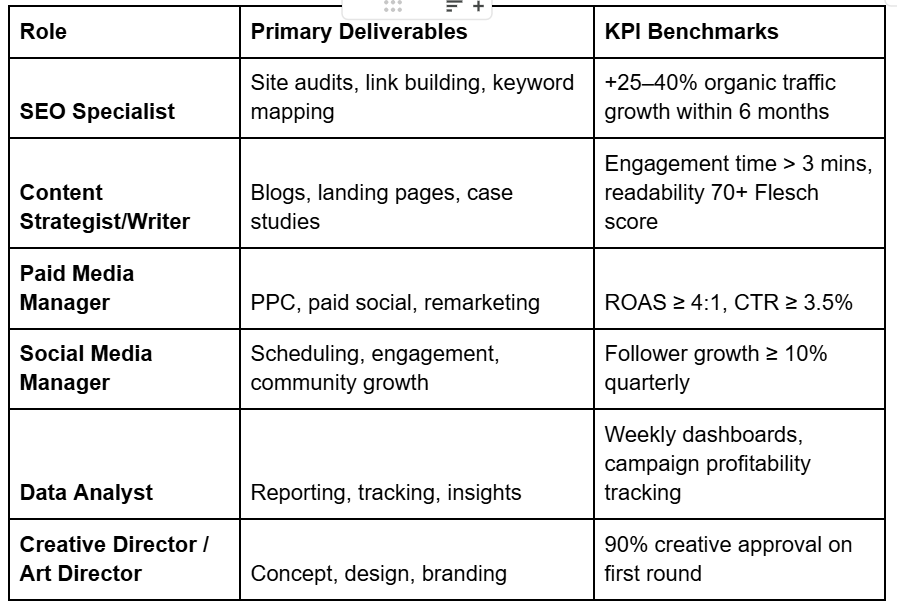
For instance, you may have one creative director managing 10 copywriters and 3 designers, plus sitting in every pitch meeting, and see campaign quality dropping. But once you hire a production head and split the load, you’ll see deadlines stop slipping.
3. Document the Structure
Once roles are defined, document them. Don’t assume “everyone knows.”
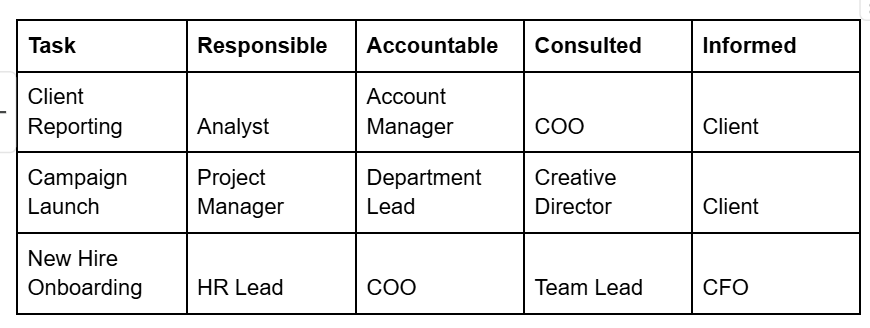
Use a RACI matrix (Responsible, Accountable, Consulted, Informed).

For example:
Step 4: Map Your Workflows and Communication Channels
Structure alone doesn’t fix your bottlenecks. How work moves through that structure does.
Your agency’s organization is static, and sort of like a mannequin. Your workflow is what breathes life into it, turning structure into motion and strategy into results.
Let’s walk through how leading agencies map their end-to-end processes.
1. The Core Agency Workflow
Whether you’re running SEO or full-service creative, your process follows the same lifecycle.
Client Onboarding > Strategy > Execution > Reporting > Renewal
Here’s what happens inside each stage in a high-performing setup:
Client Onboarding
Average duration: 7–14 days
- Create a client workspace on a tool like Synup, ClickUp, or Asana.
- Schedule a kickoff within 72 hours of contract signing.
- Deliver a “Client Starter Deck” explaining timelines and communication flow.
- Collect brand assets, logins, and approval workflows in one shared folder.
Agencies that complete onboarding quicker (usually within two weeks) usually enjoy higher retention and better productivity.
Learn More: 8-step Client Onboarding Process for Marketing Agencies (+ Checklist)
Strategy
Average duration: 2–3 weeks
- Account Manager and Strategy Lead define specific campaign KPIs and benchmarks in consultation with the client and their team.
- Example: “Grow organic traffic by 30% within 6 months,” “Reduce CPL by 20%.”
- The strategy deck should fit on one slide per objective; short, visual, and measurable.
Execution
Ongoing
- Each department owns delivery within its sprint cycle (usually 2 weeks).
- Daily updates on Teams/Slack; progress tracked on project management tools.
- Best practice: one PM handles up to 20 tasks per sprint to avoid overload.
- Automation: agencies using workflow automation tools reduce admin time by 18 hours per employee per month (Zapier, 2024).
Reporting
Frequency: Weekly (internal), Monthly (client)
- Analyst builds a report in Looker Studio.
- AM translates numbers into strategy insights.
- Average deck length: 10 slides max, sent within 48 hours of the month-end.
- Include the “next steps” section; don’t just dump data.
Renewal
- Renewal discussions begin 45–60 days before the contract ends.
- Include proof metrics, next-phase roadmap, and updated pricing.
- Clients renew when they see forward motion.
2. Identify the Gaps Between Stages
Most agencies lose efficiency in handoffs and knowledge transfers and not in execution. A lot of project delays come from poor transitions between teams. Here’s an example:
Client signs > AM briefs PM > PM briefs team leads > Department executes > Analyst reports > AM renews
If any handoff in this chain comes with a “we usually…” or shows gaps, your process isn’t clearly defined enough.
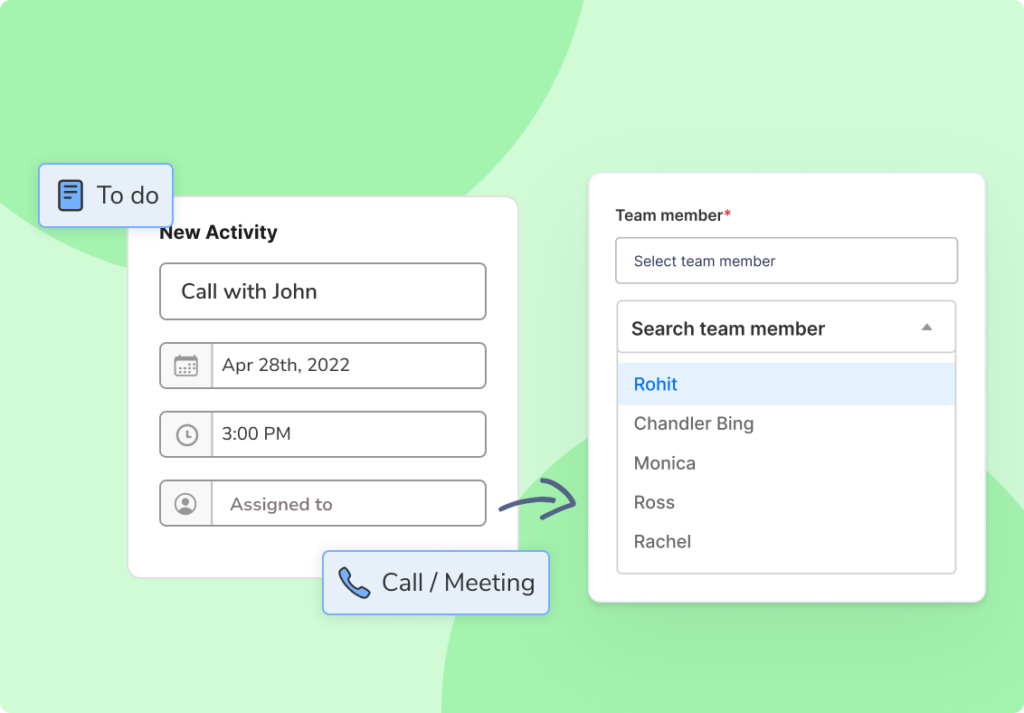
Let’s say you run a creative agency in Austin. When a project goes into revision, let’s say your designers aren’t usually notified. The project manager assumes the account managers are handling communication, while the account managers assume the PMs are taking care of it. At the end of all this, no one informs the design team, and each project ends up delayed by about three days. You can fix something like this by adding a “handoff notification” email/task to tools like Synup OS.
3. Communication Stack That Works
You don’t need ten tools. You need maybe three that everyone can use effectively.
Internal Tools:
- Slack (daily comms)
- ClickUp or Synup OS (tasks, dashboards)
- Google Drive (assets)
External Tools:
- CRM (HubSpot, Synup OS, or Pipedrive)
- Monthly reporting through Looker Studio
- Email for approvals only
Avoid WhatsApp or iMessage for client updates. It’s instant but destroys accountability.
You can also create predictable communication cadences. For example, a 15-minute weekly department standup (just with the core team), a bi-weekly client status call (where you can provide updates and receive feedback), and a strategy review meeting once a month.
4. Build SOPs That Save Time
Create a proper documentation of all repetitive processes, from onboarding to report delivery and approvals. Store them in Notion, Confluence, or Google Drive.
See here an example SOP template:
Process: Monthly SEO Report
Owner: Analyst
Deadline: 2nd business day of each month
Steps:
- Pull Google Analytics + GSC data
- Generate slides in Looker
- Send to AM for review
- AM sends to client with action notes
That one sheet eliminates back-and-forth emails later.
Step 5: Implement Your New Structure
When it’s time to bring what you’ve built to life, you have to remember that real evolution takes time, not just a couple of days (or even weeks).
Implementation cannot mean holding one staff meeting or drawing up a new org chart. It’s a gradual 6–12 month journey of communication, testing, and refinement that helps your team grow into the structure you’ve designed.
1. Announce the “Why,” Not the “What”
When you reveal the new structure, don’t start with titles. Start with pain points.
- “We’re doing this so our teams stop working overtime.”
- “We’re giving clearer ownership so clients stop waiting for answers.”
Also, update key clients early. Let them know who their new point of contact is and what’s changing in your reporting rhythm.
2. Choose the Right Rollout Strategy
Avoid the “big bang rollout,” i.e., reassigning everyone to new teams at the same time. It almost never works. Here’s a phased rollout that you’ll find more helpful instead:
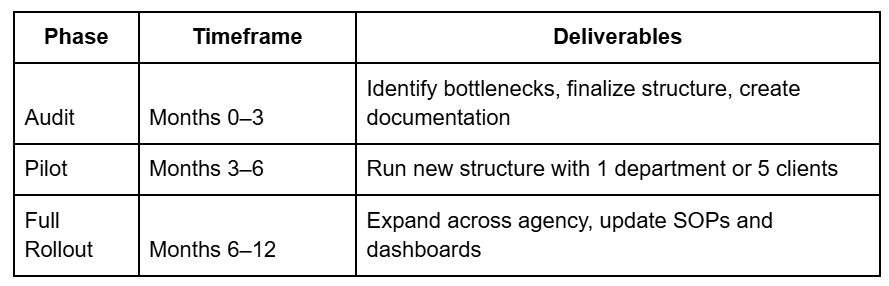
Here’s the point: pilot, learn, refine, and scale!
3. Get Your Team’s Buy-in
Never assume people will “figure it out” or forget to consider the insights of the people who’ll actually be operating within the structure. Host short workshops by department and rehash them during stand-ups. Walk through new processes, roles, and approval flows. Record everything and store it in your agency’s database.
Taking the full spectrum of opinions and insights means you start off on the right foot with the whole ‘building-the-right-structure-around-the-right-people’ endeavor.
But don’t just let those opinions simmer after you’ve heard them out. Make sure you act within a week. Fast fixes build trust in the process.
4. Appoint Change Champions
Encourage your leaders to coach the workforce through any administrative changes. Visible support from leadership helps make new initiatives feel approachable, but lasting change requires going deeper.
Help your leadership by appointing dedicated “change champions.” People often trust their peers more than executives. Nominate respected team members to act as internal advocates and give them the authority to suggest improvements and drive progress.
5. Measure the Wins
Within 90 days, track all impactful metrics. You can use the below as a guide.
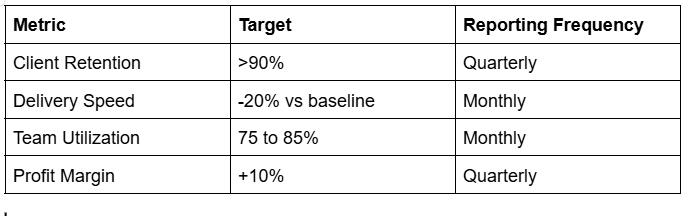
When those numbers move, celebrate them publicly. It reinforces the “why” behind the whole restructure.
Once your new agency structure is running smoothly, the next step is keeping it flexible because what works at 40 people will inadvertently start breaking at 80.
Step 6: Review & Optimize
A marketing agency’s structure should be built to move and grow. It’s not something you set once and forget. As your clients, services, and markets change, your structure should stretch and adapt to keep pace.
Agencies that make a habit of reviewing their structure grow faster and stay more profitable. But what does that process look like day to day?
Set a Review Cadence
Start with two checkpoints:
- Quarterly deep-dive: Assess what’s working, where projects slow down, and which roles feel overloaded.
- Annual structural refresh: Update your agency’s organizational chart to reflect team changes, new departments, or service pivots.
This cadence gives leadership a clear rhythm to spot inefficiencies before they become fires.
Look at the Right Metrics
You can’t optimize what you don’t measure. Every agency org. chart should link back to quantifiable KPIs that reflect both people and profit.
Here’s what top agencies track consistently:
- Billable utilization rate: 75–85% across billable teams is a good place to start. Below that, you’re underutilizing staff; above that, you’re risking burnout.
- Client satisfaction (NPS): Anything below 8/10 signals communication gaps or delivery inconsistencies.
- Client retention and renewal rate: You want at least 85%. Loyal clients cost five times less than new ones.
- Profit margin per project: Keep this at a minimum of 15% to maintain healthy growth. The average US digital agency operates at 15% net margin, while top-performing agencies reach 20%+ through better scoping and time tracking.
- Employee turnover: Anything above 15% per year suggests cultural or leadership misalignment.
- Average project delivery time: Track how long tasks take from brief to delivery and whether that matches client expectations.
These metrics tell you whether your agency hierarchy supports or strangles performance.
Build Lasting Feedback Loops
We talked about tracking short-term feedback, but to truly evolve, you need a system that supports continuous improvement.
Here are three simple feedback loops you can create:
- Team surveys: Ask your team where they feel stretched or blocked. Keep responses anonymous so everyone can speak openly.
- Client feedback: Send a short “project health” survey after every major milestone to understand how clients feel about communication, timelines, and outcomes. This helps you spot friction points before they escalate.
- Role fit reviews: Regularly check whether team members still feel aligned with their roles and responsibilities. You can do this through one-on-one conversations or short self-assessment forms.
Step 7: Best Practices for a Successful Structure
Maybe by now, you’ve built your org chart, defined the roles, and mapped how work flows from pitch to reporting. That’s a great start. But the real journey begins after that, when you put it all into motion and see how it works in practice.
Structure only matters if it actually makes your agency faster, more profitable, and easier to run on a bad day.
These are the practices that separate steady agencies from those that implode the moment work scales up.
1. Prioritize Profitability
A great structure isn’t about looking impressive on paper. It’s about making money efficiently.
Every reporting layer should justify its cost. Every meeting should serve a decision. If your structure adds complexity without improving speed or margin, it’s time to trim.
Let’s say as a 30-person agency in Atlanta, you route every campaign through three layers: Creative, Account, and then Strategy. Sure, it makes you “look professional,” but it can cost you up to 40 hours a week in approvals. Switching to pods is more efficient. Have each pod led by one Account Director, with autonomy over creative sign-offs.
Also Learn: How to Scale Your Agency Without Increasing Costs + Downloadable Template
2. Keep Clients at the Core
Even the most sophisticated agency structure is worthless if it makes clients feel ignored.
Your structure should make it easy for clients to reach decision-makers, not bury them under layers of process. Every communication touchpoint (from kickoff to reporting) should be fast and responsive.
Avoid silos. Encourage shared client understanding between departments. In a creative agency structure, designers, writers, and analysts should all know the client’s goals, not just the Account Manager.
- Audit your response times. Clients should never wait more than 24 hours for a reply.
- Limit how many people talk to a single client. Too many voices lead to confusion.
- Hold monthly client retros to review wins, misses, and what’s next.
3. Empower Your Team
Micromanagement is the silent killer of agency growth.
Your team can’t take ownership if they need permission for everything.
So, define decision boundaries clearly. For instance, Account Managers should have the authority to approve campaign budgets under a certain threshold without executive sign-off. That autonomy speeds up workflow and increases ownership.
Also, encourage collaboration, but make sure every task has one accountable owner.
4. Build Career Pathways
Your team shouldn’t feel stuck in one box forever. Clear progression keeps top talent loyal.
Set visible ladders (from Junior Designer to Senior Designer to Art Director) with defined milestones.
In smaller setups, offer skill-based growth instead of title changes. For example, a Content Specialist might evolve into a Conversion Copy Lead through certifications or mentorships.
5. Keep Overhead Lean
Too many managers slow down execution and inflate costs. A smart digital agency organizational structure keeps leadership focused on strategy while team leads handle delivery.
Rule of thumb: one manager per 6–8 direct reports is ideal. Any fewer, and you’re bloated. Any more, and you lose oversight.
6. Maintain Org. Literacy and Documentation
Everyone in your team should understand your agency’s organizational structure and where they fit in. New hires should get a 1-page “org explainer” showing reporting lines, workflows, and responsibilities.
Document your processes in Notion or Confluence. Keep it updated. When people know how the system works, they spend less time figuring out who to ask and more time doing.
7. Leverage Technology to Support the Structure
Don’t let tools drive your process. Let your structure choose your tools.
If you run a mid-sized agency in Phoenix, switching from five tools to one central project system like the Synup Sales and Account Management system can significantly improve the process.
You don’t necessarily need a different tool for budgeting, another for tasks, and another for campaign reporting.
Tips:
- Use one source of truth for data. Stop duplicating info across apps.
- Choose tools that scale, not the sophisticated ones.
- Revisit tool costs every 6 months; redundancy kills margins.
Use This Checklist for Success
- Is your org chart clear and accessible?
- Are all roles documented with KPIs?
- Are workflows mapped from brief to delivery?
- Are communication channels standardized?
- Are you tracking profitability and efficiency KPIs?
- Are you revisiting structure annually?
If you can check all six, your structure is ready for scale.
Watch: How To Start A Digital Marketing Agency in 2025 (Step by Step)
Conclusion & Next Steps
A thriving agency doesn’t only rely on talent but also on a clear, efficient structure that supports growth.
This 7-step blueprint gives you the roadmap, from diagnosing your current setup to refining it through reviews and best practices.
We recommend:
- Hosting a workshop with your leadership team using Step 1’s diagnostic framework.
- Committing to a review cadence and assign ownership of your structure optimization.
Build, rebuild, adapt, and grow. The structure you refine today becomes the foundation for tomorrow’s success.
FAQs
1. What’s the best structure for a marketing agency to scale?
Once you hit around 15–20 people, a hybrid setup usually works best. It mixes the focus of departments with the speed of client pods. Each pod handles day-to-day delivery while departments keep training, hiring, and quality on track. The key is clarity. Everyone should know who they report to and who signs off on what. Review your setup every few months because what worked when you had 10 people will not when you hit 30.
2. How many departments should a creative or ad agency have?
Most growing agencies start with five pillars: strategy, creative, media, account management, and analytics. But if your team’s still small, combine functions till the workload forces a split. For example, one strategist can cover both content and SEO until you have more than 10 clients. Build departments when the pressure shows, not because an org chart says so.
3. Can a hybrid agency model work for small agencies?
Yes! Even a 10-person shop can use hybrid principles. Create small pods with a strategist, designer, copywriter, and ads person. Everyone owns a handful of clients together. Keep department leads for coaching and consistency, but let pods make day-to-day calls. It’s not about size but flow. When everyone knows their role and talks daily, things move faster, and clients stay happier.