Top 8 Local SEO Updates You Should Know About in 2026


The local SEO game never sleeps. You’re dealing with the core of your clients’ cash flow, and every time Google makes a move, it can change everything. 2026 is the year the AI engine fully takes over the driver’s seat in local discovery.
For agency owners and strategists, staying ahead of this is the only way to hold on to that client roster and keep scaling those per-location service packages. The major themes we’re seeing now are: AI-driven user experience and a painful but necessary focus on data integrity.
We’ll break down the eight most crucial local SEO updates and Google local search trends that demand immediate action in your agency workflows.
TLDR: The Top 8 Local SEO Updates You Should Know About in 2026
- AI Overhaul (Gemini): Google Maps now uses Gemini AI for conversational discovery and landmark-based navigation, requiring agencies to ensure all GBP attributes and content are highly accurate to feed the hyper-contextual AI.
- Operational Efficiency: Google added native multi-location scheduling for Posts in GBP, a major operational feature that simplifies brand consistency for chains and frees up agency hours.
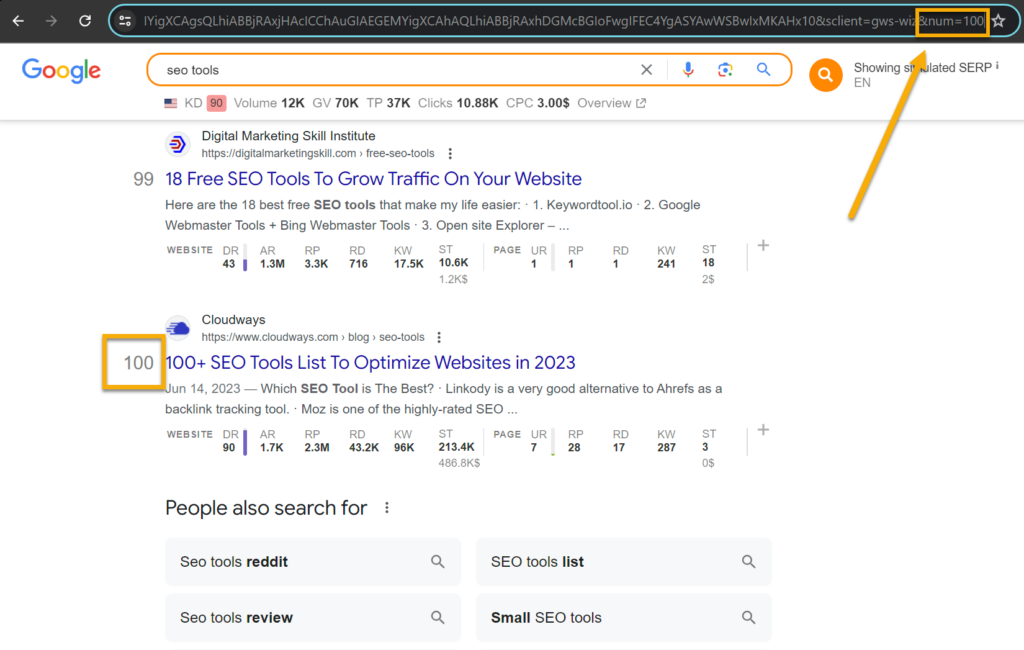
- Data Correction: Disabling the &num=100 parameter ended bot-driven impressions, resulting in GSC impression drops (40-70%) and a required reset of client reporting baselines.
- Reputation Risk: Anonymous reviewer nicknames reduce accountability, increasing the risk of review extortion scams. Agencies must adopt strict, objective review response protocols.
- Review Recency: Industry data confirms that the recency and cadence of new reviews (e.g., 5-10 per month) are now heavier local ranking signals than overall review volume.
- Q&A Death: Google has phased out the Q&A feature, forcing agencies to migrate that content to the client’s website and apply FAQ Schema to maintain data visibility with the AI.
- Anti-Extortion Tool: Google introduced a dedicated Merchant Extortion Report Form, requiring agencies to follow a strict protocol of gathering proof and never paying the scammers.
- AI Mode: The entire local discovery process begins with AI Overviews, making foundational SEO (Schema, NAP, clean data) the non-negotiable fuel for modern AI-driven ranking.
1. The &num=100 Search Parameter is Disabled
Source: BloggerJet
This might sound like a technical, inside-baseball change for the developers. But it’s sent a shockwave through agency reporting, especially if you rely on Google Search Console (GSC) data.
In September 2025, Google officially killed the &num=100 parameter. Historically, this feature has allowed third-party tools and scrapers to pull the top 100 search results in one go. The sneaky part, however, is that every time a tool checked for a ranking at position #95, GSC registered an “impression,” even though no real user ever scrolled past the first page.
That was bot-driven vanity data.
The Agency Impact
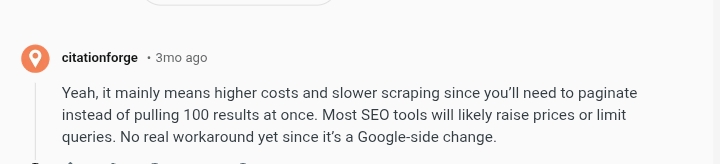
Now, this is what it means:
Source: Reddit
And that’s not all…
This seemingly small change caused a massive data correction across the board:
- Inflated Impression Reality is Over: Many GSC properties saw reported impressions drop by 40% to 70% overnight.

Source: Google
77% of sites lost keyword visibility. Your client who bragged about 10,000 monthly impressions was likely only getting 4,000 real views. The rest was scraper noise. You need to frame this correctly: the drop isn’t a penalty; it’s Google finally cleaning out the garbage from the metrics.
- Average Position Lies: Since phantom impressions from deep, irrelevant positions disappeared, your average position may have actually mathematically improved. Besides that, though, you need to manage client expectations. This is a statistical cleanup and not proof of ranking gains.
- The Cost of Deep Tracking: Your rank-tracking tool now has to make 10 separate requests to retrieve the old 100 results, which seriously spikes the cost of data retrieval. Many agencies are responding by cutting competitive analysis to the top 20 rankings to keep their “tool stack” budget manageable.
2. Google Posts Finally Gets Multi-Location Scheduling and Publishing
If you manage a multi-location brand, you know the intense, time-wasting pain of manually publishing Google Posts. Logging into ten or fifteen profiles just to post a holiday schedule?
Well, that operational bottleneck is finally gone.
Google has officially launched native scheduling and multi-location publishing functionality for Google Posts (Updates, Offers, Events) directly within the GBP management dashboard.
Source: GBP
This feature was previously restricted to advanced, expensive third-party APIs and was newly launched in November.
This is a massive operational win that directly impacts your profit margins by freeing up valuable time:
- Workflow Simplification: An account manager previously spending 30 minutes publishing a single promotional post across 15 locations can now do it in five minutes. If they run 10 such campaigns monthly, that’s 7.5 hours per client saved.
- Seasonal Campaigns: This is especially critical for retail and hospitality clients. You can now pre-schedule 50 separate posts (e.g., “Holiday Hours,” “End-of-Season Sale”) across a 25-location franchise network in a single afternoon.
- Consistency Assurance: This eliminates the risk of human error where different staff members post slightly different messaging. On top of that, it ensures instant brand compliance across all profiles, which is a big deal for regulated industries like finance or healthcare.
- Actionable Step: Pull up your account managers’ last week of time logs. Calculate the efficiency gain from this feature and assign the freed-up hours directly to Reputation Management tasks, which feed the critical AI trust signals we’ll discuss in the next sections.
3. Google Maps Gets a Major AI Overhaul with Gemini Integration
Forget algorithm updates; the biggest local SEO update is the transformation of Google Maps itself.
In November 2025, Google successfully integrated Gemini for hands-free AI assistance. All you need to do is ask.
The integration of Google’s flagship AI, Gemini, fundamentally changes how users discover, navigate, and interact with your clients.
That now means Google Maps is morphing into a truly conversational, hyper-contextual platform:
- Conversational Discovery: Users can ask complex, multi-layered queries while driving, like, “Hey Gemini, find me an affordable, family-friendly Italian restaurant with outdoor seating that has a 4.5-star rating near the next toonie machine.” Gemini processes the multiple variables (affordability, cuisine, features, rating, proximity) instantly.
- Landmark-Based Navigation: The AI uses Street View data and popular spots to give guidance based on visual anchors (“Take a left after the red gas station,” instead of “Turn left onto Elm Street”). This means the specific name and location of even small businesses are critical for navigation.
- AI Lens Q&A: Users can tap a map pin and ask questions like, “What is the vibe inside this bar and why is it popular?” Gemini instantly provides a summary based on reviews, photos, and public descriptions.
Impact for Your Agency
The conversational AI shifts the focus from simple keyword matching (e.g., “plumber”) to contextual relevance and trust signals.
- Content is Context: If your client is a “bakery,” but Gemini also sees hundreds of reviews mentioning their “great birthday cakes,” “strong coffee,” and “fast WiFi,” it will recommend them for searches like “quiet spot with strong coffee to do work.” Use this insight to your advantage by playing into the prevailing public opinion.
- Attribute Accuracy: Your agency’s job is now to ensure every single GBP attribute is filled out and accurate. Attributes like ‘Gender-neutral restroom,’ ‘Good for groups,’ or ‘Free Wi-Fi’ are directly weighted by Gemini to answer complex, multi-variable queries. In addition, these attributes must be validated by user feedback to hold weight.
4. Businesses Facing Negative Review Extortion Scams: Stronger Reporting
The silver lining to the rise of fake reviews and review anonymity is that Google has finally given agencies a direct, functional tool to report malicious behavior. Review extortion (where a scammer demands money, crypto, or gift cards to remove a negative review) is now handled via a dedicated workflow.
The Feature Shift
Google created a dedicated Merchant Extortion Report Form that guides users through collecting the specific, high-quality evidence that its internal teams require for action. This is the only path that bypasses general, often ineffective, support channels.
How to Protect Your Business: The Agency Protocol
If a client receives a threat, your agency’s protocol must be immediate and disciplined:
- Do Not Engage or Pay: This is critical. Engaging encourages further attempts. Never try to resolve it by offering money or services. It guarantees that the scammer will come back later.
- Gather Evidence Immediately: You need proof that connects the threat to the reviews.
- Screenshots: Clear screenshots of the extortion attempt (emails, WhatsApp, Telegram, or social media DMs). Ensure the date, time, and sender’s contact info are visible.
- Review Links: Collect direct, permanent links to all suspicious reviews involved in the extortion attempt.
- Contextual Details: Document the date the first bad review appeared, the number of suspicious reviews, and the exact demand made (e.g., “$500 in Bitcoin”).
- Report the Scam: Submit the full package of evidence via the official Merchant Extortion Report Form.
Also Read: Negative Review Scams: How to Protect Your Business
5. The Rise of Anonymous Reviews (Reviewer Nicknames)
Google is now allowing reviewers to use chosen nicknames and profile pictures instead of their real names.
This grants users a layer of privacy, making it nearly impossible for a business owner to identify a customer outside of the platform. Unfortunately, this is setting up a huge headache for your reputation management teams.
Will Negative Review Scams Get Worse?
The use of a real name was the last major psychological deterrent against malicious or fake reviews. That’s now gone.
- Reduced Accountability: An anonymous nickname allows bad actors (competitors, disgruntled former staff, or general trolls) to attack your clients without fear of repercussion or identification. This is a gift to the spammers.
- The Client Headache: Your clients will inevitably question the legitimacy of every single negative review. Also, your agency must immediately implement a stricter, more professional, and less defensive review response policy. The old rule stands: assume every negative review is permanent, and your response is for the future 1,000 customers who read it, not the reviewer themselves.
- Actionable Step: Educate your clients immediately. Your public response must be objective, polite, and focused on resolution, proving your professionalism to the vast majority of users who are just reading the thread.
6. Google Business Profile Q&A Feature is Officially Disabled
The familiar Google Q&A feature is officially dead.
The programmatic access (API) was discontinued on November 3, 2025, signaling a complete phase-out of the public-facing feature.
Google is making a strategic move here. The Q&A feature was often a source of outdated or unmoderated data, i.e., a customer asking about 2018 prices. That kind of information is toxic to an AI model’s reliability. Google is clearing the slate, forcing the shift toward AI-generated answers powered by verified, structured business information (the Gemini integration).
What Agencies Must Do Next: Your 3-Step Plan
The customer questions aren’t going away. They’re just being answered by AI pulling data from your clients’ sources.
- Export Your Old Q&A Content: Before the feature completely disappears, export and save your best and most common Q&As. These are invaluable, real-world insights into what customers actually want to know. Not just that, they are great content ideas for your blog.
- Use Structured Data (FAQ Schema): Repurpose your exported Q&A content into dedicated FAQ pages on your client’s website. Then, add FAQ schema markup to those pages. This special code tags your questions and answers, telling Google’s AI exactly what verified information to use when generating answers in Maps and search snippets.
- Ensure Consistent Data Everywhere: The AI pulls information from across the system. Make sure your Google Business Profile (hours, services, amenities), your website content, and your online listings are all perfectly accurate and consistent. Missing information means missing signals for the AI, which can lead it to pull generic, incorrect data from a less trustworthy source.
- Finally, ensure your foundational data is consistent across all platforms to feed the AI correctly. Learn more about reliable white-label local SEO tools for presence management.
7. Review Recency Seems to Matter More Than Ever
While Google will never officially confirm it, extensive industry case studies and testing strongly suggest that review recency has become a much stronger ranking signal, especially since the Vicinity algorithm update. This is a critical factor for local pack performance. Industry research has provided striking, measurable evidence:
- The Discovery: According to a case study carried out by Joy Hawkins, a client with stable rankings suddenly saw them drop for a couple of weeks. The only variable was that they had stopped their internal staff incentive program for generating new customer reviews, causing their new review count to flatline.
- The Test: When the client restarted the staff incentive program (where staff mentioned in a review were entered into a weekly lottery), new reviews started flowing in consistently. As a result, their local rankings significantly improved, shifting their geo-grid from poor visibility back to high saturation.
- The Pattern: This pattern has been repeated: Google views a steady stream of reviews (e.g., 5–10 new reviews per month for an SMB) as a strong signal of an active, responsive, and relevant business. It’s a trust factor that outperforms a huge number of old, stale reviews.
The takeaway is that you must prioritize review generation equally with review response.
- Actionable Step: Build “review cadence” into every client strategy. You must aim for a consistent flow (e.g., 5–10 new reviews per month) rather than sporadic bursts. This means integrating automated review requests into the point-of-sale or service-completion process.
- The Competitive Edge: If your client is in a competitive market where rivals get 20+ reviews a week, you need to match that velocity to maintain ranking strength. Plus, emphasize the value of that user-generated content for feeding the AI’s contextual understanding.
8. How AI Mode is Shaping Discovery for Small Local Businesses
The rise of generative AI search (AI Overviews, AI Mode) is now the first layer of discovery. For small local businesses, this creates both risk and opportunity, redefining what “ranking” means.
When a user asks Google a question that has a local intent (e.g., “Where is the best place to get artisanal bread near me?”), AI Mode will synthesize an answer.
- The Confidence Game: The AI is engineered to give a confident, concise answer. It relies on the most authoritative, consistent, and structured data it can find. If your client’s data is messy, the AI will ignore them in favor of a competitor with cleaner data.
- The SEO Bridge: AI Mode relies on underlying search signals. If your client’s site isn’t optimized, the AI cannot confidently pull information from it, and you risk being invisible. Not just that, the fundamentals of SEO strategy are now the essential fuel for the AI engine.
The Agency Strategy: The Fundamentals Feed the Future
Your agency must ensure every client meets the minimum threshold for data quality across a few pillars:
Providing comprehensive SEO services, including schema implementation, is now crucial for feeding the AI.
Conclusion
The theme of the latest local SEO changes for 2026 is data integrity and AI readiness. Your agency’s success depends on adapting to these local SEO trends immediately. From the death of the Q&A feature to the critical importance of Review Recency and the challenge posed by Gemini AI, every change points toward the need for meticulous data management and a focus on generating constant, authentic customer feedback. Focus on structured data and consistent presence, and your clients will continue to dominate the local SERPs.
FAQs
1. How will Gemini integration impact local SEO?
AI and Gemini integration are shifting local SEO away from simple keyword matching toward contextual relevance and data accuracy. Businesses that maintain complete, consistent Google Business Profile data, structured schema, and strong review signals are more likely to be used by AI-driven local discovery.
2. Why did impressions drop in Google Search Console after recent local SEO updates?
Impression drops often result from Google cleaning up bot-driven and low-quality data, especially after disabling deep result scraping. While this can be scary at first, it usually reflects more accurate reporting rather than a loss in actual visibility or rankings.