

There’s a moment every growing agency hits (usually somewhere between 20 and 40 clients) where things that used to happen naturally start falling through the cracks. The organic attentiveness that made clients love you at 10 accounts (the quick responses, the proactive updates, the sense that you genuinely knew their business) gradually stopped scaling with the headcount.
The average annual client churn rate for marketing agencies sits between 15–25%, meaning agencies lose roughly 1 in 4 to 1 in 6 clients every year. A chunk of that is performance-related. But a significant portion is engagement-related: clients who drifted, felt underserved, or simply stopped seeing the value clearly enough to justify renewal.
The agencies that retain clients are the ones that run better systems. That’s because client engagement at scale requires structure, not just effort. This article covers what that structure actually looks like across four specific areas.
- Engagement doesn’t scale naturally. It needs systems.
- Consistent reporting and proactive updates improve retention.
- Silent disengagement is the biggest early warning sign.
Why Client Engagement Breaks Down at Scale
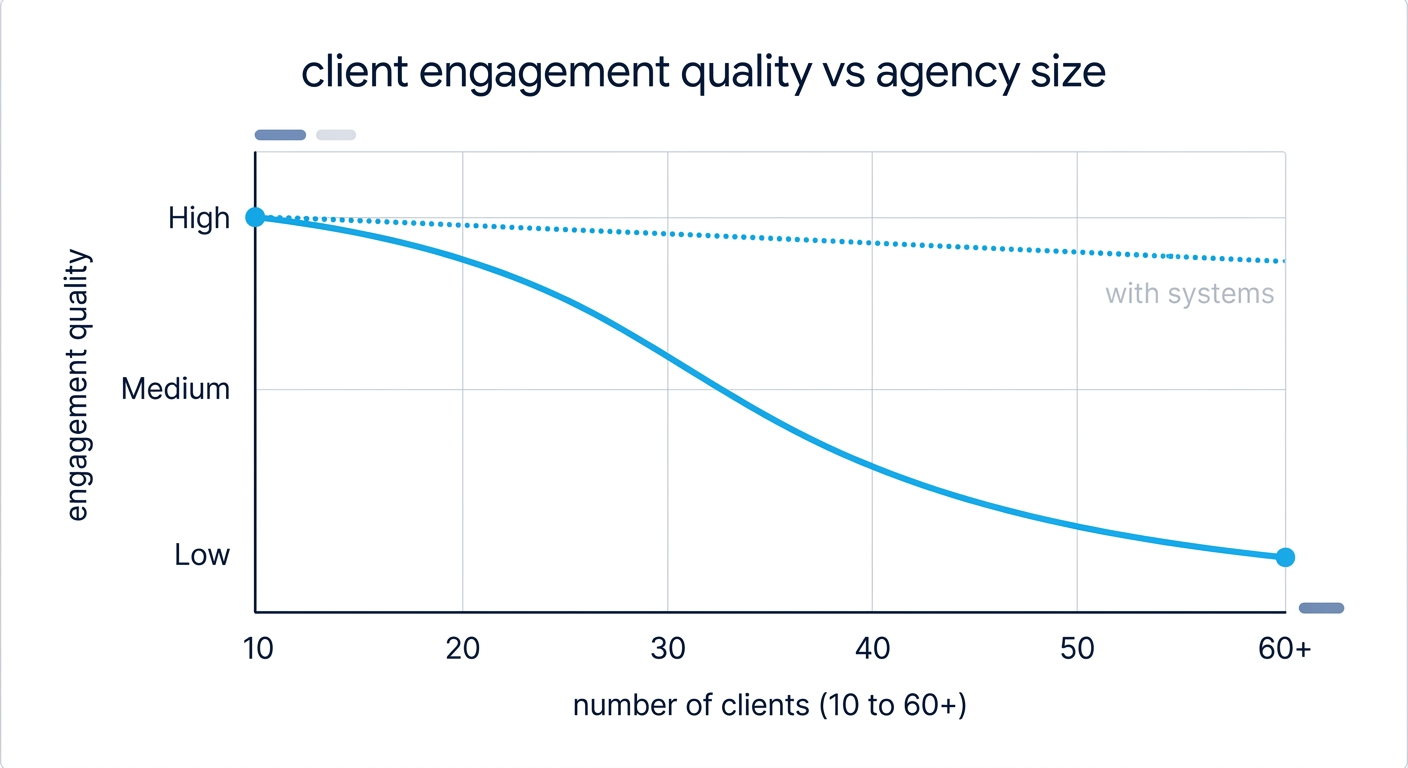

Naming the real causes matters because “we got too busy” isn’t a diagnosis. The structural reasons are more specific and more fixable:
- The boutique trap: Small agencies build client loyalty through personal attention from senior people. As you grow, day-to-day account management sometimes gets handed off to junior staff who don’t have the same context or relationship equity. Clients who were used to the founder’s involvement feel the shift.
- No single source of truth: At 40 clients, information lives across multiple tools, different inboxes, and several team members. A client asks a reasonable question, and it takes 48 hours to find the answer. That’s an organizational signal that says we don’t have our act together on your account.
- Reactive-only communication: Agencies that only reach out with good news or a problem that needs solving train clients to feel a low-grade anxiety in the silence between touchpoints. Every unanswered question and quiet week is interpreted as a gap.
- The silent churn signal: This one is the most dangerous because it’s invisible until it’s too late. Disengaged clients don’t typically complain before they leave. They reduce responsiveness, start skipping calls, and stop opening reports. The formal cancellation email is almost never the first sign of trouble. It’s the last one.
Systematize Onboarding Before You Scale It
If you want to know where most agency-client relationships go wrong, look at the first 30 days.
Onboarding is the highest-leverage engagement investment in the entire client lifecycle. It’s where expectations get set. Unmanaged expectations are the root cause of most friction that comes later.
- The practical starting point is what some agencies call a Communication Charter: a documented agreement established in week 1 that covers preferred communication channels, the primary decision-maker on the client side, the approval hierarchy for deliverables, meeting cadence preferences, and response time expectations on both sides. This sounds administrative. But it’s the kind of administration that prevents the 11 pm “why didn’t you tell me?” message 3 months from now.
- Equally important is to tell clients exactly what they’ll see and when. Monthly report on the 1st, biweekly check-in every other Thursday, and performance alerts if any key metric drops below a defined threshold. Clients who know the communication rhythm don’t panic in the silence between touchpoints. They’re not waiting to hear from you because they know when they will.
- However, the most common onboarding failure at scale is inconsistency. When each account manager onboards differently (some thorough, some rushed), the client experience becomes dependent on who gets assigned to the account. A templated onboarding checklist that every account follows, regardless of who’s managing it, removes that variability. It also means you can onboard a new account manager in days instead of weeks because the process is documented rather than tribal.
Check Out: 8-Step Client Onboarding Process for Marketing Agencies (+ Checklist)
Build a Reporting Rhythm That Does the Relationship Work
Here’s a framing shift that changes how high-performing agencies think about reporting: the monthly report isn’t an administrative obligation; it’s a primary relationship touchpoint. For most retainer clients, it’s the most substantive contact they have with your agency each month. Treating it as a data dump is a missed opportunity.
The tiered cadence that works at scale looks roughly like this:
- Weekly pulse (3–5 bullets, async, just the key movements)
- Biweekly working session (decisions and near-term tactics)
- Monthly strategic report (KPIs, narrative context, 30-60-90 roadmap)
- Quarterly business review (executive alignment, contract health check)
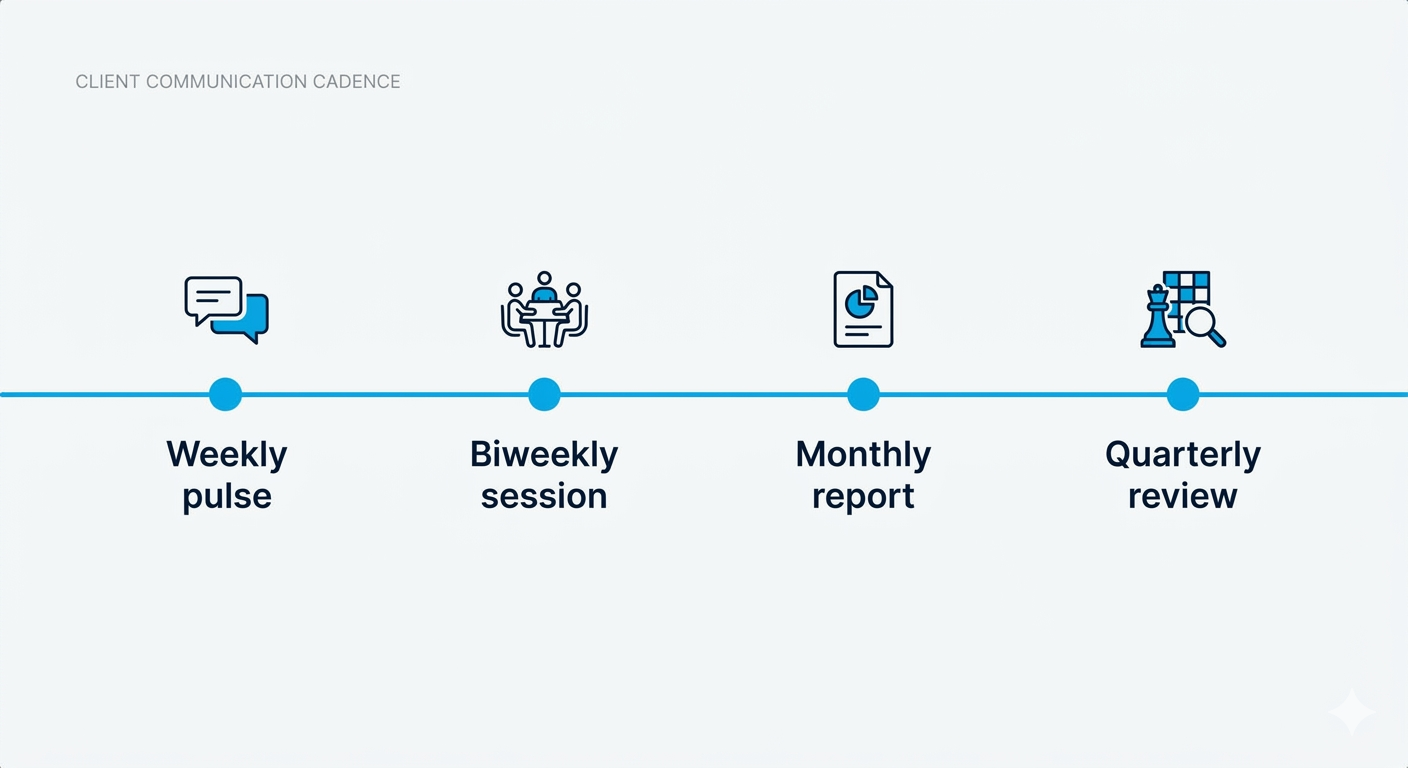
Not every client needs every layer. That’s a judgment call. But the framework prevents the common failure of only communicating when something goes wrong.
What separates useful reports from forgettable ones is narrative. The most common mistake is sending a PDF of metrics without any explanation of what changed, why it changed, what the agency is doing about it, and what the client should expect next month. Clients who understand the “why” behind a slow month are far more tolerant of that slow month. Clients who just see a dip in the numbers without context make their own interpretations, and those interpretations are rarely generous.
Two practices that consistently improve report engagement:
- End every report with the next 30 days of planned activity. Clients feel more engaged when they can see what’s coming, not just what happened. It repositions the agency as forward-looking rather than retrospective.
- Give clients access to a live performance dashboard between formal report dates. A real-time dashboard makes updates visible without requiring an account manager to field status-check calls. It also signals transparency, which is itself a retention lever.
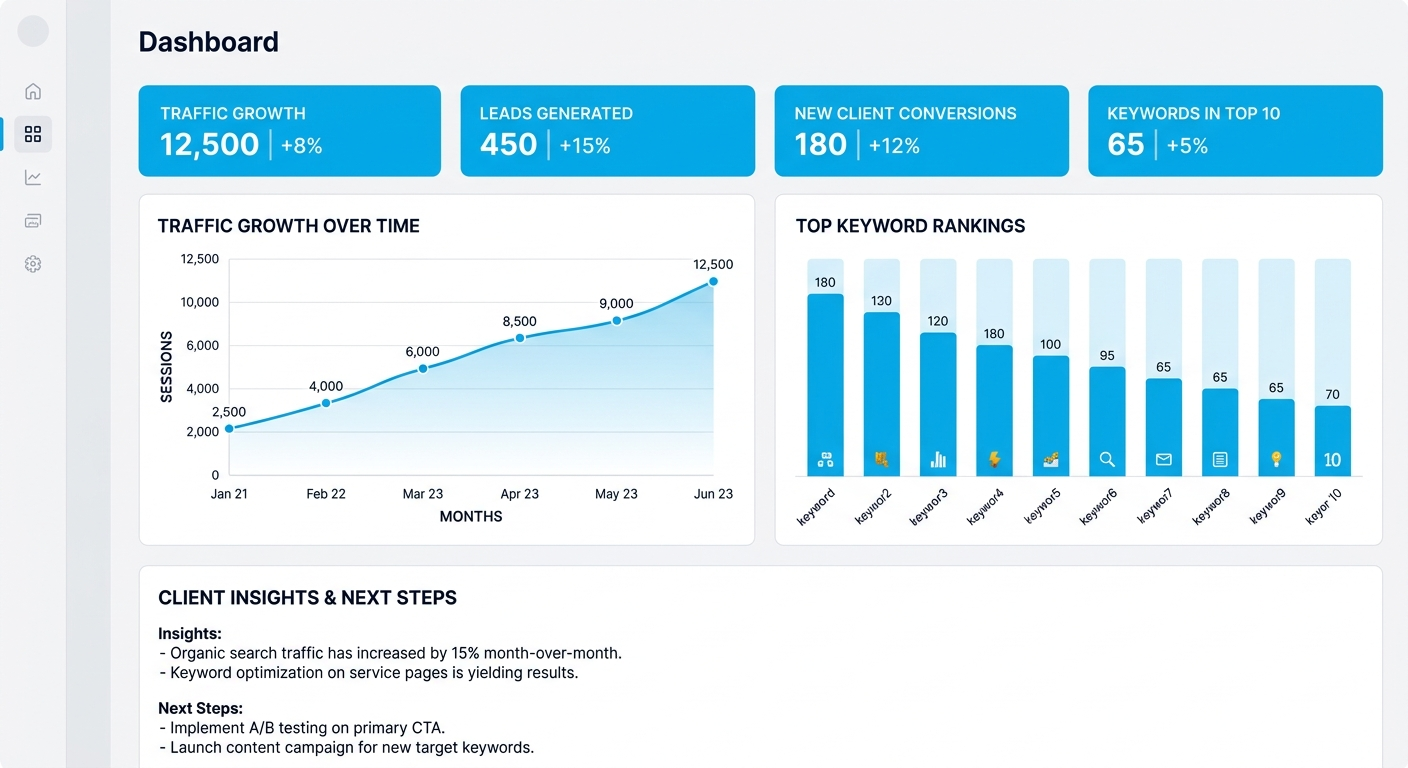
For agencies doing this across 30, 50, or more client locations, client reporting has to be systematized. At that scale, automated report delivery frees up 8–10 hours of account management time per client per month.
Proactive Communication Is the Churn Antidote
One principle, applied consistently, does more to prevent client churn than almost anything else: when performance drops, you communicate first before they ask.
An agency that surfaces a problem proactively, with a diagnosis and an action plan already attached, builds more trust than one that waits for the client’s email asking what happened.
The execution requires triggers rather than memory. If a key metric drops below a defined threshold, the account manager should get an internal alert before the client sees the data. Within 24 hours, a proactive update goes to the client. This is simple to build in most client management platforms; it’s just rarely done because agencies haven’t codified “communicate proactively” into an actual workflow.
Also Read: How to Manage Client Expectations During Algorithm Changes
Watch for the disengagement signals too before they become resignation. A client who misses two check-in calls in a row, stops opening monthly reports, or starts responding with one-line answers where they used to write paragraphs. These are the early indicators. Proactive support (outreach before an issue escalates) reduces churn among customers who have experienced a problem.
The positive flip side is equally worth building in: celebrate small wins explicitly and visibly. A quick message when a KPI improves, a ranking jumps, or a campaign outperforms targets keeps the relationship warm between formal touchpoints. Clients who only hear from their agency about problems, or only during scheduled reviews, develop a subconscious association between the agency and bad news. Don’t let that happen.
The Systems That Make This Scalable
Every engagement practice described above breaks down at 50 clients if it depends on the individual account manager’s memory and judgment rather than a repeatable system.
The operational requirements are relatively straightforward:
- Centralized client data: All client information, performance metrics, communication history, and deliverables should be in one place rather than scattered across individual inboxes, separate spreadsheets, and disconnected platforms. When a client asks a question, the answer should take minutes to find, not a day of internal emails. For a practical look, check out our guide on managing client data at scale with Synup OS.
- Templated communication at every touchpoint: Onboarding emails, weekly pulses, performance alerts, monthly report narratives, and quarterly review agendas should all be templated and adjustable instead of getting built from scratch per client. Account managers can then add value from their judgment.
- Account health scoring: A simple internal metric that flags at-risk accounts based on engagement signals (report open rate, call attendance, response time trends, recent NPS score) gives team leads the visibility to intervene before silent churn becomes actual churn. This doesn’t require a sophisticated tool to start; a basic scoring model in a shared CRM does the job.
- Automated report delivery: Monthly reports that generate and deliver automatically eliminate the biggest time tax on account management at scale. Keep an eye on important client metrics to track each month to make sure automated reports are surfacing what actually matters for retention.
Conclusion
Clear communication and transparency are the top strategies for retaining clients. The agencies that grow past 30, 40, or 50 clients without burning through their base are the ones that replaced organic attentiveness with systematic engagement.
The communication charter, the tiered reporting cadence, the proactive alert workflow, and the account health score – none of these is complicated. But they compound. A client who has been consistently informed, proactively updated, and genuinely heard out for two years doesn’t cancel. They expand.
FAQs
- What are the early signs a client is about to churn?
The early signs that a client is about to churn include missed calls, lower response rates, and reduced engagement with reports or updates. These changes often indicate declining interest or satisfaction and should be addressed quickly.
- How often should agencies communicate with clients?
Agencies should communicate with clients through a mix of weekly updates, monthly reports, and quarterly reviews. This balanced approach ensures consistent engagement, keeps clients informed, and builds stronger relationships over time.
- How do agencies manage client communication at scale?
Agencies can manage client communication at scale by using centralized data, templates, dashboards, and automated reporting systems. These tools help streamline processes, maintain consistency, and ensure timely communication across multiple clients.


