



Managing an agency for small and medium-sized businesses brings unpredictable spikes in workload. There will be weeks when your dashboards fill up, tasks stack, and you’re forced to prioritize on the fly.
Leads are pouring in, your team is slammed with inquiries, and the client is frustrated because conversions aren’t happening. Amidst all that, you’re burning through thousands of marketing dollars with nothing to show for it.
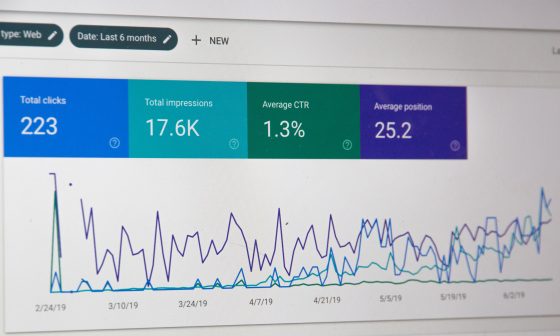
Most agencies experience this same scenario. We tend to celebrate vain metrics like:
- Number of leads
- Number of impressions
- Number of clicks
Unfortunately (and it really is), those numbers don’t tell you a thing about whether your agency marketing is effective.
A local client might get 200 leads tomorrow, but if every single one is a tire kicker worth only about $0.01, you haven’t done anything.
This guide will show you exactly which monthly tracking metrics you need to master. We promise, taking charge of these will skyrocket your client lifetime value and dramatically lower your client acquisition cost.
Here are the 7 fundamental agency KPI categories you must track every month to improve your services, boost agency client retention, and scale your business.
TL;DR
- Metrics like leads, clicks, and impressions tell you nothing about whether your campaigns are driving revenue or keeping clients happy. Key things to track include:
- Client Lifetime Value (CLV) shows long-term revenue per client. Higher CLV = better margins, clearer focus on high-value segments (e.g., multi-location businesses vs. single-location shops).
- Client Acquisition Cost (CAC) tells you how much you spend to land each client. Your CLV should be at least 3× CAC to stay profitable.
- Client Satisfaction Score (CSAT) is your early-warning system. Low scores usually show up before clients cancel, giving you a chance to fix small issues early.
- Client retention rate is your strongest stability metric. Healthy agencies sit around 84–85% annual retention. Anything lower drains profit.
- Client churn rate shows how fast clients leave. High churn leads to constant firefighting, high acquisition costs, and stagnant revenue.
- Net Promoter Score (NPS) measures who’s willing to refer you. High NPS = more referrals = highest-value clients at almost zero CAC.
- Client Engagement (custom metric) is your strongest predictor of churn. Low logins, skipped meetings, and slow replies = “about to churn.” High engagement = visible value = longer retainers.
Tools like Synup OS help you stay ahead of problems by automating engagement tracking, churn prediction, and client health reporting so your team spends less time digging for data and more time improving strategy.
1. Client Lifetime Value (CLV)
A CLV is arguably the most critical metric for any scaling agency.
What it Measures
Client Lifetime Value (CLV) calculates the total revenue your agency can expect from a single client throughout the entire duration of your professional relationship. It moves your focus from the immediate monthly retainer to the long-term potential of a client relationship.
Why it’s Important
Understanding your CLV directly informs how much you can reasonably spend on acquiring a new client (more on that in the next section!). More importantly, it helps you identify your most profitable client segments.
Think about the difference between a single-location local flower shop on a basic $300/month listing management package and a regional chain of five auto repair shops on a $1,000/month full-service local SEO and reputation management retainer.
While the flower shop is a profitable business, the auto repair chain has a significantly higher CLV due to the recurring (and therefore, reliable) retainer payments and packaged services that you can charge for. Tracking this metric helps you focus your sales and onboarding client processes on high-value segments.
How to Track
The basic calculation for CLV is straightforward, making it one of the most actionable agency KPIs you can track:

For a local restaurant example:
- Scenario 1 (Basic): A single-location restaurant on a $500/month listing management retainer. If your average client retention is 18 months, their CLV is $500 x 18 = $9,000.
- Scenario 2 (Full-Service): A three-location regional chain on a $1,200/month full-service local SEO retainer. If their average lifespan is 24 months, their CLV is $1,200 x 24 = $28,800.
By clearly seeing this difference, you can prioritize sales efforts and structure service packages to maximize that profitable, long-term value, leading to dramatically higher client lifetime value.
2. Client Acquisition Cost (CAC)
You need to know exactly what it costs to acquire a client. Without that insight, you’re flying blind and likely wasting money in the process.
What it Measures
Client Acquisition Cost (CAC) measures the total sales and marketing expenses your agency invests in to acquire just one new paying client. This includes salaries, commissions, software, advertising spend, and every penny related to bringing a client through your pipeline, from initial lead to closed deal.
Why it’s Important
CAC must be compared directly against your Client Lifetime Value (CLV). If it costs you more to acquire a client than the revenue they bring in, your agency is fundamentally unsustainable. This metric provides a crucial reality check on your sales efficiency and marketing campaign performance. For a healthy agency focused on scalability, the goal is always to drive CAC down while increasing CLV.
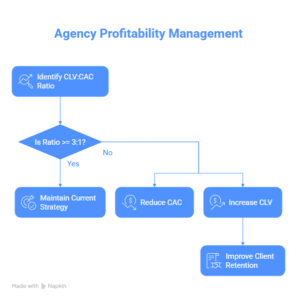
A commonly accepted benchmark for agency profitability is a Customer Lifetime Value (CLV) that is at least three times the Customer Acquisition Cost (CAC) (a 3:1 ratio). Working around this ratio is essential for managing your growth phase. If your ratio is 1:1, you need to either reduce your CAC or increase your CLV, likely by improving your agency client retention.
How to Track
This is a simple division of your expenses by your results:

CAC = {Total Sales & Marketing Costs} divided by {Number of New Clients Acquired}
Example For a Local Business Client
Imagine you ran a social media ad campaign targeting local multi-location business owners, resulting in five new clients.
- Total Monthly Spend: $4,000 (Includes ad spend, sales salary allocation, and CRM software costs)
- New Clients Acquired: 5
- CAC: $4,000 / 5 = $800
If your CLV for this segment is $6,000, your CLV:CAC ratio is 7.5:1. That’s fantastic! You are generating $7.50 for every $1 you spend on acquisition.
Now, compare that to another channel. If cold emailing costs $500 per client, but those clients churn faster, your effective CAC might be much higher because the resulting CLV is lower.
Remember, local business owners prioritize their bottom line. A lot of clients don’t care about reports, and, like, 95% of the metrics we tend to pull up.
They care about sales and how much they spent. This means connecting your CAC spend to client-visible, bottom-line results is the only way to justify the initial acquisition investment. This focus on outcomes improves your client satisfaction score and helps justify your fees from the initial client onboarding meeting onward.
3. Client Satisfaction Score (CSAT)
Don’t wait for a client to churn to find out they were unhappy. You should be there before the guillotine falls. This is what the CSAT tracks.
What it Measures
The Client Satisfaction Score (CSAT) is a metric that gauges a client’s short-term satisfaction with a specific interaction or service delivery. It is typically a quick, simple survey question asked immediately after a key touchpoint. It’s a snapshot of how a client feels in the moment.
Why it’s Important
CSAT is one of the best early indicators of potential friction and churn. A consistently low score after a recurring deliverable is a clear warning sign that your service quality or communication is falling short. You can’t fix what you don’t measure, and CSAT gives you the chance to intervene and resolve an issue before it spirals into a lost retainer, protecting your high client lifetime value. A high score is also crucial data for improving your agency’s client retention.
How to Track
To track CSAT, send a brief, one- or two-question survey right after a client-facing event. The question is usually, “How satisfied were you with the recent service/interaction?” with a scale ranging from “Very Unsatisfied” to “Very Satisfied.”
For instance, let’s say you send out a survey immediately after delivering the monthly local SEO performance report to a local dentist client.
If the resulting CSAT score is low, it might not mean they hate the service, but rather that the report itself was confusing or lacked the specific marketing agency metrics they care about (like new appointment requests). This allows your account manager to call them immediately and clarify, potentially saving the relationship. It’s an active, not passive, measure of client satisfaction score.
4. Client Retention Rate
Now that you know what a client is worth to you (your CLV), let’s talk about how to keep them.
What it Measures
The client retention rate measures the percentage of clients your agency keeps over a defined period, whether that’s monthly, quarterly, or annually. It is a direct measure of your agency’s overall service quality and stickiness.
Why it’s Important
This metric directly determines your client lifetime value and is the bedrock of agency stability.
That’s because retention is simply cheaper and more profitable than acquisition. Think about it: once you’ve successfully completed the new client onboarding process, all the upfront work is done. Every subsequent month of retainer revenue has a significantly higher margin.
Successful marketing agencies typically retain around 75 to 80% of clients annually. If your agency client retention rate is below that range, then you’re spending too much effort replacing lost revenue instead of growing new revenue.
How to Track
The calculation for client retention rate gives you a clear, objective number. Here’s the formula for calculating client retention rate:
Client Retention Rate = (Clients at End of Period minus New Clients Acquired During Period) divided by Clients at Start of Period, then multiplied by 100.

For example, let’s say you kicked off the month with 22 clients, brought in 4 new ones, and ended the month with 23. That means you kept 19 of the original 22.
Your retention rate = (23 – 4) ÷ 22 × 100 = 86%.
Simple and clean, and it tells you immediately whether people are sticking around or quietly slipping out the back door.
What Improves Retention (Based on Real Agency Behavior)
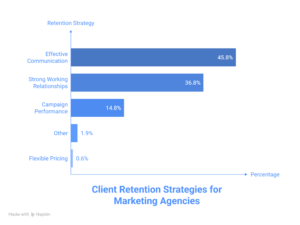
Surprisingly, when agencies were surveyed, most didn’t credit “crushing KPIs” as their biggest retention driver (Source: Agency Analytics). They pointed to things that happen outside the dashboard as their best strategies for retaining agency clients. Things that tend to get ignored when agencies get busy.
Effective Communication
Agencies ranked this as their top factor, and for good reason. Most clients aren’t living in GA4 or Facebook Ads Manager. They just want to know what changed on the ground.
Instead of telling them how their CTR improved by 2.4%, you can say, “Your Marion store got 15 more phone inquiries this month. Most of them came from the new local keyword set we added.”
That way, you’re translating work into outcomes they recognize.
Day-to-Day Working Relationship
You don’t have to be overly friendly. It’s about understanding how the client runs their business so your decisions aren’t made in a vacuum.
A strong working relationship looks more like:
- You know their monthly revenue targets, not only their “goal conversions.”
- You know which location struggles on weekdays, so you tailor the ads accordingly.
- You know their approval bottlenecks, so your turnarounds match their internal process.
When you operate with this context, your recommendations are sharper, and clients feel it.
Campaign Performance (Important, But Not the Deciding Factor)
Good performance keeps the account stable. But it rarely saves a relationship that’s already strained.
Most clients assume you’re competent. So they judge you on:
- The clarity of your explanations
- How early you flag problems
- Whether you take initiative instead of waiting for them to notice gaps
Yes, performance is expected. But the way you handle performance is what keeps the contract from ending early.
Also Read: How To Manage Difficult Clients Professionally
5. Client Churn Rate
Let’s take a different approach. While retention is your goal, client churn rate is your greatest challenge.
Most agencies that fail to scale fall into a brutal churn-and-burn model. They are constantly cycling through clients, acquiring a few only to lose the same number next month.
This often happens because, as some SEO professionals observe, many agencies are founded by salespeople who overload their delivery teams.

Agencies often assign their SEOs to manage 20 or even 35 clients simultaneously, imposing a uniform strategy on local businesses. This means the multi-location auto repair shop gets the same generic project plan as the single-location dentist. This kind of blanket strategy, without tailored explanations or service, is where the core problem of high churn usually begins.
The agency fails to deliver individualized value, leading clients to feel neglected and question the expense.
What it Measures
Client churn rate measures the rate at which clients stop doing business with your agency over a specific period. It is the direct opposite of your retention rate.
Why it’s Important
High churn cancels out expensive acquisition efforts. If your client acquisition cost is $1,000 and your monthly churn rate is 10%, you need to replace 10% of your clients every month just to stay even. That’s a treadmill nobody wants to be on. Managing churn is essential for maximizing your client lifetime value.
How to Track
Calculating churn is straightforward, but its implications are massive:
Client Churn Rate = (Clients Lost During Period / Clients at the Start of Period) x 100

But instead of just calculating churn after the fact, the smartest agencies use technology to predict it.
Platforms like Synup OS offer a churn risk tracking and prevention feature that factors in multiple churn signals to tell you when a client is about to walk out.
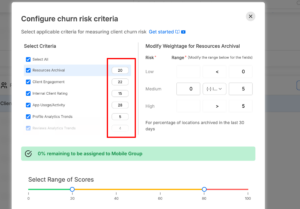
You can define thresholds for different parameters to classify clients as Low, Medium, or High Risk. You can also assign weights to the criteria you consider most important (because no two clients are exactly alike).
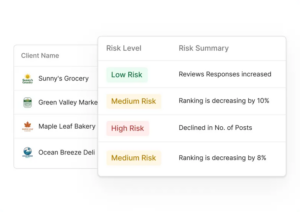
You’ll have real-time visibility into how every client is performing, making it easy to spot accounts that require extra support at the right moment. With these insights, you can adjust your service approach, strengthen engagement, and uncover new opportunities to upsell.
It’s about getting ahead of the problem, allowing your team to deploy a retention strategy immediately, not weeks later when the cancellation email arrives.
Also Read: 7 Fixes to Reduce Client Churn for Your Agency
6. Net Promoter Score (NPS)
If CLV is the revenue metric, NPS is the client lifetime value multiplier.
What it Measures
The net promoter score (NPS) measures a client’s likelihood to recommend your agency to others. On a scale of 1-10, NPS divides your client base into three groups:
- Promoters (9-10): Enthusiastic loyalists who fuel growth through referrals.
- Passives (7-8): Satisfied but unenthusiastic; they could easily switch.
- Detractors (0-6): Unhappy clients who can actively damage your brand.
It is the definitive measure of long-term loyalty and referral potential.
Why it’s Important
Referrals are, without question, the highest-CLV clients for agencies, especially those serving local markets. That’s because the trust is already established. They require minimal sales effort, driving your client acquisition cost down to almost zero. A high NPS creates a virtuous cycle of profitable, easy growth.
How to Track
NPS is measured using a single-question survey: “On a scale of 0 to 10, how likely are you to recommend our agency to a colleague or friend?”
The formula is:
NPS = % Promoters – % Detractors

An NPS score above 50 is generally considered excellent. Low scores indicate a failure in the client experience, which must be fixed to improve your client satisfaction score.
7. Client Engagement (Custom Metric)
This is one of the strongest early signals of a client’s overall health… Are they truly paying attention?
What it Measures
Client engagement is a custom, composite marketing agency metric that tracks how actively a client interacts with the value you deliver. This could include:
- How often a client logs into the Client Portal to check their local ranking or reputation dashboard.
- The number of scheduled meetings/calls per month the client attends.
- Report views and time spent reading performance summaries.
- Average feedback response time from the client.
Why it’s Important
Low engagement is a top predictor of churn. Think about this: a client who doesn’t log in, doesn’t check results, and doesn’t engage with the process may quickly forget the value provided.
When they see the monthly invoice, they ask, “What am I paying for?” However, a highly engaged client receives constant reminders of your value, resulting in superior agency-client retention.
For local multi-location businesses, they need to see that you are actively managing their local presence across multiple sites. If they aren’t logging in to their client portal to see those local SEO gains and review streams, the entire effort is invisible.
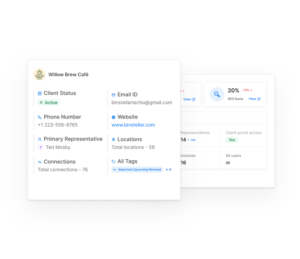
A unified platform like Synup OS lets you track engagement automatically. It monitors these signals and alerts you when a client’s engagement score dips below a set threshold.
With built-in client summaries that give you an at-a-glance view of each account, your team can take proactive steps, such as scheduling a high-value review call or sending a personalized video update, before the client disengages and churns. This targeted intervention is the definition of proactive relationship management.
Conclusion & Next Steps
Successfully tracking these seven metrics can shift your agency from reactive service delivery to proactive, data-driven relationship management. By optimizing for high client lifetime value and low client acquisition costs and supporting them with strong agency client retention and engagement, you build a truly scalable business.
However, making this shift requires strong, reliable tools. Platforms like Synup OS simplify the process of gathering and analyzing essential marketing agency metrics, especially engagement and churn indicators. The real advantage is the time it gives back to your team. Instead of getting buried in data, they can focus on delivering the strategic guidance your clients actually value. Book a demo to learn how to gain a holistic, immediate view of every client’s health and scale your agency to take on new, exciting horizons.
Also Read: 11 Most Important Marketing Agency KPIs to Track Every Month
Frequently Asked Questions
1. What metrics should be used to measure improvements in client experience?
To measure improvements in client experience, focus on core CX metrics like NPS for loyalty, CSAT for satisfaction after key interactions, and CES to gauge how easy it is for clients to get support. Operational metrics such as first response time, average resolution time, and first contact resolution also help you track how efficiently your team solves client issues.
2. How often should my agency calculate key performance indicators?
You need a mixed reporting schedule. Track leading indicators like CSAT and client engagement weekly or in real time so you can spot issues before a client churns. Review churn rate and retention rate monthly for a quick read on service stability. Reserve long-term metrics like CLV and CAC for quarterly reviews, since they require more data to guide strategic decisions about profitability and sales priorities.
3. What are the 7 P’s of customer service?
The classic 7 P’s of marketing are product, price, place, promotion, people, process, and physical evidence. Product refers to the core services you deliver, such as local SEO or listings. Price is your retainer structure and value proposition. Place is where clients interact with your service, such as your client portal. Promotion is how you communicate value through reports, updates, and check-in calls. People are your account managers and specialists, and the quality of their expertise and communication. Process is the efficiency of your workflows from onboarding to monthly reporting. Physical evidence includes tangible outputs like polished reports, portal access, and meeting decks.