



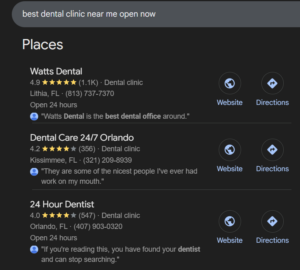
Someone with a toothache just grabbed their phone and searched “best dental clinic near me open now.” Within an hour, they walked into a nearby practice. For agencies managing local businesses, this moment represents the highest-value search opportunity available today.
Real-time intent search shifts the focus away from traditional rankings toward visibility at the exact moment a customer is ready to act. It is about being present when someone is ready to spend money right away. 76% of people who search for a service that’s nearby on their smartphone visit a business within 24 hours. 28% of those searches end in a purchase.
Local search has shifted. It is moment-based decision-making. And if your agency is not optimizing for that, your clients are losing customers to competitors who are.
TL;DR: How to Rank for Real-Time Intent Searches
- Ranking signals Google prioritizes:
- Accurate Google Business Profile (GBP) data
- Updated business hours and special hours
- Consistent NAP information
- Recent reviews and responses
- Correct categories and attributes
- The GBP is the primary data source Google uses for real-time visibility.
- Data freshness matters more than data perfection.
- Agencies managing multi-location clients face unique operational challenges at scale.
- Common mistakes: wrong hours, inconsistent business names, category mismatches, and ignoring non-Google listings.
What Are Real-Time Intent Searches?
Real-time intent searches are queries from users who are actively expressing a desire to buy a product or service.
“Near me” is the most famous example.
Source: Google
Think about how your clients’ customers actually search:
- Coffee shop open now
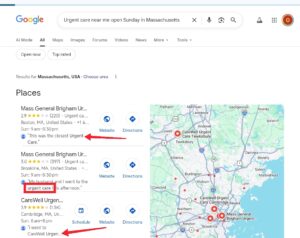
- Urgent care near me open on Sunday
- Best tacos open late
- Dentist accepting new patients near me
- Locksmith available now
- Pharmacy near me open 24 hours
These searches are often performed on mobile devices and frequently lead to immediate offline actions such as calls, navigation requests, or in-store visits.
This is very different from informational queries like “how does a root canal work” or even traditional local queries like “dentists in Chicago.” Those are research-phase searches. Real-time intent searches are action-phase.
How Google Understands “Near Me” Searches
Users no longer need to type a city name or even “near me.” Google infers location intent from context.
If someone searches “best Thai restaurant,” Google already knows where they are typing from through their phone’s GPS information. It treats that as a local query automatically. The explicit phrase “near me” is just one version of a much broader implicit signal.
The Three-Legged Stool: Proximity, Relevance, Prominence
Google uses three interdependent core factors to rank local results.
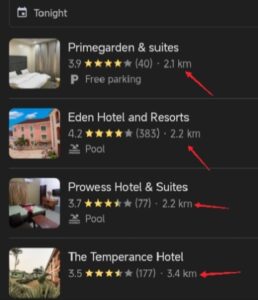
- Proximity: How physically close is the business to the searcher? Google tries to suggest places within a tight geographic radius based on the user’s real-time location.
Source: Google
- Relevance: Does the business match what the person searched for? Categories, services, contexts mentioned by users in reviews, keywords in the GBP description, and website content all feed into this.
Source: Google
- Prominence: Is this a well-known, trusted business? Review quantity, review quality, citation signals, and online activity all factor in.
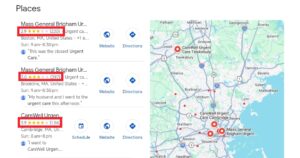
Source: Google
The tricky part is that proximity is largely outside your control. After all, you cannot move a client’s business. But relevance and prominence are very much within reach.
Google has gotten remarkably good at understanding neighborhood-level intent. A search for “gym near me” from someone in the Wicker Park neighborhood of Chicago will surface results within a tight radius of that specific neighborhood, not just gyms in Chicago broadly. Optimizing for neighborhood names in GBP descriptions and posts can, therefore, make a significant difference.
The Mechanics Behind “Open Now” Results
The “open now” filter is deceptively simple. It looks like a toggle.
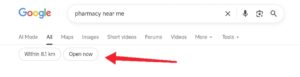
Source: Google
But because the filtering happens instantly, inaccurate hours can quickly remove a business from visibility even if all other ranking signals are strong.
Here are a few reasons your clients might not be ranking for “near me” and “open now” searches.
- Regular hours not updated after schedule changes
- Holiday hours never set (so Google defaults to regular hours, which may be wrong)
- Temporary closure not communicated (business shows “open” when it is actually closed)
- Special hours for events or seasonal changes ignored
- Hours listed inconsistently across directories, creating conflicting signals
Core Ranking Factors for Real-Time Local Searches
What actually moves the needle for real-time local visibility? Here are the factors that matter most.
Business Location and Proximity
You cannot change where a business is located, but you can ensure Google has the precise coordinates. A pin dropped in the wrong spot (even by a block or two) can push a business outside the radius Google considers for a given search. Check the map pin in GBP. Verify it sits on the actual storefront entrance, not a parking lot or back alley.
Accuracy and Freshness of Business Data
Google cross-references GBP data with dozens of other sources: Yelp, Bing, Apple Maps, Foursquare, data aggregators like Data Axle and Neustar, and hundreds of niche directories. Conflicting entity signals mean confidence in the business information is reduced.
A typical small business has between 40 and 120 live listings across the web. NAP consistency at a granular level matters. If the GBP says “Suite 100” but Yelp says “Ste. 100,” that small difference can fragment entity authority.
Local SEO practitioners frequently highlight NAP consistency as a foundational ranking factor, though updates across directories may take time to propagate.
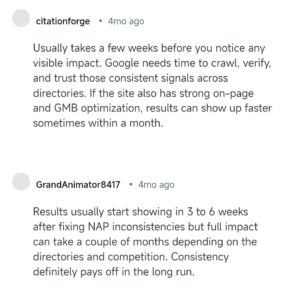
Source: Reddit
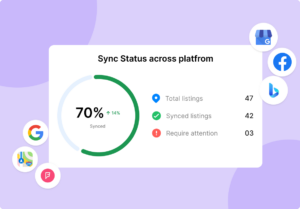
Managing this at scale is where a good local listing management solution pays for itself.
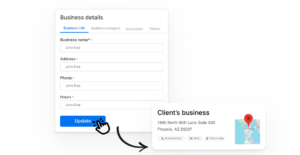
Source: Synup
You don’t have to play the firefighter when NAPs start going haywire across listings. As you make changes on Google, Synup, for instance, rolls out the change across tens of other platforms you’re listed on.
Source: Synup
Categories and Services
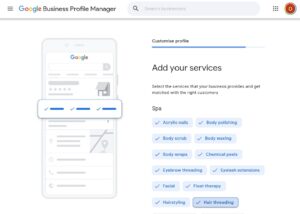
The primary category tells Google exactly what the business is. Most agencies set this during onboarding and never revisit it.
Source: Google Business Profile
However, Google regularly adds new categories. A client who is a “nail salon” might now qualify for more specific categories like “nail art salon” or “gel nail salon” that better match how their customers search. Reviewing categories quarterly is easy work with high impact.
Secondary categories and services listed on the GBP also matter. A multi-service business, like an auto shop, should list every service it offers. “Oil change,” “brake repair,” “tire rotation” each represent a separate search query someone might use.
Reviews, Ratings, and Engagement Signals
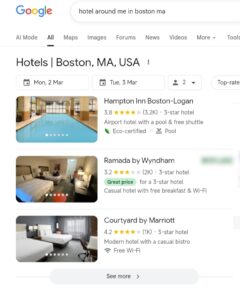
Reviews influence real-time rankings in two ways. The rating affects click-through.
A 4.7-star business beats a 3.9-star every time, even if the 3.9-star ranks higher for some queries in some locations.
Source: Google
In the above, Courtyard by Marriott has a higher star rating but is beaten to it by Hampton Inn, probably due to proximity to the searcher and other factors like quantity of reviews.
The volume and recency of reviews signal active business engagement to Google.
Plus, responses to reviews matter. An actively managed GBP with regular responses tells Google that someone is tending to this listing.
Website vs GBP Signals
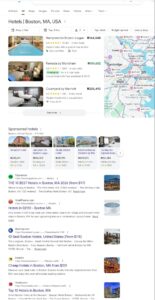
For real-time local pack results, the GBP carries more weight than the website. In fact, websites typically play a supporting role compared to Google Business Profile listings in real-time local pack results, regardless of how many backlinks or domain authority they have accumulated. Google prioritizes listing sites like GBP, Yelp, Hotels.com, and TripAdvisor.
Source: Google
But the website still matters. It provides consistent signals. However, a website with a different address or phone number from the GBP creates a conflict that can suppress rankings.
The website also matters for the organic results that appear below the local pack. Your agency needs both to work in sync.
Synup’s SEO solutions help you track both local pack and organic performance in one dashboard.
Why Traditional SEO Tactics Fall Short Here
Traditional SEO operates on a slower timeline. You build content, earn links, improve domain authority, and eventually rank. That process takes months. It also targets organic SERP positions, not the local pack.
The local pack operates differently. It is a separate algorithm. It updates more dynamically and responds to signals that traditional SEO largely ignores.
Why “Ranking #1” Misses the Point
The local pack dominates the screen on mobile. If your client is not in the pack, they are invisible to the majority of real-time searchers, even if they rank high organically.
Plus, the map pack yields different results depending on the exact location. Two people half a mile apart see different businesses. There is no single “rank 1” that applies to everyone.
The Role of Google Business Profile in Real-Time Rankings
Google re-evaluates GBP data more frequently than most people realize. Changes to hours, categories, and descriptions can influence rankings within days. Conversely, outdated or incomplete data can suppress rankings just as quickly.
Key GBP Fields That Drive Real-Time Visibility
- Business name: Should match the actual storefront name. No keyword stuffing. Google penalizes this, and competitors can flag it.
- Primary category: The single most important ranking field. Review quarterly.
- Service areas: For businesses that serve customers at their location (plumbers, cleaners), define service areas clearly.
- Hours including special hours: Updated, accurate, and complete. This is important for “open now” visibility.
- Attributes: Features like “wheelchair accessible,” “free Wi-Fi,” “outdoor seating,” and “accepts credit cards” appear in search results and filter options. Fill them all in.
- Photos: Regularly updated photos signal an active, engaged business. GBPs with recent photos consistently outperform static ones.
- Posts: Weekly GBP posts keep the profile active. These updates also contribute to ongoing activity signals associated with profile freshness.
- Q&A section: Seed this with frequently asked questions. Unanswered questions from customers look bad and missed opportunities to add keyword-rich content.
Pro Tip: The GBP description allows 750 characters, but many businesses use only a fraction. Use this space to describe exactly what the business does, who it serves, and where it is located. Include neighborhood names, nearby landmarks, and the specific services offered.
Data Freshness: The Hidden Advantage
One important principle about local search visibility is that up-to-date data beats perfect data.
A GBP that was last touched two years ago sends a signal. A GBP that had updates this week sends a different signal.
This does not mean making random changes just to trigger an update. It means building a rhythm of legitimate updates into your client management workflow. Here’s what counts as fresh signal activity:
- Adding or responding to reviews
- Posting GBP updates or offers
- Updating photos
- Correcting or confirming business details
- Adding new services
- Setting holiday hours before major holidays
Beyond the GBP itself, Google watches what happens across the web. When a business gets mentioned in a local news article, earns a new directory listing, or sees increased activity on Yelp, those signals contribute to freshness perception.
Ranking Across Locations: The Agency Challenge
Single-location local SEO advice is everywhere. Multi-location management is where it gets genuinely hard.
An agency managing a franchise with 30 locations, or even 10 independent clients each with 3 locations, is dealing with 30 to 300+ individual GBPs that all need active management. This inefficiency in managing location data directly impacts profitability and client retention.
Why Single-Location Advice Does Not Scale
Most local SEO guides are written assuming one business, one GBP, and one team member who logs in and makes updates. At scale, you need systems.
- Who is responsible for updating holiday hours across 50 locations?
- Who is notified when a GBP gets flagged by a competitor?
- Who responds to reviews within 48 hours?
Without defined workflows, things fall through the cracks.
Operational Challenges Agencies Face
Here are some challenges agencies face with local SEO and client listing:
- Client data living in different formats and systems
- No centralized view of which GBPs are incomplete or outdated
- No automated alerts when hours change, reviews come in, or listings get flagged
- Difficulty proving ROI to clients who cannot see their local search performance
- High time cost of manual updates across multiple locations and directories
The agencies that succeed at multi-location real-time search are those that actively invest in infrastructure. They use white-label platforms that aggregate GBP management, citation monitoring, and review response into a single workflow.
When evaluating your stack, looking at the top whitelabel local SEO tools or top local listing management tools is a smart place to start.
Other Common Mistakes That Kill “Near Me” Visibility
Apart from the usual culprits we’ve detailed above, the following issues frequently appear during local SEO audits.
- Ignoring Local Data Outside of Google: Google is not the only place that matters. Apple Maps now drives a significant share of navigation requests, especially on iPhone. Bing Places affects Bing search and Cortana results. Yelp remains dominant in certain verticals. And data aggregators like Data Axle, Neustar, and Foursquare feed information to dozens of other platforms. Agencies that only manage GBP leave a lot of trust-signal infrastructure unattended. Inaccurate data on these platforms conflicts with GBP data and can confuse Google’s entity understanding.
- Over-Optimized or Inconsistent Business Names: Adding keywords to a business name on GBP is a clear violation of Google’s guidelines. “Chicago Best Plumbing and Drain Service LLC” when the real name is “Mike’s Plumbing”, creates confusion and risks a suspension. If you want keywords in your business for a local SEO boost, you may have to rebrand.
Consistency between the GBP name and the actual business name matters.
The Future of Local Search Is Moment-Based
Industry trends indicate that Google continues to prioritize real-time and hyperlocal search experiences. With AI now woven into search, the sophistication of real-time query understanding is only increasing.
Search Generative Experience (SGE) and AI-powered local summaries pull data directly from GBPs, reviews, and citation networks. The businesses with clean, complete, and consistent data across the web will appear in these AI-generated results. The ones with gaps will not.
“Open Now” Queries Will Only Grow
Mobile usage continues to rise. As the statistics on voice search show, this inherently real-time and local technology is growing. Smart speakers and in-car navigation systems rely on local data to answer questions like “find a gas station open now.” And it’s specifically why Synup now has a system that optimizes your listings for voice search.
The investment your agency makes today in clean listing data and active GBP management is not just for Google Search. It feeds every channel that handles real-time local intent.
What Agencies Should Prepare For
- AI-generated local summaries that synthesize GBP and review data directly in search results
- Increased importance of attribute completeness as filters in search interfaces get more sophisticated
- Voice-driven queries that are phrased as questions: “Is there a vet near me open on Sunday?”
- Photo and visual search are playing a bigger role in how users evaluate local businesses before clicking
- Real-time inventory and availability signals are becoming ranking factors for retail clients.
Wrapping Up
Real-time intent searches represent the moment when discovery turns into revenue. Agencies that treat Google Business Profile management, listing accuracy, active profile management, and data freshness as ongoing operational processes instead of one-time SEO tasks. These are best positioned to capture these high-intent searches. Building scalable systems around these signals is no longer optional; it is becoming a competitive requirement for local visibility.
Start with an audit and an automated tool like Synup for listing management. Clean the mess and then build the workflow that keeps it that way across every client, every location, every month.
FAQs
-
Why is my client’s business not showing up in “near me” searches even though they have a GBP?
The business location pin might be slightly off; i.e., placing it outside the radius Google considers for a given search. The primary category might not match what users are searching for. The profile could be incomplete or have outdated data that conflicts with other directory listings. Start with a full GBP audit, verify the map pin location, check NAP consistency across directories, and ensure all core fields are complete and accurate.
-
How often should I update my client’s Google Business Profile to stay visible?
There is no fixed rule, but activity matters. A good baseline is weekly GBP posts, monthly photo updates, quarterly category and hours audits, and immediate updates whenever any business detail changes. Set special hours for holidays at least a week before each holiday.