

There is a staggering amount of advice out there regarding SEO: the 200-page “ultimate” guides, the random pitch-making guys on Quora promising Page 1 under a week, and the LinkedIn gurus who treat every minor Google update like it’s the apocalypse.
Much of these are useless when you’re sitting across from a plumber in Des Moines or a lawyer in Toronto. You can’t bill them for theoretical insights. You need to know for real how to start SEO for website results that keep them paying their $1,500 retainer month after month.
A winning SEO strategy isn’t just a spreadsheet of keywords but a scalable, repeatable roadmap. It connects the “techie” stuff, the content, and the authority building directly to the client’s bank account. Whether you’re figuring out SEO strategies for website authority from scratch or trying to fix a site that’s been stagnant for years, you need, above all, a system that doesn’t eat up all your team’s time. This 7-step guide shows exactly how to create an SEO campaign that makes sense for local SMBs.
TLDR: 7-Step Guide to Creating an SEO Strategy for New Clients
- Step 1 – Discovery & Revenue Mapping: Interview the client to find their high-margin “money makers” (e.g., dental implants vs. basic cleanings). Set a 6–12 month expectation early, identify “striking distance” keywords on Page 2 for quick wins, and map the specific local pain points of their actual customers.
- Step 2 – Competitive Reconnaissance: Identify “Search Competitors” (who actually rank) vs. “Business Competitors.” Use a keyword gap analysis to find “table stakes” topics (the content Google expects a reputable business in that niche to have) and find “content voids” like missing calculators, videos, or pricing guides that you can own.
- Step 3 – Technical Foundation & Cleanup: Prune “thin” content, fix broken internal “plumbing” (internal links), and ensure the site passes the 4-second load test. Crucially, use tools like Synup to automate NAP (Name, Address, Phone) consistency across local directories to win the “Map Pack” without wasting staff hours.
- Step 4 – The Content Roadmap: Organize keywords by the sales funnel: TOFU for awareness (how-to guides), MOFU for consideration (comparisons), and BOFU for the “money shot” (service pages). Prioritize high-intent, low-difficulty terms first to prove ROI fast, and build a 6-month calendar that balances new posts with updates to old ones.
- Step 5 – Authority & E-E-A-T Building: Focus on “Digital PR” and local citations (Chambers of Commerce, local news). Remember that for local SEO, reputation is a ranking signal. Use automated systems to monitor and respond to reviews, as a 4.8-star rating is often a bigger ranking lever than a backlink.
- Step 6 – The “Impact vs. Effort” Action Plan: Don’t overwhelm the client with a 100-item task list. Group work is divided into phases: Foundation (Months 1-2), Growth (Months 3-4), and Authority (Months 5+). Report on “business KPIs” like lead volume and phone calls, rather than just “rankings,” to ensure they never want to fire you.
- Step 7 – Execution & The “Marathon”: An SEO mindset is about consistency over intensity. Use white-labeled client portals to provide jargon-free, transparent reporting. Re-audit every 6 months to stay ahead of algorithm shifts and new competitors, ensuring your agency moves from “vendor” to “essential business partner.”
Step 1: The Discovery Phase, Defining the “Why” Before the “How”
Before you ever open a keyword tool or poke around a backlink profile, you have to get a grip on the actual business model of the person signing your checks.
Most agencies crash and burn because they’re still chasing “vanity metrics,” ranking for high-volume terms that bring in zero dollars.
You have to start with the revenue.
You aren’t just an SEO person; you are a business consultant who happens to use search engines as a lever. If the client’s phone isn’t ringing with the right kind of customers, your “number one rankings” don’t mean a thing.
Client Interviews
You need to sit down with the owner and ask the uncomfortable, “nosey” questions. Don’t just ask what keywords they think they like.
Ask about their profit margins and their capacity. If you’re working with a local plumber, ranking for “how to fix a leaky faucet” might bring in 5,000 visitors a month, but those are DIYers who aren’t going to spend a cent. That same plumber needs “emergency pipe repair near me” or “sump pump installation cost.”
Understand the difference between their “bread and butter” work and their “dream” jobs. A dental client might see 50 patients a week for cleanings (bread and butter), but they really want to grow their dental implant business (high margin).
Equally important is managing the “SEO takes time” talk. A study by Ahrefs found that only 1.74% of all newly published pages will reach the Google Top 10 within a year. So, if your client is expecting a 10x ROI in thirty days, your strategy is dead on arrival. Use this discovery phase to set a baseline: SEO is a six- to twelve-month commitment. You are building an asset, not buying an ad.
Another thing to nail down is their short-term vs. long-term goals.
- Short-term: “I need more calls for AC tune-ups before the July heatwave hits.”
- Long-term: “I want to be the most recognized roofing brand in the Tri-State area so I can sell the business in five years.”
Current State Analysis
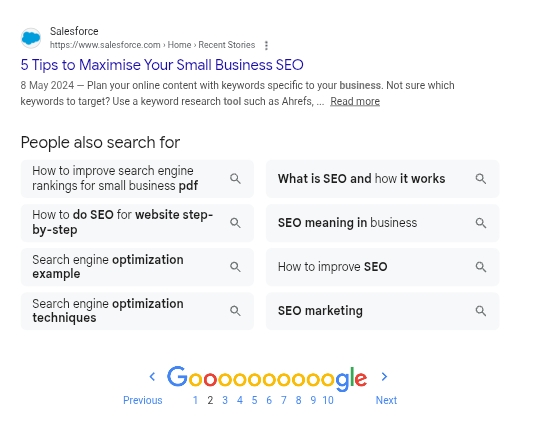
Now it’s time to pop the hood and look at the actual wreckage (or treasure) left by the previous SEO agency. Pull the Google Analytics 4 (GA4) and Google Search Console (GSC) reports. Hunt for “striking distance” keywords. These are the “low-hanging fruit” sitting on the top of Page 2 (positions 11 through 15).

Source: Google
If a keyword has 1,000 monthly searches and is at position 12, it’s getting nearly zero clicks. Move it to position 4, and you might see a 7% to 10% click-through rate. That is 70 to 100 new visitors from a single change. Plus, a simple metadata tweak or an extra internal link from a high-authority page is often all it takes to make that jump.
Check the historical performance for “ghosts.” If the site’s traffic fell off a cliff in October, cross-reference that with Google’s algorithm update history.
Did they get hit by a Helpful Content Update? Or did someone accidentally check the “discourage search engines from indexing this site” box in WordPress? Along with that, look at the local context.
According to a recent local SEO statistics, 87% of consumers used Google to evaluate local businesses in the last year. If your client has a 3.2-star rating while the top three competitors have 4.8, no amount of SEO will make the phone ring.
Audience Mapping
Who is actually clicking “Call Now”? If the client is a boutique family law firm in Toronto, their audience isn’t just “people getting divorced.” It is likely “working professionals with significant assets who are worried about child custody and pension division.”
Map their pain points. What are they typing into Google at 2:00 AM when they can’t sleep?
- Generic: “Divorce lawyer”
- Pain-Point Specific: “How to protect my business during a divorce”
- Local Intent: “Best family law firm near [Specific Neighborhood]”
When you understand the audience, you can identify local search intent with much more precision. This is where Synup’s SEO tool becomes essential for growth-minded agencies.


A visual guide like this helps you peel back the layers of how local users are actually finding businesses in their specific neighborhood. For example, people in an affluent suburb might search for “luxury landscaping,” while people in a more urban area might search for “small backyard patio ideas.”
Besides that, your SEO campaign should address the “information gain” aspect. Google’s recent patent filings and algorithm shifts show that it favors content that provides new information, not just a rewrite of the top three results. If you can provide a local pricing guide or a “what to expect” video for a specific city, you are providing value that national competitors can’t touch.
On top of that, you need to look at the “User Journey” for these local clients. A “mom-and-pop” shop might have a very short journey (see ad > check reviews > call), whereas a specialized contractor might have a journey that spans three months. Your strategy must provide content for every step of that journey if you want to be the one they eventually hire.
Step 3: Technical SEO & The Baseline Cleanup (The Foundation)
If you’ve ever talked to an SEO strategist who has actually moved the needle, taking a site from zero to 200,000 monthly visitors, they’ll tell you the same thing: you can’t build a skyscraper on a swamp.
You can write the most brilliant, Nobel-prize-winning content in the world, but if Google’s “crawlers” get stuck in a maze of broken redirects or slow-loading scripts, your client is going to stay buried on Page 5.
The technical audit is like “clearing the deck.” It’s about making the site so easy to read that a search engine can digest it in milliseconds. Not just that, but for local agencies charging a per-location model, technical cleanup is a “quick win” factory. While content takes months to rank, fixing a broken mobile menu or a “no-index” tag can show results in a week.
Comprehensive Content Auditing (The “Thin” Content Purge)
Most local business sites are cluttered with “ghost pages,” 300-word service descriptions written in 2014 that offer zero value. According to a study by Ahrefs, nearly 96.5% of content gets zero traffic from Google. Your job is to make sure your client’s site isn’t part of that statistic.
- Word Count vs. Substance: Don’t just hit “1,500 words” for the sake of it. Analyze the top three guys. If the guy in the #1 spot for “Denver Roof Repair” has an 800-word page that covers pricing, materials, and local permits, you need a 1,200-word page that covers all that plus a weather-specific maintenance guide.
- The “Visual Value” Rule: Ditch the cheesy stock photos of people in hardhats shaking hands. They’re “eye-roll” bait. Google’s Vision AI is smart enough to know a stock photo from a real one. Plus, actual photos of the client’s trucks, their office, or a finished job site build massive trust.
- Actionable Content Tip: Run a “Content Audit” spreadsheet. Mark every page as Keep, Refresh (update the info), or Kill (301 redirect it to a better page). This “pruning” focuses all the site’s “link juice” on the pages that actually matter.
The Internal Link Architecture (Connecting the Dots)
Internal links are the “roads” that tell Google which pages are the most important. If a page has zero links pointing to it, it’s an “orphan,” and Google will treat it like trash.
- The “Power Page” Strategy: Identify your “heavy hitters,” usually a high-performing blog post or a page with a lot of natural backlinks. Link from that page directly to a high-margin service page using descriptive anchor text. Another thing to watch out for is using generic “click here” text; it’s a wasted opportunity to tell Google what the next page is about.
- The 3-Click Rule: No important page should be more than three clicks away from the homepage. Besides that, use your footer wisely. For a local plumber, having a “Service Areas” list in the footer with links to specific city pages is an easy way to spread authority. And for a SaaS company, this is a good opportunity to list your products and solutions.


Backlink Profile & The “Neighborhood” Check
You are who you hang out with. If your client’s backlink profile is full of “low-rent” directory links from Eastern Europe but they’re a realtor in San Francisco, Google is going to get confused.
- Geography Matters: For local SEO, a link from the neighborhood Little League sponsor page is often more valuable than a “guest post” on a generic tech blog. You want links from the countries and cities where the client actually does business.
- The Disavow Debate: Don’t get trigger-happy with the disavow tool. Google is better at ignoring spam now. However, if you notice a large, unnatural spike in links (for example, gambling or other clearly irrelevant niches), it may be worth investigating and, in rare cases, taking action.
Also, monitor your anchor text profile. If most of your backlinks use the exact phrase “best credit cards” instead of a natural mix like brand names, URLs, or generic phrases (e.g., “click here” or “this site”), it can look manipulative to Google. An unnaturally high percentage of exact-match anchor text can increase your risk of penalties.
Performance & Core Web Vitals (The Need for Speed)
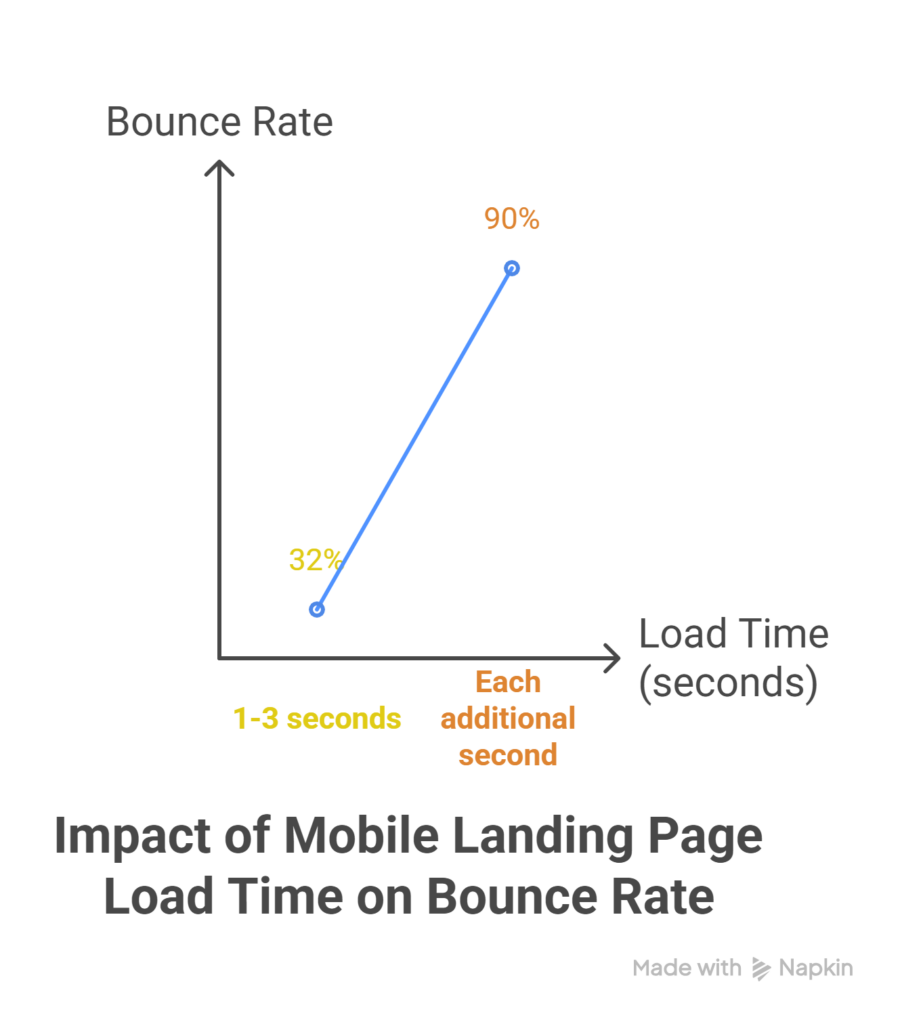
Speed isn’t just a “nerd metric”; it’s a conversion metric. Google’s own research shows that as page load time goes from 1 second to 3 seconds, the probability of a bounce increases by 32%. For each additional second of load time, the bounce rate increases by 90%.

Source: Medium
- The 4-Second Rule: If the site takes more than 4 seconds to load on a 4G connection, you’re losing money. On top of that, check the “Cumulative Layout Shift” (CLS). Nothing annoys a user more than a button moving right as they’re about to click it.
- Image Optimization: This is the easiest win in the book. Use a tool to compress every image. Plus, enable “Lazy Loading” so the browser only loads images as the user scrolls down.
Local SEO Foundation & NAP Consistency
If you’re managing an agency, this is your bread and butter. You have to make sure the business’s digital footprint is a “mirror image” of reality.
- GBP Optimization: It’s not just about “claiming” the Google Business Profile. You need to fill out every single category. Plus, use the “Posts” feature like a mini-social media feed to show Google the business is active.
- The NAP Audit: Name, address, and phone number must be identical across the web. If one site says “Suite 100” and another says “Ste 100,” it can cause friction in the algorithm.
- Practical Context: Things can get tedious for a team of ten here. Using a listing management software allows you to sync this data across 40+ directories instantly. Instead of a junior staffer spending six hours on manual entry, they can spend thirty minutes on a strategy that moves the needle. Equally important, these directories provide “Local Citations,” which remain a top-five ranking factor for the Map Pack.
Another thing to remember: technical SEO is an ongoing chore, not a one-time project. Every time a client installs a new WordPress plugin or uploads a 10MB photo from their iPhone, they’re breaking the “foundation” you built. Besides that, as you scale your agency, you need a way to track these technicalities across all your clients.
Step 4: Keyword & Content Roadmapping (The “Revenue” Blueprint)
Once the technical “plumbing” is done, you’re standing on a solid foundation. But a fast site with no content is just an empty warehouse. This is where you actually build the store. If you want to master building SEO for website authority, you have to move past the “keyword dump” and start building a logical architecture.
Mapping to the Sales Funnel (The Intent-to-Income Framework)
You should stop picking keywords just because they have high volume in a tool. High volume usually equals high competition and, frankly, a lot of “tire kickers.”
For a roofing contractor in Philly, ranking #1 for “roofing” globally is a pipe dream and totally useless.
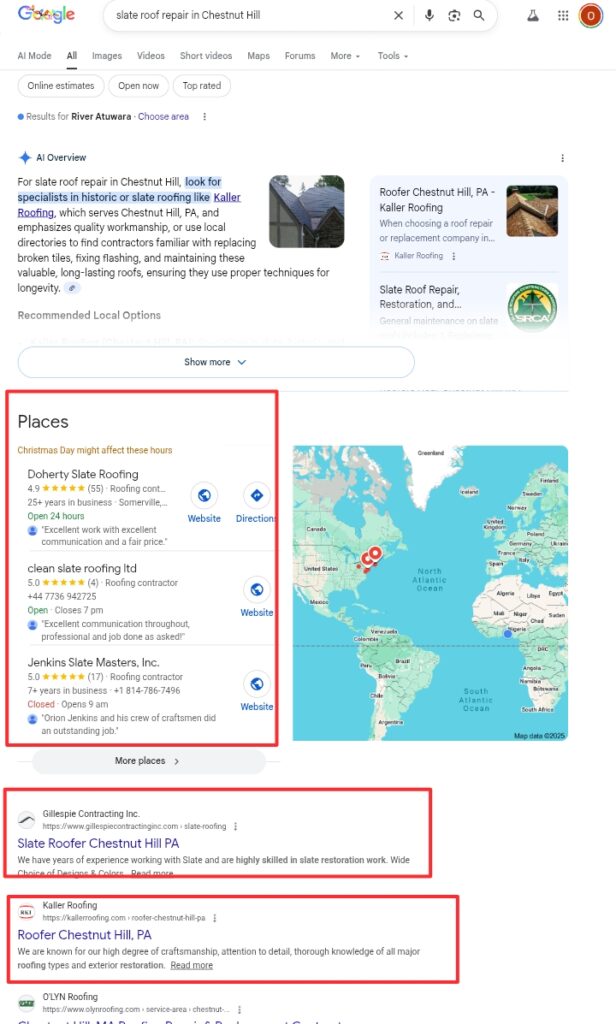
Most of those global clicks come from people who will never be in your service area, resulting in a 0% conversion rate and a sky-high bounce rate. Conversely, “slate roof repair in Chestnut Hill” is pure gold because it targets a specific, high-intent customer in an affluent neighborhood where specialized skills are required; these searchers are local, have a high-value problem, and are ready to book a consultation immediately. And Google totally understands the assignment.

Source: Google
Focusing on this “long-tail” local intent ensures your agency delivers actual revenue rather than just empty traffic spikes, which is exactly how you prove your worth to an SMB owner.
You have to bucket your efforts into the three stages of the local buyer’s journey:
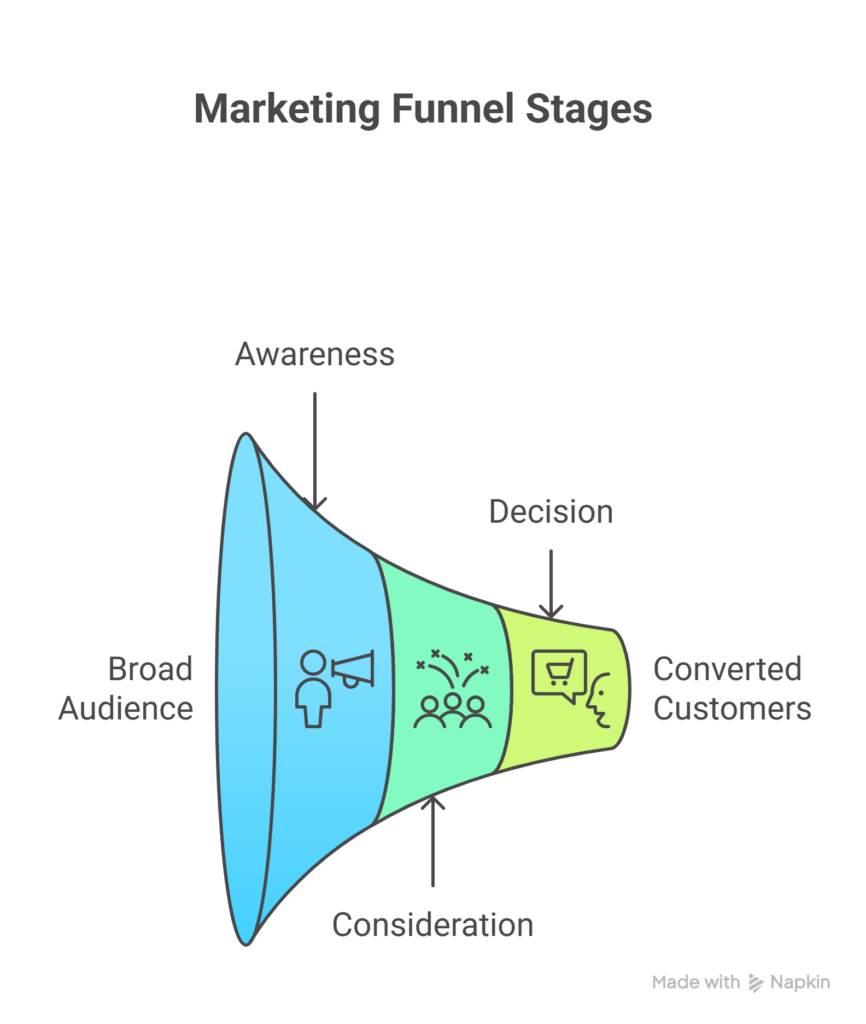

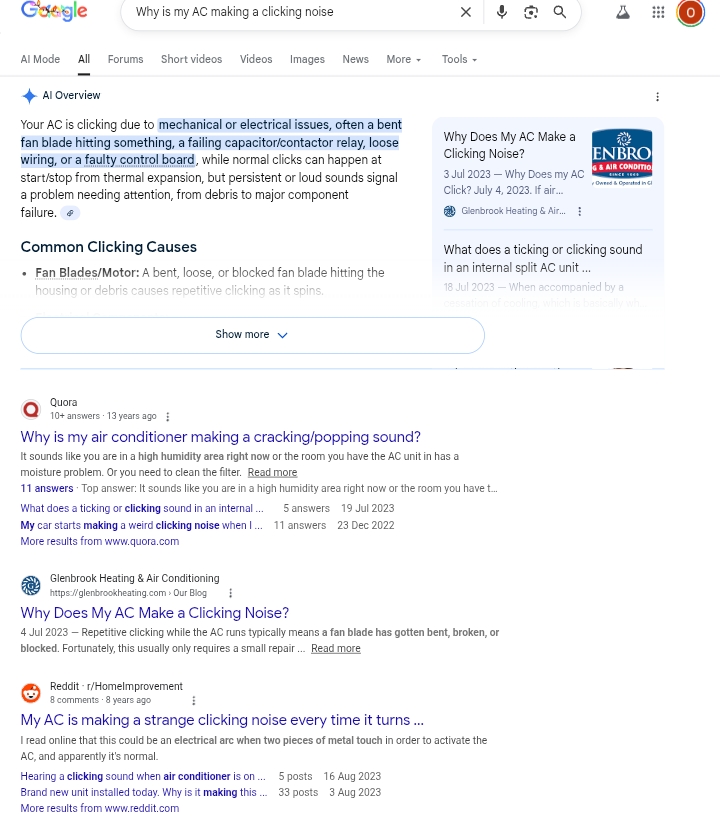
- TOFU (Top of Funnel – Awareness): These are the “I have a problem” searches. “Why is my AC making a clicking noise?” or “Ice on AC coils in summer.” These users aren’t ready to whip out a credit card yet; they are diagnosing.
TOFU queries are answered mostly by the Google AIO, blogs, and forums.

Source: Google
Google won’t pull up your business page for them. But by answering these, you become the local hero. Plus, consumers are 131% more likely to buy from a brand immediately after reading educational content. You’re essentially pre-selling them.
- MOFU (Middle of Funnel – Consideration): This is the “Comparison” phase. “Central AC vs. Ductless Mini-Split” or “Cost of R-22 vs. R-410A refrigerant.” The user knows they need a pro; they’re just figuring out what kind of pro. This is where you use case studies and “Versus” posts. Also, another thing to include here is “Best [Service] in [City]” lists, even if you mention a few competitors, being the one who wrote the guide gives you the “Expert” edge.
- BOFU (Bottom of Funnel – Conversion): This is the “Money Shot.” “Emergency AC repair services [City Name]” or “Carrier AC unit installers near me.” These are high-cost, high-competition keywords. Google understands these queries have high commercial intent, so it shows your business pages for these.
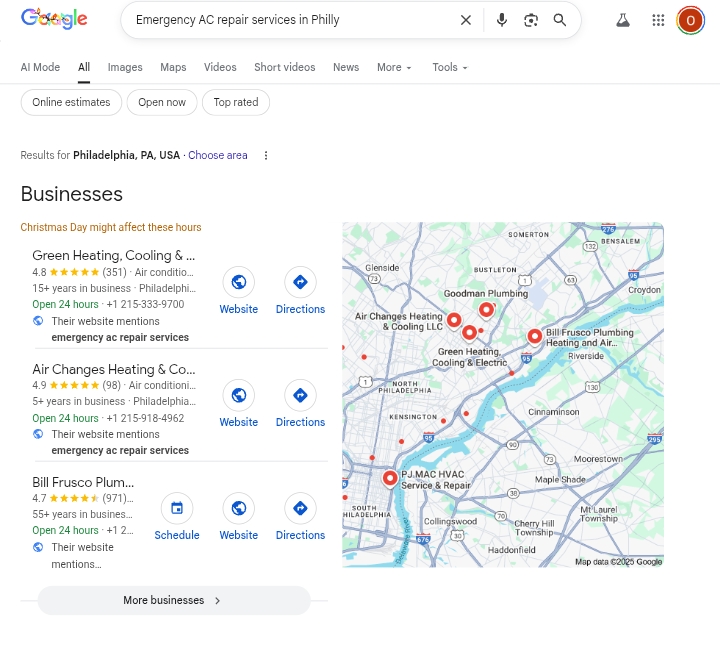

Source: Google
You need dedicated service pages with clear phone numbers and social proof to win here. On top of that, these pages need to be localized. Don’t just say, “We fix ACs.” Say “We’ve been fixing ACs in [City] since 1998.”
Prioritization: The “Quick Win” vs. “The Big Bet”
When you take on a new client, you are on trial. If you don’t show movement in the first 90 days, the owner starts looking at that $200-per-location fee and wondering if they should’ve just bought more radio ads. This is why you need a two-track system for your website SEO growth strategy.
- The Quick Win (low difficulty/high intent): Look for “long-tail” phrases that the big franchises are too lazy to target. If your client is a personal injury lawyer, don’t start with “Car accident lawyer.” That is a 12-month bloodbath. Start with “What to do after a car accident on the [Local Highway Name].”
- The Logic: These terms might only have 15 searches a month, but the “Intent to Hire” is almost 100%. Five of these niche pages can generate more actual revenue than a Page 1 ranking for a generic term that just brings in students or curiosity seekers.
- The Big Bet (high volume/high difficulty): These are the “trophy” keywords. “Best Dentist in [Major City].” You start working on these in the background. You build the “Pillar Page” today, knowing it won’t hit Page 1 for six months. In addition, you use the “Quick Win” pages to link up to the “Big Bet” pages. This conveys “topical authority” and tells Google that you know every little detail about this niche.
The 6-Month Content Calendar (The Operational Rhythm)
Stop improvising with blog posts. A strategy that relies on “whenever we have time to write” is doomed to fail. You need a schedule that balances fresh content with “historical optimization.”
- The 70/30 Rule: Spend 70% of your energy on new, high-intent pages. Spend 30% on “Refreshing” what already exists.
- Why Historical Optimization? HubSpot found that over 75% of their blog views and 90% of their leads come from “old” posts. Take a post from 2022 about “Local Tax Laws.” The info is dusty. You go in, update to 2025 numbers, add a new “Expert Tip” video from the client, and swap out the grainy cell phone photos for high-res shots. Change the publish date to today. Google sees a “Freshness” signal, and you often see a 20% to 50% jump in traffic within weeks. It is significantly cheaper and faster than writing a 2,000-word piece from scratch.
- The “Hub and Spoke” Setup: * The Hub: A massive “Ultimate Guide to [Service] in [City].” The Spokes: 5-10 smaller articles answering specific questions (the TOFU stuff) that all link back to the Hub. This tells Google you are the local authority.
Equally important is the “Visual Roadmap.” Don’t just plan for text. Plan for a “Project Gallery” update in Month 3 and a “Customer Video Testimonial” upload in Month 4. Along with that, make sure your calendar includes “Local Context.” If you’re an HVAC agency, your “Furnace Prep” content needs to be live and indexed by September, not November. Besides that, as you scale, managing this for 20+ clients becomes a nightmare.
Using the tasks/activities feature in Synup helps your team stay on top of the “Refresh” dates and publishing deadlines so nothing falls through the cracks. It moves the agency from “reactive” (panic-writing a blog because the client asked for a report) to “proactive” (delivering a planned, high-value asset every single month).
Step 5: Off-Page Strategy & E-E-A-T Building
SEO does not just happen on the client’s website. You have to prove to Google that the client is a real authority in the real world.
Beyond Simple Backlinks
Google looks for Experience, Expertise, Authoritativeness, and Trust (E-E-A-T). This is especially true for “your money or your life” (YMYL) industries like finance or healthcare. Ensure your client’s “About Us” page actually lists their credentials, years in business, and any awards.
The Modern Link Acquisition Plan
Forget the old school link farms. Focus on Digital PR. If your client is a local expert, get them quoted in local news stories.
Another thing to try is resource page outreach. Find a local community page that lists “Best Home Services in [City]” and ask to be included. Broken link building is also a great tactic: find a dead link on a relevant site and offer your client’s content as a replacement.
Check Out: How to Find Local Backlinks for Your Local Business Website
Reputation as a Ranking Factor
For local businesses, reviews are a massive ranking signal. A business with a 4.8-star rating and 200 reviews will almost always outrank a business with a 3.0-star rating.
Along with that, responding to reviews (both good and bad) shows Google that the business is active. Managing this at scale for multiple clients can be a nightmare, which is why the Synup’s Review Management tool is a lifesaver for agencies. It lets you monitor and respond to reviews across different platforms from one dashboard.
Also Read: 5 Ways To Automate Review Management For Your Clients
Step 6: Prioritization & The Action Plan (Getting Client Buy-in)
At this stage, you have a mountain of tasks. If you show the client a list of 100 things to do, they will get overwhelmed and do nothing. You need to simplify.
The Impact vs. Effort Matrix
Rank every task on a scale of 1 to 10 for both impact and effort.
- High impact / low effort: Fixing a broken contact form or updating Page Title tags. Do these in Week 1.
- High impact / high effort: Building a 5,000-word skyscraper guide or a major site migration. Schedule these for Month 3.
- Low impact / high effort: Changing the font on the whole site just because the owner likes it. Put these at the bottom of the list.
The Phased Rollout
Present the strategy in phases.
- Phase 1: Foundation. Technical cleanup, GBP optimization, and metadata fixes.
- Phase 2: Growth. Launching the content calendar and starting internal link sprints.
- Phase 3: Authority. Heavy link building, digital PR, and reputation management.
Defining “Success” KPIs
Stop reporting on “rankings” as the primary metric. Rankings fluctuate.
Instead, report on lead volume, organic revenue, and phone calls. If you show a client that you increased their “Request a Quote” submissions by 20%, they will never fire you. This is the ultimate way to reduce churn.
You can also use the Client Summary to give them a high-level view of these results without switching between different spreadsheets in the middle of a call.
Also Read: Client Data Management: How to Store, Monitor, & Use Client Data Effectively
Step 7: Ongoing Execution, Measurement, & Adaptation
SEO is never a “set it and forget it” service. It is a process of constant refinement.
The “Marathon” Mindset
Explain to your team and your client that consistency beats intensity. It is better to publish two high-quality articles per month for a year than to dump twenty articles in month one and then do nothing for the rest of the year.
Client Reporting: Jargon-Free Communication
Your clients do not know what “LSI keywords” or “canonical tags” are. They want to know if they are making more money. Provide clear, human reports.
Explain why the traffic went up (e.g., “Our new guide on kitchen remodeling is now ranking #3”) and what the next step is. For agencies managing dozens of clients, the Synup Client Portal provides a white-labeled space where clients can see their own progress, which builds massive trust.
Also Read: Mastering Agency Client Communication: Best Way to Communicate with Clients
Iterative Re-Audits
The internet changes. A competitor might launch a massive new campaign, or Google might release a “Core Update” that changes the rules.
Re-audit the strategy every six months. Check your keyword gaps again. See if your “Power Pages” are still performing. If you stay proactive, you stay ahead.
Conclusion
Building an SEO strategy for a new client is basically just moving from total chaos to a clean, repeatable system. When you follow this 7-step process to create an SEO strategy for new clients, you can stop guessing and start executing like a real business partner.
Always remember: SEO is a high-value asset that appreciates over time, not a pesky monthly expense that should be on the chopping block. When you tie every keyword and technical fix back to the client’s actual revenue goals, everything else just clicks. Now that you’ve got the blueprint to create an SEO strategy that creates impact in the real world, it’s time to stop reading and start doing the work.
FAQs
1. How long does it take to see results for a new client?
You’ll usually see some green shoots like technical quick wins or page 1 rankings for obscure long-tail terms within the first 30 to 60 days. However, significant ranking improvements for competitive terms and a steady increase in organic leads usually take 6 to 12 months of consistent work.
2. Should I focus on technical SEO or content first?
Tech first, every single time. There is zero point in paying a writer for world-class content if Google’s bots get stuck in a “crawl trap” or if the page takes five seconds to load on a smartphone. Get the site healthy, fast, and indexable, and then shift your focus to the content engine.
3. How do I price agency SEO strategy phases?
Most agencies serving SMBs stick to a retainer model. A smart move is charging a higher “Onboarding Fee” in Month 1 to cover the heavy work, like deep-dive audit and roadmap creation. After that, you can transition to a monthly fee of $100 to $200 per location for the ongoing execution. Plus, using an all-in-one setup like Synup Agency OS helps you protect those margins because you aren’t getting nickel-and-dimed by ten different third-party tools.


