



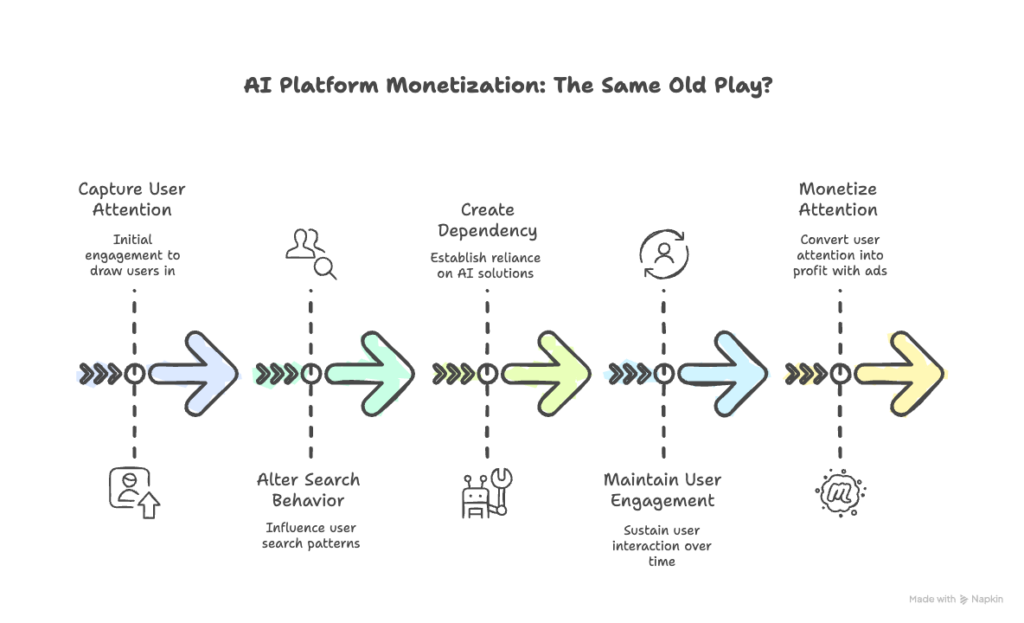
AI search seems to be following the lead of search engines when it comes to monetization. The same old play – capture attention, change consumer search behaviour, create dependency, and then monetize that attention.
We spent the better half of the year trying to win back clicks lost to AI tools & AIOs, while figuring out ways to make our brand more visible on AI. While organic search continues to be a thorn in the flesh, another thing that’s worrying marketers is the rising CPCs and CACs of ads.
As more brands lose organic traffic, the marketing dollars are slowly shifting towards performance channels, with a lot of it going into search ads. But the increased competition and cluttered SERPs after AI overviews have made this quite an expensive channel.
At the same time, OpenAI, Microsoft, and now Google are hinting towards paid placements in their AI platforms. Will this likely open a new revenue channel for marketers? AI tools that claim to be impartial and informative in their answers may now subtly recommend partners or show ads in between answers – how will this impact consumer preferences?
Who did what when: A brief timeline
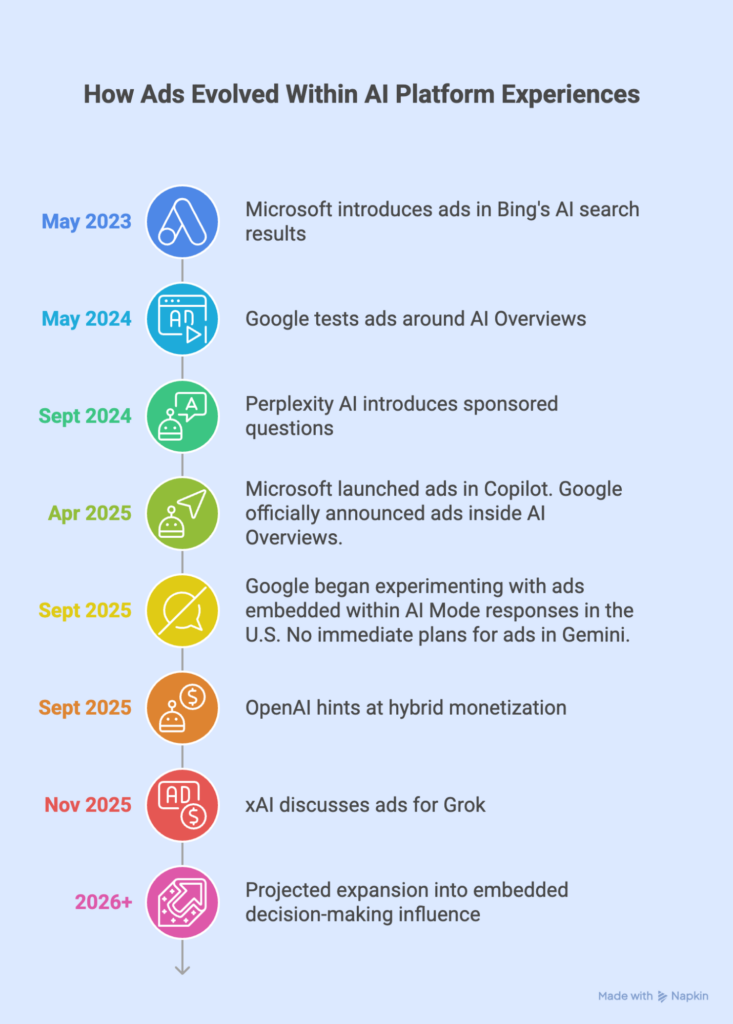
Before we talk about what’s possible, I want you to take a quick look at what’s already been tested by major search platforms & AI stalwarts. The idea of monetizing AI search with ads has been seeding since early 2023. The first in line being Microsoft.
> Microsoft’s Early Experiments with Bing Ads
Bing was one of the firsts to combine AI-style search with advertising, though this wasn’t exactly the same as ads inside a purely generative answer interface. Bing introduced ChatGPT-powered search in 2023. Following this, ads appeared alongside AI-generated answers in Bing search results. These were traditional search ads shown next to or below AI responses.
This was a big signal that AI-powered search would not be ad-free and these ads could coexist with generative answers without breaking UX.
> Google takes the baton
You’d be surprised to know that ads in AIOs isn’t a will-they/won’t-they, Google has already been testing out ad formats & placements around AIOs for over a year now. Google launched AI Overviews in early 2024. Initially launched in the US, it quickly became a global search experience.
The first appearance was in May 2024 in the United States. Google began testing ads in its AI Overviews and within AI-powered search summaries, and then publicly discussed/expanded them throughout 2025. These ads appeared above or below the AI-generated summary responses and are tied to Google’s existing Search ad auctions.
> Perplexity tries… and stops
Perplexity introduced what is one of the earliest examples of ads designed specifically for conversational AI, not adapted from search (like in case of Bing & AIOs). This was in late 2024.
Ads appeared as sponsored questions and branded follow-up prompts within AI answers. They started testing these ads for their large publisher partners like Whole Foods, Indeed, PMG, and others.
For example, if a user asks about healthy eating, a sponsored question might ask about organic grocery options, with Whole Foods as the sponsor. The answers to these sponsored questions are generated by Perplexity’s AI, not written by the advertiser, to maintain objectivity. The pricing would be CPM-based.
By the way, their About Us page used to mention, “Perplexity was founded on the belief that searching for information should be a straightforward, efficient experience, free from the influence of advertising-driven models.”
But they changed it to “Perplexity was founded on the belief that searching for information should be a straightforward, efficient experience”.
And now it’s entirely gone👀😂
In early 2025, Taz Patel, Head of Advertising at Perplexity, was seen saying their top priority is not to mess with a user’s search experience. Which seems quite contrary, because people don’t query an LLM to see ads; they’re simply looking for answers to their questions.
That didn’t last long, as Patel exited from the company in August. Right after, Perplexity announced they have stopped taking on new advertisers and is instead focusing on rethinking how ads fit into their platform.
I’d say that’s the right move so far. But it does make us question what problems did they face with a conversational ad model that made them stop & step away for a while? Are Google and other players in this space likely to face the same issues?
> Sam Altman discusses what ads will look like in ChatGPT
Unlike Google, OpenAI hasn’t rolled out ads yet. But it has been unusually transparent about how it thinks about monetization — and more importantly, what it believes would break ChatGPT.
Over the past year, OpenAI has repeatedly hinted that ads or monetization will exist in ChatGPT at some point. Not in the classic “sponsored result” sense — but in ways that (at least in theory) don’t interfere with trust.
And Sam Altman has been very deliberate about drawing that line.
Sam Altman has publicly criticized traditional search advertising models where platforms make money because results fall short. Google makes money when users don’t find the perfect answer immediately and have to keep searching. ChatGPT, Altman argues, should only make money when it earns a user’s trust, not when it exploits friction.
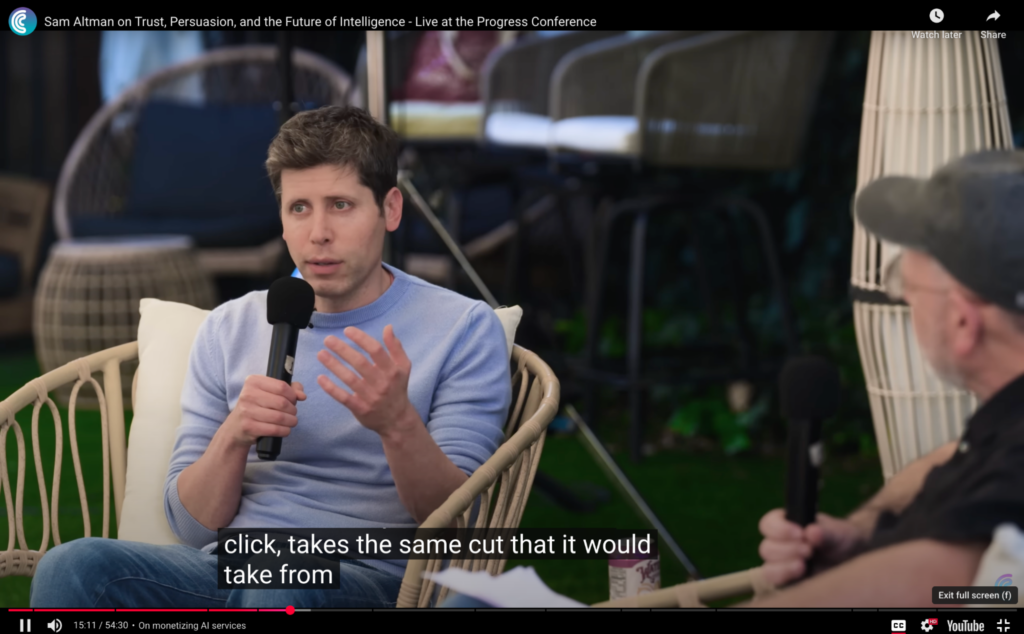
“If ChatGPT were accepting payment to put a worse hotel above a better hotel, that’s probably catastrophic for your relationship with ChatGPT.”
That statement alone tells you how seriously OpenAI views ranking integrity. In Altman’s view, the moment money corrupts recommendations, the product collapses.
Which is why the ad model he describes doesn’t look like ads at all, at least not in the way marketers are used to.
Source: Search Engine Journal
> Google pushes ad experiences within AI Overviews & Launches AI Mode
If OpenAI is being careful and philosophical about monetization, Google is doing what Google has always done best: shipping first and normalizing later.
These ads are powered by the same Google Ads auction that’s been running Search for decades.
In other words: if you were already bidding on search ads, your ads could now sit right next to an AI-generated “answer.” (This was first rolled out to advertisers using Google’s AI-first ad formats like P-Max, AI Max, broad‑match Search and Shopping)
This is important because it tells us something very clearly — Google doesn’t see AI answers as a replacement for ads. It sees them as new real estate.
As AI Overviews rolled out globally, Google executives began openly acknowledging that ads would expand across AI-powered surfaces. Philipp Schindler, Google’s SVP and Chief Business Officer, confirmed that ads around AI-generated experiences would extend to more regions and formats over time, including what Google now calls AI Mode.
AI Mode is where things get more interesting, and more dangerous for organic visibility.
Unlike AI Overviews, which still sit on top of a traditional SERP, AI Mode shifts Google closer to a conversational, task-oriented interface. Fewer blue links. Fewer opportunities to “scroll and compare.” More synthesized answers, suggestions, and nudges.
And yes, more ads.
But these ads don’t feel like ads in the classic sense. They feel like contextual recommendations embedded inside a guided flow. That distinction matters.
In a traditional SERP, users expect ads. They scroll past them. They understand the game.
In an AI-led interface, recommendations carry implied authority. When Google suggests something inside an answer, it feels closer to advice than advertising, even when there’s a paid component underneath.
Google knows this. But they’re betting that users will accept ads here the same way they accepted ads in Maps, Shopping, and local packs — slowly, then all at once. But that’s a big bet (That’s a bet Perplexity already made. And that didn’t turn out so well)
> Other platforms are not shying away from the conversation
While Google and OpenAI dominate the narrative, they’re not the only ones thinking about how AI search pays for itself. Smaller (and newer) platforms have been far more open (sometimes blunt) about the trade-offs they’re willing to make.
And collectively, they reveal something important: there is no consensus yet on what “ethical” or “acceptable” AI ads actually look like.
Everyone is experimenting. Everyone is hedging. No one has cracked it.
For example, xAI’s Grok doesn’t pretend to be neutral territory.
Tied closely to X’s existing ad ecosystem, Grok’s monetization story has always been more straightforward: ads are part of the platform, and they’re not treated as a philosophical dilemma. With Elon Musk publicly emphasizing scale and distribution over purity, Grok is positioned less as a “trusted oracle” and more as a real-time, opinionated assistant embedded in a social platform.
That matters, because when your AI is already sitting inside an ad-driven feed, the user’s tolerance for promoted content is much higher.
Grok doesn’t need to convince users that ads won’t influence answers, it just needs to make them feel relevant.
With Meta, the direction is obvious even if the execution is still evolving.
Meta AI is embedded across WhatsApp, Instagram, and Facebook, platforms that are already optimized for monetization. Rather than introducing “ads into AI,” Meta is more likely to blend AI into ads.
- AI-assisted product discovery inside chats
- Business suggestions powered by WhatsApp conversations
- Brand interactions that feel like support, not advertising
Meta doesn’t need a new ad model. It already has the most sophisticated targeting and performance infrastructure in the world. AI simply becomes the interface layer.
Which means recommendations inside Meta AI are almost guaranteed to be commercial, whether we call them ads or not.
What’s possible next?
At this point, it’s no longer a question of if ads evolve inside AI search. It’s about where they show up, how subtle they become, and who they advantage by default.
What we’re watching right now feels less like a single pivot and more like a slow reshaping of the entire discovery stack.
Let’s break this down by platform and then zoom in on what it means for businesses, especially local ones.
How ads are likely to evolve in Google’s AI ecosystem
Google’s direction is the easiest to read, because it’s consistent with how Google has always operated.
AI Overviews were the entry point. AI Mode is the expansion. What comes next will likely be a deeper embedding of ads into AI-led flows, not necessarily as obvious “sponsored” blocks, but as contextual suggestions that sit naturally inside answers and next steps.
Rather than inventing a new monetization system, Google will almost certainly lean on its existing ad infrastructure. Paid visibility will become another way to ensure inclusion inside AI summaries, recommendations, and task-based interactions like booking, calling, or navigating to a business.
For businesses, this means search ads won’t disappear but organic visibility will keep getting compressed. There will be fewer moments where brands can surface naturally, and those moments will carry far more weight. Paid placements may increasingly become the fastest way to stay present when AI answers reduce the need to scroll, compare, or click.
Organic SEO won’t die; it will be forced to compete in a much smaller arena.
How monetization could look inside ChatGPT
OpenAI’s approach is harder to predict, mostly because it’s trying very hard not to look like Google.
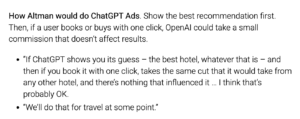
If Sam Altman’s vision holds, ChatGPT won’t monetize by selling ranking positions. Instead, it may monetize by facilitating decisions. The answer comes first. The transaction comes later. The model only makes money if the user acts.
In practice, this would turn ChatGPT into something closer to a decision engine than a search engine. A single recommendation, followed by a low-friction action. No visible bidding wars or incentive to distort results (at least in theory).
For businesses, this creates a very different set of incentives. Visibility won’t depend on how much you’re willing to pay upfront. It will depend on how reliable, clear, and easy to transact with you are. If there’s friction in your pricing, availability, or fulfillment, the AI has every reason to skip you.
In ChatGPT’s world, losing visibility won’t feel like losing an auction. It’ll feel like being quietly excluded.
Where this gets serious: local search & discovery
Local search is where these shifts stop being abstract. Local discovery already operates under intense constraints: high intent, immediate action, and a small set of viable options. AI compresses that even further. When an assistant checks prices, calls businesses, or recommends “the best option nearby,” users aren’t browsing, they’re delegating.
That delegation dramatically raises the stakes. There are fewer impressions. Fewer chances to be seen. And almost no room for ambiguity. Businesses without clear pricing, up-to-date availability, or structured data won’t be punished; they’ll just simply be ignored.
And this is where paid models become tempting. If platforms offer guaranteed inclusion inside AI-led local flows, many businesses will pay, not because they want an advantage, but because they can’t afford invisibility.
At that point, ads stop being about growth. They become about survival.
What this evolution really means for businesses
We’re slowly moving away from a world where marketers ask, “How do I rank higher?” and toward one where the real question is, “How do I get chosen?”
That shift changes everything.
Keywords matter less. Positions matter less. Even traffic matters less. What matters is whether the AI trusts your data, understands your offering, and can confidently hand you the user without creating risk.
Ads won’t just buy attention in this world. They’ll buy presence. And in AI-driven discovery, not being present often means not existing at all.
What Google won’t admit out loud
The real shift isn’t that ads exist in AI Overviews. It’s that organic visibility keeps shrinking while paid visibility keeps stabilizing.
As AI summaries answer more questions upfront:
- Fewer users click
- Fewer brands get discovered organically
- More budget gets pushed into ads just to maintain baseline visibility
AI Overviews didn’t just change how results look, but they also changed the cost of staying visible for brands.
And AI Mode accelerates that shift by reducing the surface area where organic content can even appear.
Which raises the uncomfortable question marketers are already asking quietly:
If AI answers become the default, and ads are the easiest way to be present around them… are we slowly moving toward a search ecosystem where visibility is rented, not earned?
That’s not something Google will say out loud. But it’s exactly the behavior their products are training us for.