



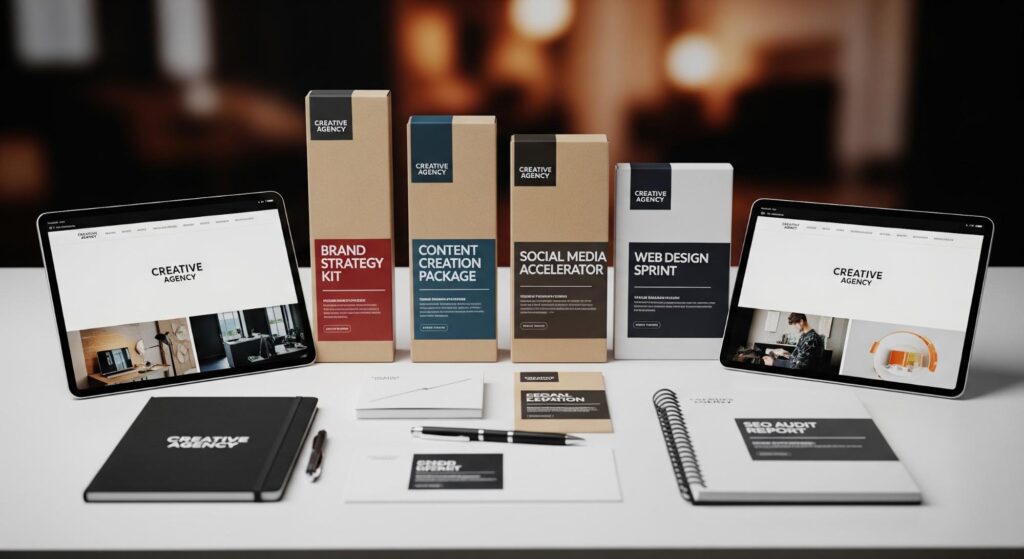
Productized agency services are exactly what they sound like: services that are bundled, priced, and sold with the same consistency as products. Instead of creating a custom proposal for every client inquiry, you offer clearly defined packages that clients can understand and purchase quickly. Think of it like ordering from a menu rather than hiring a personal chef to design a meal from scratch.
Why does productization matter for agencies? The benefits extend far beyond operational efficiency. When you productize your agency services, you create scalability by standardizing delivery processes, enabling your team to execute reliably without constant oversight. You gain predictable revenue streams through recurring packages and subscriptions. You reduce the drain of custom work that pulls senior talent into endless scoping meetings. Perhaps most importantly, you unlock easier cross-selling opportunities, once clients understand your standardized offerings, they can clearly see how additional services complement what they’ve already purchased.
In this article, we’ll explore how to successfully productize your agency services, the tangible benefits this approach delivers, and how standardization creates a foundation for effective agency cross sell strategies that drive sustainable growth.
What Is a Productized Service?
A productized service transforms traditional agency work into a clearly defined, standardized offering with fixed scope, deliverables, timeline, and pricing. Unlike custom agency work that requires extensive discovery, proposal development, and negotiation for each client, productized service examples include clearly packaged solutions that clients can understand and purchase immediately.
Consider these common productized agency services:
- Fixed retainer SEO packages: A monthly subscription that includes a set number of optimized pages, backlinks, and reporting deliverables
- Subscription design services: Unlimited design requests for a flat monthly fee with defined turnaround times
- Landing page packages: Three-tier offerings (basic, professional, premium) with clear features at each level
- Social media management bundles: Fixed packages including content creation, posting schedules, and engagement metrics
The contrast with traditional custom agency work is stark. Custom projects typically begin with extensive discovery calls, followed by tailored proposals that outline unique scopes of work. Pricing varies dramatically based on perceived client budget or project complexity. Each engagement requires significant upfront investment before any revenue is generated, and scope creep constantly threatens profitability.
Productized services flip this model. Clients visit your website, review clearly defined packages, and select the option that fits their needs. The scope is predetermined, deliverables are explicit, and pricing is transparent. This clarity benefits both parties: clients know exactly what they’re getting and what they’ll pay, while agencies can standardize delivery and operate more efficiently.
The foundation of successful productized service offerings lies in clarity and fixed deliverables. When clients can instantly understand what they receive, how long it takes, and what it costs, the friction in the buying process evaporates. This transparency doesn’t limit customization entirely, many agencies offer add-ons or customization options, but it establishes a clear baseline that makes sales conversations productive rather than exploratory.
Benefits of Productizing Your Agency Services
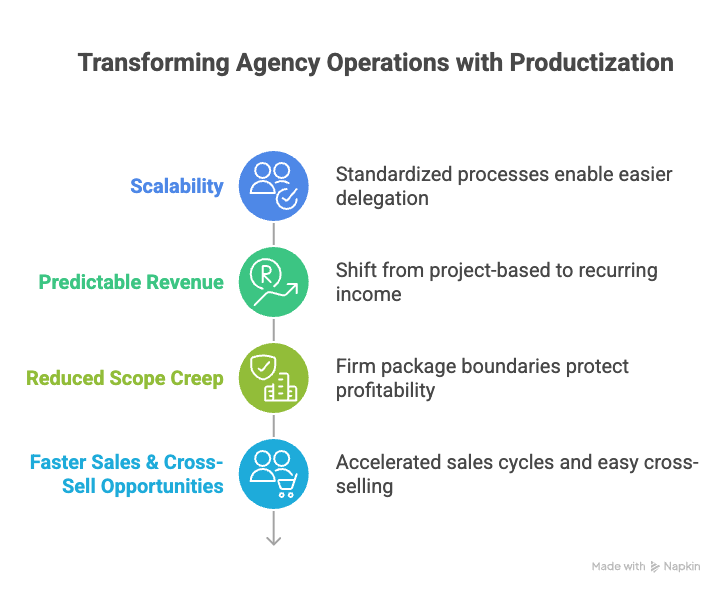
The shift from custom work to standardized service offerings delivers transformative benefits across every dimension of agency operations. Understanding these agency productization benefits helps justify the upfront investment required to restructure your service delivery.
Scalability
Scaling agency with productized services becomes exponentially easier when you standardize how work gets done. Custom projects require senior team members to scope, plan, and often deliver unique solutions for each client. This creates bottlenecks where growth is limited by the availability of your most experienced people. Productized services change this dynamic entirely.
When you define exactly how a service is delivered—the steps, the tools, the timeline—you create repeatability. Junior team members can execute documented processes without constant supervision. You can hire specialists who become experts in delivering specific packages rather than generalists who must adapt to endless variations. This standardization allows easier delegation, letting senior talent focus on strategy, refinement, and growth rather than execution.
Predictable Revenue
One of the most powerful benefits is the shift from unpredictable project-based revenue to stable, recurring income. Traditional agency models experience feast-or-famine cycles: revenue spikes when large projects close, then dips during sales droughts or project gaps. Fixed-price agency services, especially those structured as monthly retainers or subscriptions, create predictable cash flow.
When clients subscribe to ongoing packages—whether for SEO, content creation, or design services—you can forecast monthly recurring revenue (MRR) with accuracy. This predictability enables smarter hiring decisions, better resource planning, and more confident business investments. You’re no longer guessing whether next quarter will support your payroll; you’re managing a subscription base with measurable retention and churn metrics.
Reduced Scope Creep
Scope creep—the gradual expansion of project deliverables beyond the original agreement—is the silent profit killer in agency work. It happens when boundaries are unclear, when clients request “just one more thing,” or when teams lack the documentation to push back professionally. Productized services establish firm package boundaries that protect profitability.
With clearly defined deliverables, you can confidently say, “That feature is included in our premium package” or “We can add that as a custom add-on for $X.” The clarity isn’t adversarial; it’s professional. Clients appreciate knowing exactly what’s included, and your team appreciates having documented scope to reference. Fewer surprises mean projects stay profitable and clients remain satisfied with what they agreed to purchase.
Faster Sales & Cross-Sell Opportunities
Standardized service packaging strategy dramatically accelerates sales cycles. Instead of spending weeks crafting custom proposals, prospects can review packages and make decisions quickly. Some productized agencies report sales cycles shrinking from 30+ days to less than a week.
Even more valuable: productization creates obvious cross-sell opportunities. When clients understand your base offering, they can easily see how add-ons or adjacent services complement what they’ve purchased. A client buying a basic SEO package can immediately understand the value of upgrading to include competitive analysis or content creation. This clarity makes cross-selling feel like helpful guidance rather than aggressive upselling, creating easier cross-sells that genuinely serve client needs while increasing account value.
How to Productize Your Agency Services
Transforming your agency into a productized service model requires methodical planning and execution. Follow these actionable steps to successfully productize your offerings:
Step 1: Identify Repeatable, High-Demand Services
Begin by analyzing your existing client work to identify patterns. What services do you deliver most frequently? Which client requests appear repeatedly? Review your project history over the past 12-24 months and look for:
- Services you’ve delivered to multiple clients with similar outcomes
- Requests that prospects consistently ask about during sales conversations
- Deliverables that follow similar processes regardless of client
- Services with clear, measurable results that you can reliably produce
Don’t try to productize everything at once. Start with one or two high-demand services that you execute well and that clients value highly. These become your foundational productized offerings.
Step 2: Define Clear Scope & Deliverables
Successful productized agency services require crystal-clear boundaries. For each service you’re productizing, document:
Fixed deliverables: Exactly what the client receives (e.g., “10 optimized blog posts per month” or “weekly performance dashboard with 15 key metrics”)
Timelines: When work happens and how long processes take (e.g., “initial audit delivered within 5 business days; ongoing optimization every Tuesday”)
Pricing tiers: Create multiple levels (basic, professional, premium) that serve different client budgets and needs. Each tier should have clearly differentiated value.
Boundaries: Explicitly state what’s NOT included to prevent misunderstandings
The more specific you are, the better. Vague deliverables like “ongoing SEO optimization” invite scope creep. Specific deliverables like “monthly optimization of 5 target pages, 10 new backlinks, and monthly performance report” create clarity.
Step 3: Systemize & Document Your Processes
Productization only scales when your team can deliver consistently without reinventing the wheel. Create comprehensive documentation including:
Standard Operating Procedures (SOPs): Step-by-step instructions for delivering each service. Include checklists, templates, and quality standards.
Onboarding workflows: How new clients get started, what information you collect, and how you set expectations
Delivery workflows: The exact sequence of activities, responsibilities, and handoffs required to complete each deliverable
Quality assurance processes: How you review work before delivery and ensure consistency
Tools like Notion, Process Street, or even Google Docs can house this documentation. The key is making it accessible, searchable, and maintainable. As you refine processes, update documentation so it remains the single source of truth.
Step 4: Create Pricing Tiers
Effective subscription service packages typically offer 3-4 pricing tiers that serve different client segments:
Starter/Basic tier: Entry-level pricing with core deliverables, designed to capture price-sensitive clients and serve as a gateway to higher tiers
Professional/Standard tier: Your primary offering with comprehensive deliverables, priced for your ideal client profile
Premium/Advanced tier: Enhanced service level with additional support, faster turnarounds, or expanded deliverables
Enterprise/Custom tier (optional): For clients needing significant customization or volume
Price each tier based on the value delivered and your cost to deliver, not just by adding arbitrary margins to lower tiers. The premium tier should offer meaningfully better outcomes, not just marginally more deliverables. Consider psychological pricing (e.g., $997 vs $1,000) and ensure sufficient margin between tiers to make upgrades attractive.
Step 5: Build Sales & Marketing Assets
Your productized services need marketing materials that communicate value clearly:
High-converting landing pages: Dedicated pages for each service package with clear benefit statements, deliverables lists, pricing, and strong calls-to-action
Case studies: Documented success stories showing results clients achieved with specific packages
FAQs: Anticipate and answer common questions about scope, process, pricing, and outcomes
Comparison charts: Visual representations showing differences between tiers
Sales collateral: One-pagers, presentation decks, and email templates that sales teams can use
These assets do double duty: they educate prospects and they serve as sales tools that accelerate decision-making. When prospects can self-educate on your offerings, sales conversations focus on fit and results rather than explaining basic service details.
Step 6: Train Your Team
Even perfect documentation fails if your team doesn’t adopt it. Invest in thorough training:
Delivery teams must understand documented processes, where to find SOPs, and how to execute packages consistently. Conduct hands-on training sessions and shadow experienced team members.
Sales teams need to understand package boundaries, pricing rationale, and how to position tiers effectively. Equip them with objection handling scripts and cross-sell conversation frameworks.
Account managers should know how to identify cross-sell opportunities, when to suggest upgrades, and how to manage client expectations within package constraints.
Create feedback loops where teams can suggest process improvements. The best productized services evolve based on delivery insights and client feedback.
How Productization Helps Create Easier Cross-Sells
One of the most underappreciated benefits of productized services is how they naturally enable effective agency cross sell strategies. When services are standardized and clearly defined, clients can easily understand how additional offerings complement what they’ve already purchased.
Consider the customer journey with traditional custom agency work: a client hires you for a specific project, the work gets completed, and then you start from scratch explaining what else you offer. Without clear product boundaries, cross-sells feel random or opportunistic.
Productized services create logical upgrade paths and complementary service bundles. For example, a client might purchase a base SEO package that includes keyword research and on-page optimization. Once they see results, you can present a clear upgrade path:
- Base package: Monthly SEO optimization with basic reporting
- Upgrade: Add ongoing content creation to support keyword targets
- Further upgrade: Include comprehensive strategy audits quarterly
- Complementary add-on: Local SEO management for multi-location businesses
Each step feels like a natural evolution, not a sales pitch. The client understands exactly what they’re getting at each level because the packaging is clear.
This clarity transforms cross-selling from an aggressive sales tactic into helpful guidance. You’re showing clients how to maximize their results by adding services that logically build on their existing investment. The standardized product ladders help clients visualize their growth journey with your agency.
Moreover, when clients see consistent delivery on your base package, they develop trust that makes cross-sells easier. They know what to expect because you’ve delivered reliably on clearly defined promises. This trust, combined with transparent packaging, creates cross-sell opportunities that feel consultative rather than transactional.
Synup’s Plans Feature
Synup’s Plans Builder demonstrates how technology can accelerate productization for agencies. This feature enables agencies to group complementary services into coherent, sellable bundles that clients can understand immediately.
For example, a local marketing agency using Synup can create a “Local Dominance” plan that bundles:
- Local SEO optimization across directories
- Review management and response services
- Monthly performance reporting with visibility metrics
When a client purchases this bundled plan, the agency delivers all three services as an integrated offering. The Plans feature makes this packaging seamless by allowing agencies to combine different service modules into named packages with unified pricing.
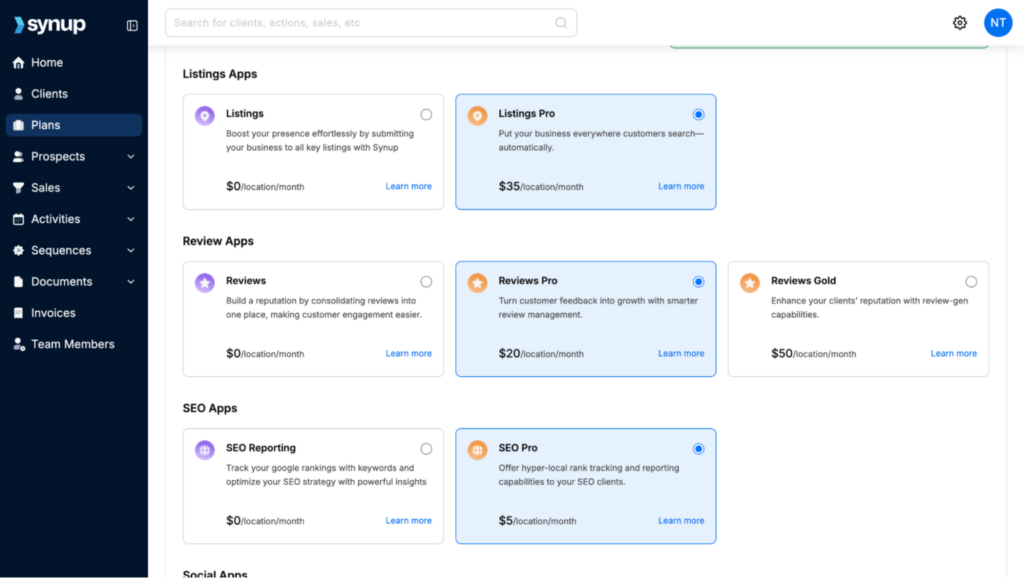
This bundling creates natural cross-sell opportunities. A client might start with just review management, then the agency can demonstrate how adding local SEO and reporting creates multiplied value. Because the Plans feature presents these bundles clearly, clients can visualize the upgrade path and understand exactly what they’re adding.
The platform approach also ensures delivery consistency. When services are bundled into plans, the agency’s team follows standardized workflows for each component, ensuring quality and enabling scale. Clients receive predictable results, which builds the trust necessary for successful cross-sells.
How Agencies Can Package Services
Marketing Agency SEO Productized Offering: A digital marketing agency might create three SEO tiers:
- Starter SEO ($500/month): 5 optimized pages, 10 backlinks, monthly report
- Local SEO ($300/month): Listings on 20 directories, 20 new review generation & responses, local rank tracking
- Social ($50/month): 15 published posts, social analytics tracking
Cross-sell path: Client starts with Starter, sees traffic growth, upgrades to Growth tier, then adds complementary content marketing package.
Design Agency Monthly Subscriptions: A design studio offers unlimited design requests:
- Essential ($2,995/month): One active request at a time, 48-hour turnaround
- Professional ($4,995/month): Two active requests, 24-hour turnaround, video calls
- Agency ($8,995/month): Four active requests, same-day turnaround, brand strategy included
Cross-sell path: Client subscribes for social media graphics, then adds website maintenance package once they see quality and speed of delivery.
In each case, the second product becomes an obvious next step once the client experiences value from the first. The standardization makes the cross-sell feel like logical progression rather than unrelated upselling.
How to Get Started With This
Successfully implementing productized services requires attention to both what works and what commonly fails.
- Test pricing with a small cohort: Before launching widely, offer your productized services to 3-5 existing clients at introductory pricing. Gather feedback on deliverables, pricing perception, and process efficiency. Use this learning to refine packages before full launch.
- Maintain clear scope documentation: Living documents that outline exactly what’s included in each package prevent misunderstandings. Make these accessible to clients and team members, and update them as offerings evolve.
- Use feedback to refine offerings: Create regular review cycles (quarterly or bi-annually) where you analyze client feedback, delivery metrics, and profitability data. Adjust packages based on what you learn, add value where clients want it, remove deliverables that don’t move the needle.
- Document everything obsessively: The difference between a productized service and a repeatable service is documentation. Invest heavily in SOPs, templates, and process guides that enable consistent delivery regardless of who’s executing.
- Build flexibility within boundaries: Allow some customization within packages through add-ons or a la carte options, but keep the core package fixed. This balances standardization with client needs.
Conclusion
Productizing your agency services represents a fundamental shift from trading time for money to building scalable, predictable service offerings. By packaging your expertise into clearly defined deliverables with transparent pricing, you create multiple advantages: operational scalability through standardized processes, predictable revenue through recurring packages, reduced scope creep through firm boundaries, and dramatically faster sales cycles.
Whether you’re implementing Synup’s Plans feature to bundle local marketing services, creating tiered SEO packages, or launching subscription design offerings, the principles remain consistent: identify what you do best, standardize how you deliver it, document everything, and price for value. The agencies that master productization don’t just create more efficient operations, they build businesses positioned for sustainable growth through clearer positioning, easier sales, and logical cross-sell opportunities that expand account values while genuinely serving client needs.