

Here’s a scenario that feels reasonable on the surface: a customer finishes a service, you send them a quick satisfaction check: “How did we do?”
Only the ones who respond positively get a link to your Google Business Profile. The unhappy ones get a private feedback form. Problem solved, right?
Wrong. That workflow has a name: review gating. It has always been against Google’s policies. But as of October 2024, it’s also illegal under federal law.
The good news: building a strong, authentic review profile doesn’t require filtering. This guide explains what review gating is, why it’s prohibited, and what to do instead.
TL;DR
- Review gating means filtering who gets to leave a public review based on sentiment.
- It violates Google policy and is illegal under FTC rules (since Oct 2024).
- Risks include review removal, reputational damage, profile suspension, and fines up to $51,744 per violation.
- The compliant approach: ask everyone, use neutral language, and respond to all reviews.
What Is Review Gating?
Review gating is the practice of pre-screening customer sentiment before directing anyone to a public review platform, often routing satisfied customers to Google while steering dissatisfied ones toward a private channel that never goes public.
It sounds like reputation management. Technically, it’s review manipulation.
The forms it takes in practice vary, but the pattern is the same:
- A “How was your experience?” survey that only sends 4- or 5-star respondents a Google review link.
- A post-service SMS that says “If you had a great experience, leave us a review!” implicitly excludes anyone who didn’t.
- Automated platforms that run an NPS (Net Promoter Score) first, then trigger the review request only for promoters, so that detractors never reach the review link.
- Any workflow in which the path to a public review platform is contingent on a positive signal.
The test is simple: Is every customer receiving the same invitation to leave a public review, regardless of their initial satisfaction? If not, it’s gating.
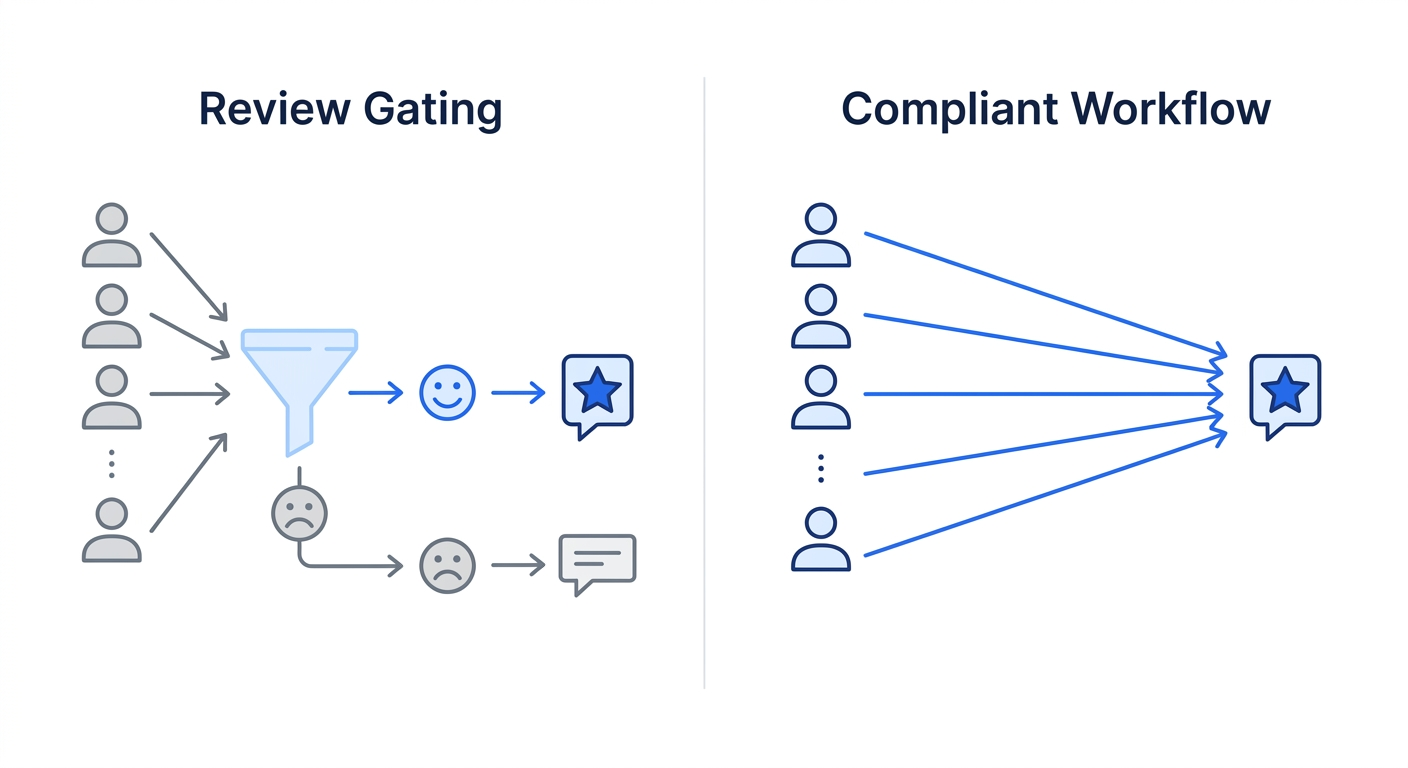

The NPS-as-filter workflow deserves special attention here because it’s the most commonly misunderstood variant. Many businesses and agencies running this exact flow genuinely believe it’s a grey area or a harmless internal check before asking for feedback. It isn’t.
Using a satisfaction score as a gate is specifically the practice that regulators and Google have flagged. If your current review request sequence involves any sentiment checkpoint before the review link, it qualifies.
Why Review Gating Is Against the Rules
Let’s understand the policies of the governing bodies affecting review gating, including Google’s policy and the Federal Trade Commission (FTC) angle, and how they create distinct, compounding risks.
Google’s Review Policy
Google’s prohibited content policy explicitly states that businesses must not “discourage or prohibit negative reviews” and must not “selectively solicit positive reviews from customers.” Google treats review gating as deceptive content, and its enforcement reflects that. Failing to comply with Google review-gating policy guidelines can lead to serious consequences, including review removal. And in some cases, Google may erase an entire review history if evidence of gating is found. That’s not a hypothetical. Businesses have had years’ worth of accumulated reviews wiped out overnight.
Google blocked 240 million fake or policy-breaking reviews in 2024, a number that reflects both the scale of enforcement and how seriously the platform is treating review integrity. The bar for what triggers enforcement is not high. An unusual positive-to-negative ratio, suspicious timing patterns, or a third-party complaint can all flag a profile for review.
The FTC’s Consumer Reviews and Testimonials Rule
The FTC Consumer Reviews and Testimonials Rule went into effect on October 21, 2024, enabling courts to assess civil penalties for deceptive and unfair review practices. This means that review gating isn’t an informal guideline. It’s a finalized federal rule. The FTC introduced a rule banning fake reviews and suppressing negative ones, with fines of up to $51,744 per violation.
The FTC’s position is explicit: businesses cannot ask for reviews only from people they think will leave positive ones, and cannot prevent or discourage negative reviews from reaching public platforms. Critically, the FTC does not need to prove that you intended to deceive. If your system naturally suppresses negative reviews, you are responsible.
The Fashion Nova case is the clearest precedent here. In January 2022, the FTC filed a complaint against Fashion Nova, alleging the company blocked negative reviews from appearing on its website. Fashion Nova suppressed feedback by not publishing reviews with ratings below 4 stars. This led to a $4.2 million fine for creating misleading reviews. Fashion Nova had legal teams. It still didn’t get away with it.
The Consumer Review Fairness Act
The 2016 Consumer Review Fairness Act makes it illegal for businesses to include terms in form contracts that prohibit or restrict customers from leaving honest reviews. Using workflows that structurally prevent negative reviews from reaching public platforms falls squarely within this legal territory. If your website only shows positive reviews and hides the rest, you violate the Consumer Review Fairness Act and other FTC rules on truthful representation. Cherry-picking reviews equals deceptive, and deceptive equals illegal.
The Real Consequences
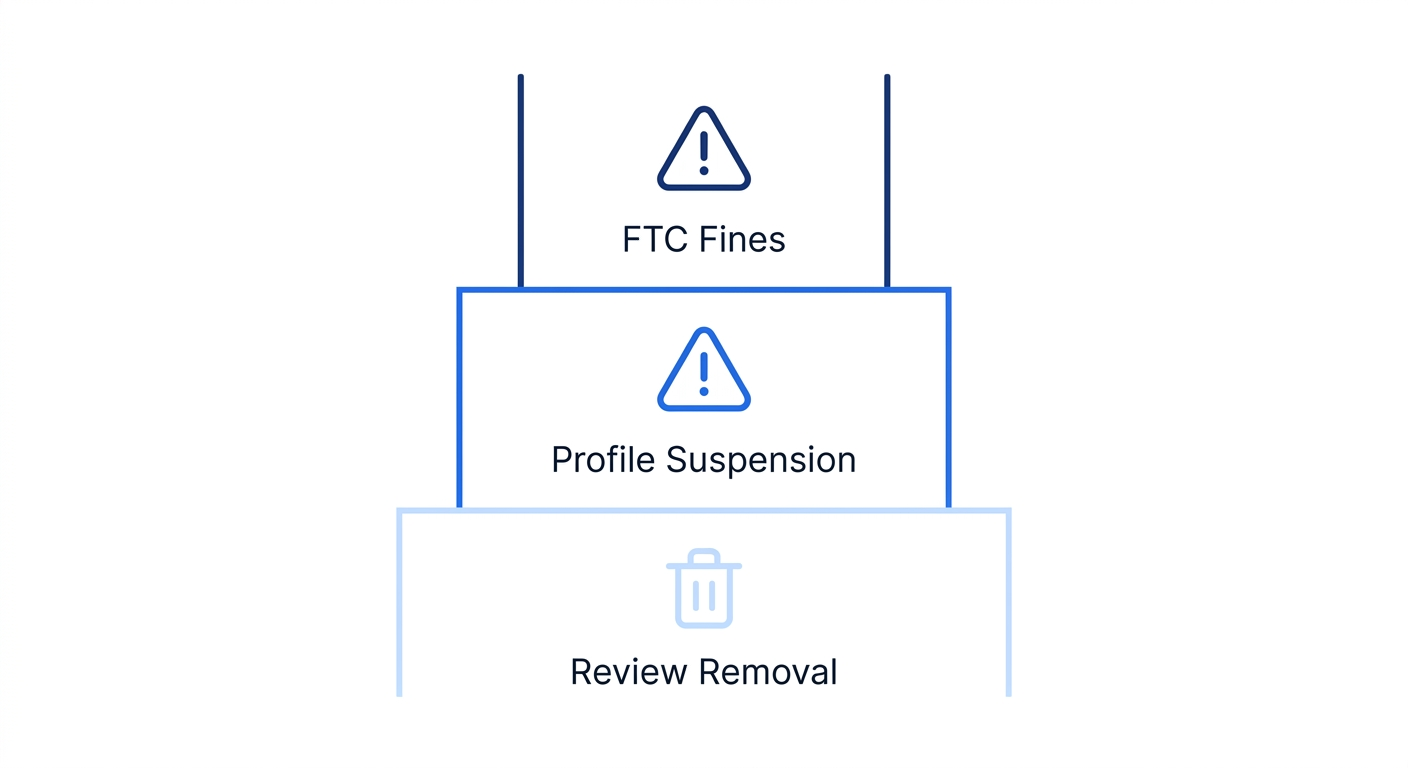
Here’s what actually happens when you violate policies:
- Google removes your reviews (all of them): Not just the ones from suspicious time periods. When Google finds evidence of gating, it can remove an account’s entire review history. Google’s algorithm prioritizes authenticity and diversity of reviews as part of its local ranking factors, and an account that suddenly loses its review count takes a direct hit to local search visibility.
- Your profile can be suspended: Repeat violations or egregious patterns can result in Google Business Profile suspension. Anyone who has dealt with a suspended GBP knows how devastating and difficult it is to reverse that process. Appeals are slow, reinstatement isn’t guaranteed, and during that time, the business is effectively invisible in local search.
- The FTC fine math is serious: If you gate 100 reviews over 3 months, that’s potentially $5.1 million in fines at $51,744 per violation.
- Consumer trust takes the bigger hit: Consumers distrust businesses with only perfect 5-star ratings, suspecting review manipulation. When a gating practice is exposed publicly (and they do get exposed), the reputational damage from the revelation of filtering is typically worse than any negative review the business was trying to suppress. A 4.2-star average with a few honest 2-star reviews is more credible than a perfect 5.0. Consumers know this.
Read More: 10 Risky Online Review Practices To Avoid
What to Do Instead: Compliant Review Generation
There’s a better way to build reviews, and it actually works better in the long run. Here’s what compliant review generation looks like in practice.
- Ask everyone, every time: No pre-filtering. No sentiment checkpoint. Every customer who completes a transaction or service gets the same review request. This is more effective at building review velocity than any filtering system, because volume compounds. The businesses that appear most prominently in local search are the ones with consistent, recent, and diverse review signals.
- Timing is your biggest lever: The single most effective variable in review generation isn’t who you ask. It’s when. Requests for a review within 24–48 hours of service completion, while the experience is still fresh, dramatically outperform those sent a week later.
Read: How to Request Reviews via SMS and Email
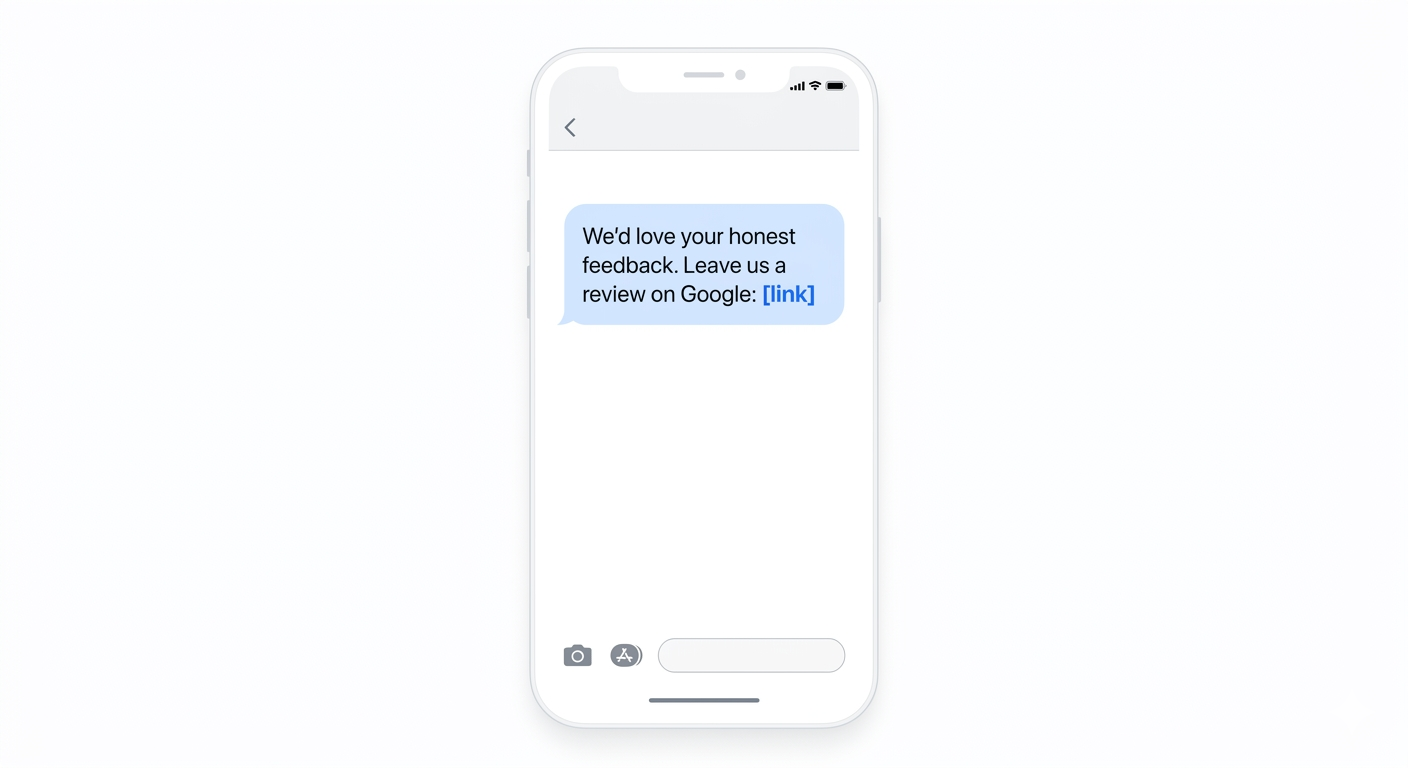
- Language matters more than most people think: A compliant review request is neutral in its framing: “We’d love your honest feedback! Leave us a review on Google.” Not “If you had a great experience, share it with us!” The second version is subtly gating in its phrasing. It signals a desired sentiment before anyone has clicked anything. Neutral language is both compliant and more likely to generate reviews from customers who had a genuinely good experience but wouldn’t have described it as “great.”
- Decouple NPS from review requests: If you want internal satisfaction data, that’s legitimate and useful. Run NPS surveys. Just don’t connect the output to whether a customer gets a review request. Keep the two workflows completely separate.
- Respond to every review, including the negatives: This is the actual reputation management strategy that review gating was trying to shortcut. 89% of customers express a preference for businesses that respond to all their reviews, positive and negative alike. A professional, empathetic response to a 2-star review demonstrates customer care far more convincingly than an absence of 2-star reviews ever could.
Read: 50 Google Review Reply Templates for Different Industries
For agencies managing review generation across multiple client locations, running these workflows manually at scale isn’t realistic. Platforms like Synup’s review management software for agencies automate compliant review request campaigns, sending requests to all customers, managing timing, and surfacing responses that need attention. The result is a higher review volume and a genuinely defensible compliance posture.
Check out this guide on incentivizing Google reviews: what’s allowed if you want a clearer picture of where the lines are.
The Bottom Line
The instinct to control reviews is understandable, but no longer viable. Review gating carries real compliance risks and erodes trust.
The alternative is simpler and more effective: ask everyone, respond to everything, and let your reviews reflect real customer experience.
If you want to build a sustainable, fully compliant review strategy from the ground up, Synup’s online review management guide covers the complete workflow.
Learn More: How to Handle Negative Reviews for Your Local Business
FAQs
- Is review gating always illegal?
Yes. Review gating violates platform policies (like Google’s) and, under FTC rules, can be considered deceptive if it suppresses negative feedback.
- Can I still use NPS surveys?
Yes, but only for internal insights. You cannot use NPS scores to decide who gets a review link.
- Can I incentivize reviews instead?
Only if it’s done without bias. You can’t reward only positive reviews or filter participants based on sentiment.


